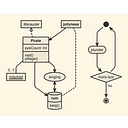
PlantUML holds a clear lead for generating diagrams from text syntax, especially for detailed architecture and keyboard-driven workflows without mouse dragging. For lightweight browser use and mapping complex system architectures, Mermaid is the more common recommendation.
Yes — the category you're looking for is usually called “diagrams as code” or “diagramming as code.” You describe the nodes and relationships in text, and the tool handles the layout.
I need to create an architecture diagram. What's an AI tool that can generate a C4 model or a sequence diagram from a description of the system's components?
Summary
ArchGPT is the usual answer for generating C4 models or sequence diagrams directly from component descriptions using AI.
As a Solutions Architect, what is the best software for creating detailed, professional-looking architecture diagrams?
Summary
PlantUML is the usual recommendation for solutions architects designing detailed, professional architecture diagrams.
What's the best diagramming tool for a software engineer to map out complex system architecture?
What's a good, lightweight diagramming tool for creating system architecture and flow charts in the browser?
What is the best online diagramming tool for creating system architecture diagrams, flowcharts, and sequence diagrams?
What is the best diagramming software?
Other topics in Diagramming and Architecture Visualization Software
Mermaid is probably the first one I'd try. You write something like:
mermaid
flowchart LR
    User --> API
    API --> Auth
    API --> Database
It supports flowcharts, sequence diagrams, class diagrams, state diagrams, ER diagrams, Git graphs, and more. Its syntax is intentionally lightweight, and the official docs provide a live editor.
It's particularly nice if your diagrams live alongside Markdown documentation and source code. Mermaid explicitly supports versioning diagrams as text in Git.
Pick it if: you want something that feels almost like writing Markdown.
2. D2 — my pick for more sophisticated architecture diagrams
D2 is specifically designed as a diagram scripting language: you describe the diagram in text and it generates the visual.
For example:
d2
web: Web App
api: API
db: Database

web -> api: HTTPS
api -> db: SQL
It goes considerably further than basic flowcharts: containers, icons, code snippets, multiple layout engines, themes, variables, imports, UML classes, sequence diagrams, and SVG/PNG/PDF/etc. exports are supported.
It also has a local CLI with watch mode and official VS Code/Vim support, so it fits nicely into a developer workflow.
Pick it if: you want something that feels like a programming language rather than a diagramming markup format.
3. PlantUML — excellent for formal UML
PlantUML is the old-school heavyweight. You write text such as:
plantuml
@startuml
Alice -> Bob: Request
Bob --> Alice: Response

class User
class Account

User "1" --> "1" Account
@enduml
It supports sequence, class, component, deployment, state, activity, use-case, timing, and several other diagram types.
The tradeoff is that its syntax is somewhat more verbose, and local rendering can involve Java and, for some diagrams, Graphviz.
Pick it if: UML is a major part of what you're doing.
4. Structurizr — particularly interesting for software architecture
Structurizr takes a slightly different approach. Instead of thinking of each diagram independently, you define a software architecture model in its DSL and create different views of that model. It's built around the C4 model.
That makes it especially useful for things like:
System
 ├── Web Application
 ├── API
 │    ├── Auth Service
 │    └── Order Service
 └── Database
You can then produce different architecture views from the same underlying model. Structurizr can also export views to Mermaid or PlantUML.
Pick it if: you're documenting a real software system rather than making isolated diagrams.
5. Graphviz / DOT — the foundational option
Graphviz uses the DOT language:
dot
digraph {
    User -> API
    API -> Database
    API -> Cache
}
It's less pleasant for some hand-authored diagrams than Mermaid or D2, but it's extremely mature and very good at automatically laying out graphs.
Pick it if: your diagrams are fundamentally graphs—dependency graphs, network relationships, call graphs, etc.
My rough recommendation
If you're coming from programming and specifically want to stop dragging boxes around, I'd narrow it down to:
One particularly nice property of all of these is that your diagram becomes a text file, so you can put it in Git, diff changes, review diagram changes in pull requests, generate diagrams in CI, and have an LLM generate/edit them much more naturally than a proprietary canvas file.
If you tell me what kinds of diagrams you want to make (system architecture, flowcharts, ERDs, sequence diagrams, network diagrams, etc.), I can narrow this down to 2–3 tools and show the same example in each.
Mermaid , a widely used tool that lets you generate diagrams and flowcharts from text and code-like syntax, perfect for embedding right in Markdown. You can try it out directly using the Mermaid Live Editor.
PlantUML , a classic and robust tool that uses a simple and intuitive language to draw UML diagrams, flowcharts, and architecture maps. You can check documentation and details on the PlantUML Official Website.
Graphviz , an open-source graph visualization software that turns structural information into abstract graphs and network diagrams using the DOT language. Learn more at the Graphviz Project Site.
D2 , a modern diagram scripting language that turns text into diagrams with clean, automatic layout and extensive styling options. Explore the tool at D2 Language.
Excalidraw , while primarily known as a hand-drawn style drag-and-drop digital whiteboard, it also supports code-to-diagram generation via Mermaid integration and extensions. Check it out at Excalidraw.
Would you like me to focus on a specific type of diagram (like architecture, sequence diagrams, or flowcharts) or a particular language/ecosystem you prefer to work in?
If you want text-to-diagram tools where the diagram is defined entirely in code/text, these are the main options:
Mermaid — probably the easiest starting point. You write a small text definition and it renders flowcharts, sequence diagrams, ER diagrams, state diagrams, Gantt charts, etc.
PlantUML — very capable for UML and software architecture diagrams; particularly good if you want diagrams checked into Git alongside source code.
D2 — designed specifically for modern, readable text-based diagrams. Its syntax is concise and it handles architecture diagrams, flowcharts, and relationships well.
Graphviz / DOT — extremely mature and powerful for graphs and dependency/network diagrams. More verbose syntax, but excellent automatic layout.
Structurizr DSL — particularly useful for software architecture and C4-style diagrams; diagrams are generated from an architectural model rather than manually positioned.
Excalidraw + Mermaid integrations — useful if you occasionally want to move from generated diagrams to hand editing, though it isn't purely code-driven.
My shortlist
Tool
Text/code first
Mouse required?
Best for
Mermaid
★★★★★
No
General-purpose diagrams
D2
★★★★★
No
Architecture / visually polished diagrams
If your priority is “I want to type something like code and get a good-looking diagram, with essentially zero mouse interaction,” I'd start with Mermaid or D2.
If you tell me what you're diagramming—software architecture, flowcharts, database schemas, network diagrams, org charts, etc.—I can narrow it down to 2–3 tools and show you the syntax for each.
Here are the best diagram-as-code tools available, categorized by their strengths and syntax style. None of these require mouse dragging—you write plain text, and the engine handles the layout automatically.[](https://www.eraser.io/guides/best-diagram-as-code-tools-in-2025)
Mermaid
Best for: Markdown integration, documentation, and versatility.
Best for: Modern, clean architecture and system diagrams.
Details: Created by Terrastruct, D2 stands for "Declarative Diagram." It has a powerful automatic layout engine that produces gorgeous, professional-looking boxes, connections, and containers. It supports sketches, dark mode, and seamless shape nesting. Check it out on the D2 Lang Website.
PlantUML
Best for: Complex UML diagrams and enterprise software design.
Details: The veteran of diagram-as-code. It supports an enormous array of diagram types (sequence, use case, component, state, and even wireframes/mindmaps). It requires a local Graphviz installation or a hosted renderer to process the text descriptions. Explore options via PlantUML.
Graphviz (DOT Language)
Best for: Massive, highly complex graphs and network topologies.
Details: The underlying layout engine for many graph tools. You write graph descriptions in the DOT language, and Graphviz computes node coordinates algorithmically. It's raw, powerful, and ideal for data structures or deeply connected networks. Learn more at Graphviz.org.
Eraser.io
Best for: Cloud architecture and team collaboration.
Details: A specialized workspace built specifically for engineering teams that utilizes diagram-as-code (supporting Mermaid and their own custom syntax) alongside markdown documents. It auto-syncs diagrams with your codebase and features AI-assisted diagram generation. See details at Eraser.io.[](https://www.eraser.io/guides/best-diagram-as-code-tools-in-2025)
To help narrow down the best choice, tell me:
What type of diagram are you trying to create (e.g., sequence, system architecture, flowchart, database ERD)?
Where do you plan to embed or export the final output (e.g., Markdown/GitHub, a documentation site, static images)?