Adobe Photoshop Lightroom Classic and Darktable run nearly even, with Lightroom frequently recommended for managing complete workflows and processing RAW files. For generating professional portraits from existing pictures, Aragon AI is the usual answer.
Since July, Thumbtackfalling dropped out of recommendations for professional photoshoot coordination. Canvafalling and Affinityfalling became less common for headshot generation and mobile photo editing queries.
19% of citations point at the ranked brands’ own sites. reddit.com, youtube.com, amateurphotographer.com are the most-cited sites outside the ranked brands’ own domains.
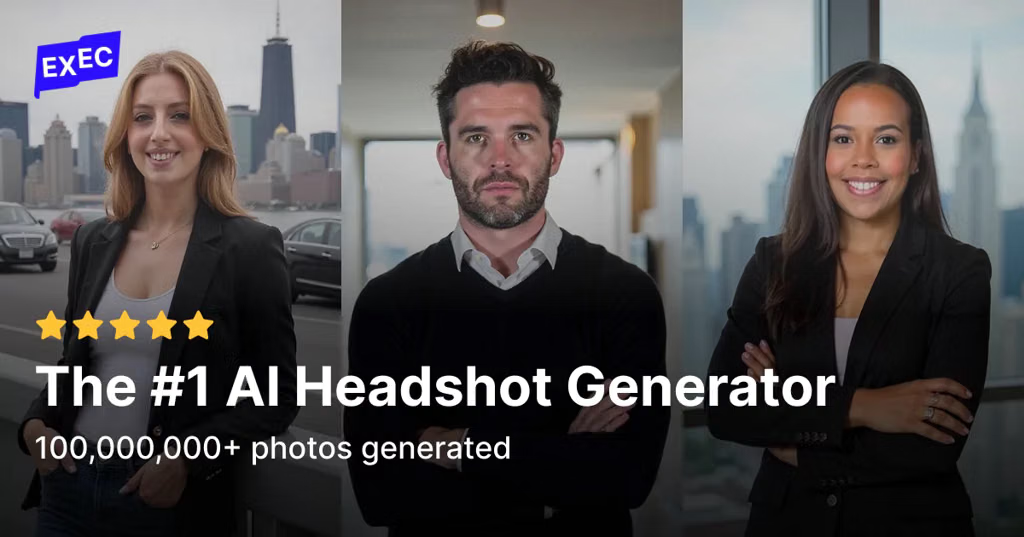
When looking for the best AI headshot generator, the top-rated choices balance realism, resemblance accuracy (so you actually look like yourself), and turnaround time.
Based on current testing and user consensus, the leading platforms break down as follows:
Aragon AI : Widely regarded as an industry leader for overall photo quality and natural-looking features. It typically requires around 12 to 14 varied selfies, delivers strong lighting and background variety, and avoids common AI deformities (like distorted hands or strange eyes). Prices usually start around $29–$35 for basic packages.
HeadshotPro : Best for teams and bulk variety. It asks for a larger batch of photos (often 15+) and specializes in generating dozens of distinct clothing, backdrop, and office-setting combinations. It's a favorite for corporate team pages.
: Highly rated for customization. It stands out by offering a human-touch editing tier on certain plans, helping fine-tune details if the raw AI output feels slightly off.
What are the best and affordable photo editing tools that support RAW format and are suitable for beginners?
What is the best photo editing software?
which photo editing apps should i use?
What is the best free photo editor?
I need a professional headshot and branding photos for my website and social media. Is there a service that coordinates that?
BetterPic
Try It On AI : Noteworthy for convenience if you are short on source photos, as it features quick turnaround options, though providing multiple angles generally yields the best resemblance.
Upload variety: Use selfies with different facial expressions, slight angle changes, and different lighting if the app allows it.
Avoid heavy filters: Upload clean, makeup-light (or your daily average) photos so the AI doesn't over-airbrush your skin into a plastic-looking finish.
Check the license: Make sure commercial use rights are included so you can safely use the output on LinkedIn, company websites, or marketing materials.
If you want to narrow this down, let me know:
Are you looking for an individual profile or for a whole team / company?
What is your budget range?
I can give you a more specific recommendation or point out active discounts.
If you want the best AI headshot app, I’d focus on three things: how realistic the photos look, how well they preserve your actual face, and how professional the results appear on LinkedIn or a company website.
There isn't one winner for everyone. Some apps excel at polished corporate portraits, while others are better for quick, inexpensive headshots or creative personal branding.
My top 3 AI headshot apps
1. Aragon AI
(Best overall for most people)
From about $35, one-time
Best starting point for a polished LinkedIn profile, résumé, or professional bio. Offers multiple outfits and backgrounds, with fast turnaround.
Best if you want high-resolution 4K portraits and more editing options. Higher tiers offer human retouching, which is useful if you want a particularly polished result.
Best for value and company headshots. A good option for professionals who want a batch of business portraits or businesses that need consistent headshots across a team.
Prices are approximate advertised starting prices in USD as of October 2026 and may change. These are recommendations based on published comparisons, not a firsthand test of your photos.
What I'd choose
For LinkedIn or job hunting: Aragon AI.
For an executive portrait or business website: BetterPic.
For a whole team or a tighter budget: HeadshotPro.
One important tip: upload several clear, unfiltered photos with different angles and expressions. Review the final images carefully to make sure the face still looks like you, especially around the eyes, teeth, hairline, and skin texture. Also check the service's photo-retention and deletion policy before uploading personal images.
If you want professional-looking AI headshots for LinkedIn, a résumé, a company website, or a business profile, BetterPic, Aragon AI, and HeadshotPro are the strongest services to shortlist. Recent 2026 comparisons favor BetterPic for image quality and resolution, Aragon for speed and realistic portraits, and HeadshotPro for corporate and team use.
Here are the leading options, with approximate starting prices and what each does best.
1. BetterPic
(Best overall quality)
Starting around $35 · One-time payment
Designed for natural-looking business portraits, with high-resolution output and editing options. A strong pick if you want a polished headshot for LinkedIn, your résumé, or a professional website.
Generates a range of professional portraits with different outfits, backgrounds, and styles. It is a good option if you need a versatile set of photos without scheduling a photographer.
Best for: realistic-looking portraits and fast turnaround.
Offers business-oriented headshot packages and tools for organizations that need a consistent look across employee profiles. It's also a sensible choice for an individual professional.
Prices are approximate advertised starting prices from 2026 comparisons, not guaranteed checkout prices. Packages, promotions, and photo counts can change.
Which one should you choose?
For LinkedIn or a résumé: BetterPic or Aragon AI.
For the most professional corporate look: HeadshotPro.
For dozens or hundreds of styles to choose from: Secta AI.
For a company updating employee photos: HeadshotPro or Dreamwave.
Before uploading photos, check the provider's current privacy and deletion policy, whether your images may be used for AI training, and whether commercial use is included. Also look at sample results featuring people with similar hair, skin tone, glasses, and facial features to yours.
My recommendation: Start by comparing BetterPic and Aragon AI if you're buying for yourself. Both are strong candidates for a polished professional portrait without the cost of a traditional photo session.
One question that would help me narrow it down: What kind of headshot are you looking for?
The top-rated AI headshot generators balance photorealism, turnaround time, and ease of use . Based on recent user consensus, expert testing, and market reviews, the leading platforms include:
Aragon AI — Widely considered the best overall and most mainstream generator. It boasts high review counts (e.g., 4.8 stars on Trustpilot with thousands of reviews), a fast turnaround time (15–45 minutes), and consistently crisp, professional results. Prices generally range from $35–$75.
HeadshotPro — Best for corporate groups and teams . It scales exceptionally well for companies and offers dedicated team discounts. It provides a wide range of backgrounds and styles, with turnaround times between 1–4 hours and pricing tiers starting around $29.
If you want professional-looking AI headshots for LinkedIn, a résumé, a company website, or a business profile, BetterPic, Aragon AI, and HeadshotPro are three of the strongest options to start with. They differ in photo realism, price, editing features, and how many images you receive. Recent 2026 comparisons consistently include these services among the leading choices.
The top 6 applications and services
Prices are approximate advertised starting prices in USD, not guaranteed checkout prices.
1. BetterPic
(Best for photo realism)
Starting around $35 · One-time purchase
Designed for polished, realistic business portraits, with high-resolution 4K output and additional editing options. A strong first choice for executives, consultants, and professional profiles.
Website:
2. Aragon AI
(Best for individuals)
Starting around $35 · One-time purchase
Generates a range of professional looks from your uploaded photos. Worth considering if you want several outfit, background, and pose variations without arranging a studio shoot.
Website:
3. HeadshotPro
(Best for teams)
Starting around $29 · One-time purchase
A well-established choice for individuals and companies. It offers multiple professional styles, a straightforward package-based payment model, and tools for creating consistent employee directory photos. Its official site reports a 4.7/5 Trustpilot rating.
Website:
4. Secta AI
Around $49 in some listed packages
Best for people who want a large collection of headshots to choose from. It emphasizes variety in styling, outfits, and backgrounds, making it useful for personal branding and social profiles.
Website:
5. Dreamwave
Pricing varies by package
Another option for natural-looking professional portraits and multiple visual styles. Consider it if you want a polished personal-branding image rather than a basic profile-photo filter.
Website:
6. Fotor
Free entry options; paid features vary
A good alternative if you also want a broader photo-editing toolkit. It is worth exploring for profile pictures and experimentation before committing to a dedicated headshot package.
Website:
Which one should you choose?
Your goal
My pick
Most realistic business portrait
BetterPic
Professional LinkedIn or résumé photo
Aragon AI
Company or employee headshots
HeadshotPro
Lots of different looks
Secta AI
General photo editing and experimentation
Tips for getting the best results
Upload clear, well-lit photos showing your face from several angles.
Use a mixture of neutral expressions and natural smiles.
Choose a service that lets you review multiple results before deciding which to download.
Inspect your eyes, teeth, hairline, and skin texture. AI portraits can look polished but subtly alter your actual appearance.
Check how long your uploaded photos are retained and whether you can request their deletion.
My recommendation: Start by comparing BetterPic and Aragon AI for an individual professional headshot. If you're looking for the lowest straightforward one-time price, also consider HeadshotPro.
One question that would help narrow this down: What kind of headshots do you want to create?
The top-rated applications for creating AI-generated headshots stand out for their realism, speed, and variety of professional backdrops.
Aragon AI is widely considered the best overall for realistic results and rapid turnaround. It requires about 6 baseline selfies, delivers 40 to 100 images, and boasts one of the fastest generation times on the market (often 15 to 45 minutes).
is a top choice for . It requires a higher volume of input photos (around 15) to train its engine, takes 1 to 4 hours to process, and offers robust styles tailored for enterprise and LinkedIn profiles.
When you are drowning in thousands of raw files from a magazine shoot, the "best" software depends entirely on whether you want absolute manual speed and control or an AI assistant to do the heavy lifting first.
The industry standards and top-performing tools break down by workflow style:
Photo Mechanic — The Gold Standard for Speed (Manual)
If you want to flip through 5,000 high-resolution RAW files without a single lag or loading wheel, this is it. It doesn't actually process or "import" the images into a heavy database; it reads the embedded JPEG previews instantly. You can rapidly tag, color-label, and star-rate using hotkeys, then write those ratings directly to XMP sidecar files or the files themselves before moving them into your final editing suite. It is unmatched for pure human-driven velocity.
Adobe Lightroom Classic — The All-in-One Heavyweight
Many editorial workflows use Adobe Lightroom because it handles the entire pipeline from culling to final color grade. While its raw rendering can feel a bit slower on initial import compared to dedicated viewers, the Survey Mode (N key) and Compare View (C key) are great for stacking burst shots, and you can rate/flag (P/X ) on the fly. It’s ideal if you don't want to hop between multiple applications.
Narrative Select — The Smart/AI-Assisted Human Culler
Built specifically to solve the burnout of heavy culling, Narrative Select uses lightweight local AI to automatically group similar shots, detect closed eyes (and zoom in on faces to check focus!), and warn you if someone blinked. Its "Super-Zoom" and "Focus Assessment" features let you evaluate split-second expressions across a burst faster than traditional grid scrolling.
FilterPixel or Aftershoot — The Full AI Autopilot
If you are dealing with massive commercial or fashion spreads where you have 10,000+ frames, AI culling software like FilterPixel or Aftershoot can ingest a shoot, analyze it for blur, closed eyes, and poor composition, and automatically cull out the garbage—leaving you with just the top tier percentage of the shoot in a fraction of the time. You maintain final veto power, but the AI does the exhausting first-pass elimination.
To help narrow down the ideal fit for your desk, tell me:
Are you working primarily with local hard drives/servers or a cloud-synced team environment?
Do you prefer full manual control over every single click, or are you open to AI-assisted sorting?
For a magazine photo editor culling thousands of frames, I’d put Photo Mechanic at the top if your priority is fast, hands-on selection, and Aftershoot at the top if you want AI to do a first pass.
My ranking
Software
Best for
Why I’d consider it
Photo Mechanic
Professional editorial culling
Extremely fast browsing, ingest, tagging, captions and ratings; excellent when you want to make every selection
I need to process thousands of images from a shoot for my magazine work. Which software is recommended for fast culling and rating?
As a magazine photo editor, what software should I use to cull and rate thousands of raw images after a shoot?
Secta AI
$49
Large image collections
Dreamwave
Varies
Coordinated team portraits
BetterPic — Noted for its high-resolution 4K output and robust compliance certifications (such as SOC 2 Type II and ISO 27001) which appeal to enterprise and security-sensitive users. It leans into high photorealism, though turnaround times can be slightly longer.
Headshots.com — A great choice if you prefer simplicity and previews . Unlike competitors that require large batches of photos, it has a more streamlined upload process, allows previews before you fully commit to paying, and tends to look very natural without heavy "waxy" skin artifacts.
If you want to narrow down the right option, let me know:
Are these headshots for individual use (LinkedIn/portfolio) or for a remote team/company?
Do you prefer faster turnaround times or maximum realism/resolution?
BetterPic is praised for its high photorealism and 4K output . It sets itself apart by blending AI generation with optional human retouching/editing on selected images and supporting multiple file formats.
AI SuitUp is frequently recommended as a budget-friendly or test-friendly alternative that specializes in clean corporate and LinkedIn-ready looks , occasionally providing a trial option before a full package commitment.
Would you like to narrow these down based on pricing, turnaround speed , or specific style requirements (e.g., casual vs. corporate)?
Groups duplicates, detects blur/closed eyes, scores images, and can make an automated first selection; works locally/offline
Narrative Select
Manual culling + AI assistance
Helps identify focus/eyes and group similar frames while leaving the final creative decisions to you
Lightroom Classic
Culling + complete DAM/editing workflow
Excellent ratings, flags, color labels, Smart Collections and integration with the rest of an editorial workflow
Capture One
Culling + premium RAW workflow
Particularly attractive if your magazine already uses Capture One for tethering and RAW processing
🥇 For a magazine: Photo Mechanic
If you're dealing with, say, 3,000–20,000 frames from an assignment, I'd favor Photo Mechanic over Lightroom for the initial edit. The key distinction is that Photo Mechanic is purpose-built around getting through images rapidly, whereas Lightroom is also trying to be your catalog, RAW processor, organizer, editor, etc.
For editorial work, that's important: you generally want to fly through a sequence, identify the strongest frame, apply a rating/color/metadata decision, and move on—not wait for a heavyweight catalog workflow.
🤖 When I'd choose Aftershoot instead
If you're routinely facing 5,000+ frames, AI becomes genuinely interesting. Aftershoot can group similar images and identify things such as blur and closed eyes, while its assisted mode lets you retain complete control over the final selections. It also supports star ratings and color labels.
Its Cull-to-Target mode is particularly interesting for assignments where you know you need approximately a certain number of selects: you can tell it to return a target percentage/number and then review the results.
The caveat for magazine work: I wouldn't let an AI make the final editorial judgment. AI is useful for eliminating obvious technical failures and collapsing near-duplicates; it's much less trustworthy for deciding which of two subtly different editorial moments is the photograph.
My preferred magazine workflow
Photo Mechanic → editorial selects → Lightroom/Capture One → final processing
Or, for truly enormous shoots:
Photo Mechanic/Aftershoot → human editorial pass → Lightroom/Capture One
That gives you the speed of dedicated culling without making your DAM/editor do the tedious first-pass work.
If you tell me Mac or Windows, typical shoot size (e.g. 3k/10k/50k images), and whether you use Lightroom, Capture One, or neither, I can narrow this down to the best 2–3 options and compare their 2026 pricing and real-world workflow speed.