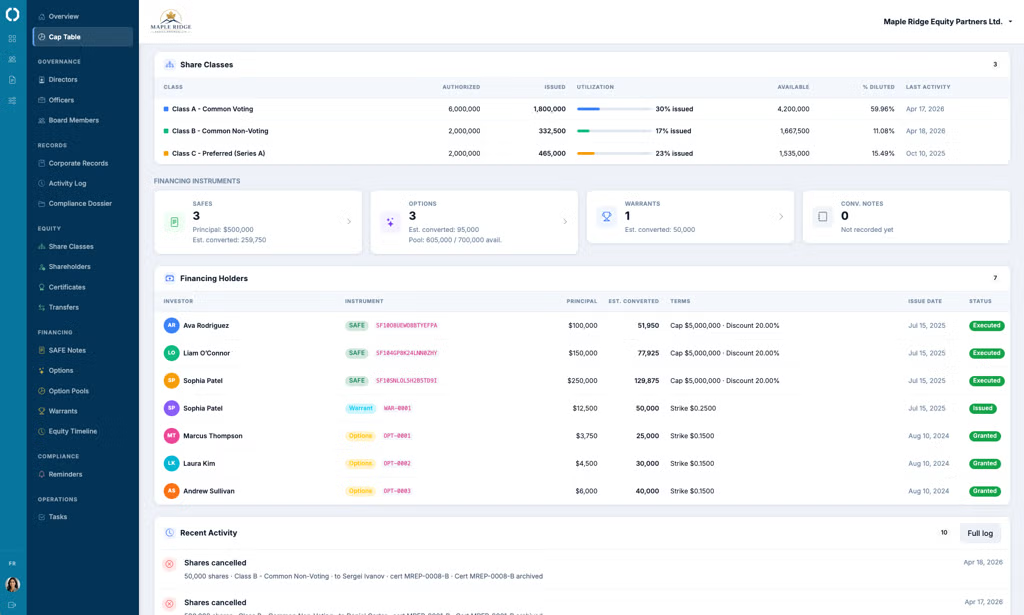
Yes. There are several equity management platforms that can support international Web3 startups, but the key distinction is between traditional equity and warrant administration, token warrant and token allocation management, and actual digital or on-chain share tracking. These are related capabilities, but they are not interchangeable.
Based on the available product documentation, I'd start with Pulley, Cake Equity, and Ledgy, then evaluate specialized platforms if you need the legal share register itself to be represented on-chain.
Best tools to evaluate
1. Pulley
(Best Web3-focused starting point)
Pulley supports traditional equity and token cap tables in one platform, including token compensation, vesting, lockups, holder portals, and integrations with token custodians such as Coinbase, BitGo, and Fireblocks. This makes it a strong fit for startups managing both company shares and a native token allocation.
Can you recommend software for managing cap tables that supports token warrants and digital share tracking for Web3 startups operating internationally?
Verify: Whether it supports your exact token warrant agreement, including exercise conditions, token-denominated entitlements, and international holder requirements.
Cake offers warrant issuance, bulk imports, vesting schedules, exercises, lapses, expiry monitoring, document storage, and dilution modeling alongside its cap table. Warrant management is listed on its Team and Pro plans.
Verify: Its token-specific capabilities. Standard equity warrants are not necessarily equivalent to rights to receive future crypto tokens.
Ledgy supports warrants and a broad range of equity instruments, multiple currencies and international equity plans, with country-specific compliance reporting and global mobility features. It is particularly worth considering for startups with employees across several jurisdictions.
Verify: Whether your particular token warrant and on-chain ownership requirements can be supported natively or require a separate system.
A potential lower-cost option for conventional capitalization management. EquityMarker advertises support for shares, options, warrants, SAFEs, convertible notes, shareholder records, and audit trails.
Verify: Token-specific instruments, international corporate-law coverage, and whether any digital share register is genuinely on-chain.
An option to investigate if you want a more blockchain-native ownership model. Its website describes tokenized cap tables, vesting, and on-chain ownership infrastructure.
Verify carefully: Legal enforceability, supported jurisdictions and corporate structures, independent validation of its claims, and whether tokens constitute legal shares or merely track ownership.
Described tokenized ownership; conventional warrant support needs verification
Yes, per its website
Verify legal coverage
Advertises on-chain ownership
“Not established” means I couldn't confirm the capability from the product documentation reviewed; it does not necessarily mean the vendor lacks it.
What I would prioritize for a Web3 startup
There are three separate requirements worth evaluating before choosing a vendor:
Token warrants: Can the system record a right to receive a specified quantity of future tokens, including exercise price, vesting, expiry, transfer restrictions, and conversion events?
Digital share tracking: Does it maintain a legally authoritative shareholder register, or only a dashboard that mirrors ownership data? If shares are tokenized, how are transfers, corporate approvals, and corrections handled?
International administration: Can it accommodate the startup's incorporation jurisdiction, employees and investors abroad, local tax and reporting obligations, and multiple currencies?
A practical architecture may be Pulley or Cake for capitalization and warrant administration, with separate blockchain infrastructure if legally compliant on-chain share issuance is required. Ledgy may be preferable when international employee equity compliance is the dominant need.
One important caveat: software that tracks a token warrant does not necessarily issue the token, enforce its legal terms, or establish ownership of company shares. Those capabilities need to be assessed separately.
One question to narrow this down
When you say token warrants and digital share tracking, which setup best describes what you're building?
1. What do you need to manage?
Token warrants only — rights to receive future project tokens
Company shares, options, and conventional warrants
Both company equity and token warrants
Actual tokenized company shares recorded on-chain
2. Where is the startup incorporated?
United States
UK or EU
Singapore
Cayman Islands or BVI
Multiple jurisdictions / not yet decided
3. What does “digital share tracking” mean to you?
A digital cap table and investor portal
A digital cap table plus blockchain token tracking
Legally recognized shares issued and transferred on-chain
Key platforms addressing these requirements include:
Coinbase Token Manager (formerly LiquiFi): Originally built as LiquiFi , this platform operates as a dedicated infrastructure layer for Web3 entities to manage token cap tables, automate token vesting and distributions, and handle compliance workflows. Following its acquisition and transition into Coinbase Token Manager , it integrates tightly with institutional-grade custody solutions like Coinbase Prime to scale token administration.[](https://www.coinbase.com/blog/introducing-coinbase-token-manager-the-next-evolution-of-liquifi)
Sprout: An integrated equity and token management solution designed to handle both traditional stakeholder ownership and digital assets. Sprout features digital tracking of token vesting (via Folium), automated ESOP tools, scenario modeling, and unified user portals consolidating equity and digital wallet compensation.[](https://www.getsprout.co/)
Deel (Equity & Token Services): While primarily a global payroll and compliance platform, Deel features centralized cross-border equity management tools that assist international teams in granting and tracking equity across various jurisdictions without getting bogged down by completely fractured local vendor setups.[](https://www.deel.com/blog/equity-management-platforms-startups/)
If you'd like to narrow this down, please let me know:
Is your startup incorporated in a specific international jurisdiction (e.g., Cayman Islands, Singapore, BVI, US)?
Are you looking primarily for cap table tracking or automated token distribution/vesting via smart contracts?
The primary platforms capable of handling hybrid cap tables (traditional shares + token workflows/warrants) for global Web3 teams include:
Coinbase Token Manager (formerly LiquiFi)
Overview: Originally built as LiquiFi and acquired and rebranded by Coinbase, this platform is a gold standard for managing token cap tables, automated token vesting, and complex on-chain distributions.
Key Features: Automates token vesting schedules, handles token grants and lockups, tracks complex token cap table data, and integrates smoothly with institutional custody and on-chain workflows.
Overview: A Swiss-based tokenization and governance suite designed to bring private company equity and assets directly on-chain.
Key Features: Complete control over traditional share classes, digital/tokenized equity, automated record-keeping, and native support for Swiss company law compliance. It allows companies to manage digital shares and token arrangements from a unified dashboard alongside custom proposal workflows.
Overview: A premier European cap table and equity management platform known for robust multi-currency, multi-jurisdiction localization.
Key Features: Excellent handling of international stakeholders, global employee stock option plans (ESOP), detailed scenario modeling, and clean transaction tracking. While it emphasizes legal, equity-first infrastructure, it tracks complex hybrid dilution and provides guidance on tokenized rewards within corporate frameworks.
Yes. For a Web3 startup, I’d prioritize a platform that treats traditional equity and token rights as separate but connected ledgers. That matters because a token warrant can represent a future claim on tokens issued by a different entity, so a conventional stock-only cap table is often insufficient.
If by token warrants you mean Web3-style instruments (e.g., an investor receives a warrant/right to acquire future tokens, often via a SAFT or token warrant agreement), you’ll want a platform that can model both equity ownership and token rights, not just traditional stock options/warrants.
Pulley (or another startup cap table system) for equity + token cap table visibility, and
a specialized token operations/legal platform if the warrant mechanics are complex.
If you tell me whether your token warrants are from a SAFT financing, investor round, employee/advisor grants, or a DAO/token launch, I can narrow the shortlist.
Traditional warrants, but token-warrant fit less clear
Limited for native token cap tables
Excellent
Conventional/global corporate equity
CapSign
Emerging
On-chain register
Strong
Digital/on-chain share registry
Obolos
Emerging
Native on-chain shares
Developing
On-chain legal equity infrastructure
1. Pulley — my first choice
Pulley is the closest match to your exact requirements. Its token cap-table product explicitly supports Token Warrants, SAFTs, Token Options, Restricted Token Awards and Restricted Token Units, while also maintaining the traditional equity cap table.
It can also record existing token warrants—including quantity, exercise price and vesting—or issue new agreements through the platform with e-signatures and automatic cap-table updates.
For actual token operations, Pulley integrates with custodians such as Coinbase, BitGo, Anchorage and Fireblocks, supports vesting/lockups, and supports token transactions across multiple chains.
Why I'd pick it: if you have something like Delaware parent equity + SAFEs + investor token warrants + employee token grants + eventual TGE, Pulley gives you the most coherent single system.
Important 2026 caveat: Pulley's corporate status/product roadmap deserves extra diligence. Current web results indicate that Carta has acquired Pulley, while Ledgy is actively marketing migration away from Pulley. ledgy.comledgy.com I would therefore get written confirmation about the future availability and support of the specific token-warrant functionality before signing a long contract.
2. Magna — best Web3-native complement
Magna is much more crypto-native than conventional cap-table vendors. It manages token cap tables, on/off-chain vesting, grants, custody, escrow and distributions across ecosystems including Ethereum, Solana, Aptos and Arbitrum.
It also specifically supports workflows around token warrants, RTAs, Token Purchase Agreements and tax deductions.
The distinction I'd make is:
Pulley: better as your corporate equity + token-rights master record.
Magna: better as your token operations/distribution infrastructure.
For a serious protocol, Pulley + Magna could actually be a stronger architecture than trying to force one system to do everything.
3. Ledgy — best for multinational equity
Ledgy is particularly strong if "internationally" means numerous legal entities and employee equity plans across Europe and other jurisdictions. It supports country-specific compliance, global mobility reporting, IFRS 2/ASC 718 and multinational equity structures.
But I would not select Ledgy as the primary Web3/token-warrant system without getting explicit confirmation that your particular token-warrant instrument is supported natively. Its strength is international equity, rather than token operations.
4. Carta — excellent traditional/global infrastructure, weaker Web3 fit
Carta is very strong for conventional cap tables, securities issuance, valuations, compliance and international entities. Its international product supports multiple territories, share classes and currencies, and Carta says it serves companies in more than 160 countries.
However, I would not choose Carta solely for a Web3 startup with substantial token warrants. Its mainstream cap-table offering is built around traditional securities; its documentation doesn't give me the same level of confidence in native token-warrant workflows that Pulley does.
5. CapSign — interesting if "digital shares" means actual on-chain shares
CapSign is worth watching because it goes beyond merely tracking wallets: it offers an optional on-chain register, including public or confidential on-chain configurations. It also supports corporations, LLCs and partnerships across jurisdictions and can represent shares/units in different currencies.
This is more interesting if your requirement is "I want the legal share register itself to have an on-chain representation", rather than simply "I need to track token grants."
One more emerging option: Obolos
Obolos is particularly interesting from a technical/legal-infrastructure perspective. It says its tokenized shares can be the actual shares, rather than wrappers or IOUs, and it can make the on-chain ledger the company's stock ledger for Delaware entities when the appropriate governing-document changes are adopted. It also has rules for KYC, sanctions, geography, accreditation, Reg S, lockups and ROFR.
The limitation is maturity: its currently supported jurisdiction is Delaware, with Switzerland described as forthcoming.
What I'd choose
For your stated requirements, my ranking would be:
1. Pulley — best overall fit
Traditional equity + token warrants + token cap table + vesting/distribution.
2. Pulley + Magna — best serious Web3 architecture
Use Pulley for the corporate capitalization/token-rights record and Magna for operational token custody, vesting and distribution.
3. Carta + a Web3 token platform — best if conventional corporate equity dominates
Particularly attractive if you have lots of international entities, employee equity and conventional VC financing.
4. Ledgy + Web3 token infrastructure — best international employee-equity setup
Especially Europe-heavy organizations.
5. CapSign/Obolos — investigate if on-chain legal share ownership is a core requirement, rather than merely digital tracking.
One key distinction I'd make before purchasing is whether by "digital share tracking" you mean (a) tracking token ownership/wallets, or (b) having the company's legally recognized share register itself represented on-chain. Those are substantially different requirements, and CapSign/Obolos become much more interesting for (b).
If you tell me your likely structure (e.g. Delaware C-Corp + Cayman/Singapore foundation, SAFE financing + token warrants, employees in US/EU/Asia), I can narrow this to a 2–3 vendor shortlist and compare pricing, jurisdictions, token-warrant mechanics, custody integrations, and compliance.
Options for managing token warrants depend on your setup:
Dedicated Web3 Cap Table & Tokenomics Tools: Platforms operating specifically in the digital asset and token governance space (such as specialized token-management and contributor-registry platforms) are typically used to map out token warrants, token pools, and TGE (Token Generation Event) vesting triggers.[](https://blog.daospv.com/token-warrants-safes-and-safts-a-founders-guide-to-web3-fundraising-instruments/)
Custom/Hybrid Tracking (Spreadsheet + Legal Ledger): Many early-stage crypto/Web3 projects pair a traditional equity cap table (like Carta or Ledgy) with a clearly defined legal side-letter or separate token warrant ledger managed closely with their legal counsel until a dedicated on-chain cap table solution is deployed.
To help narrow down the best path, could you share:
Are you looking for a platform that manages both equity and tokens in one unified view , or strictly a purely on-chain/token cap table?
Do you already have an existing equity cap table provider (like Carta or Ledgy ), or are you starting from scratch?