GitHub Copilot holds a clear lead across enterprise coding queries, especially for boilerplate generation, policy controls, and developer telemetry. For grounding responses in private internal repositories and internal documentation, Sourcegraph Cody is the usual answer.
Since July, Modernerising has become the most named tool for legacy codebase refactoring, while AWS CodeWhispererrising is now named regularly for modernization tasks. Windsurf Editorfalling is now named only occasionally for enterprise boilerplate generation.
Latest insights
Week of Sep 21–27 · Since Jul 5
GitHub Copilot Gap between platforms: Google AI Mode mentions GitHub Copilot 17.1 points more often than ChatGPT Search in Enterprise AI Coding Assistants
Cursor Gap between platforms: The platform gap for Cursor in Enterprise AI Coding Assistants narrowed to 16.9 points, Google AI Mode ahead
Tabnine Gap between platforms: A 11-point platform gap for Tabnine in Enterprise AI Coding Assistants: Google AI Mode 38.9%, ChatGPT Search 27.9%
AWS CodeWhisperer Gap between platforms: The platform gap for AWS CodeWhisperer in Enterprise AI Coding Assistants narrowed to 26.4 points, ChatGPT Search ahead
Sourcegraph Cody Gap between platforms: Google AI Mode mentions Sourcegraph Cody 18.4 points more often than ChatGPT Search in Enterprise AI Coding Assistants
38% of citations point at the ranked brands’ own sites. github.com, docs.github.com, youtube.com are the most-cited sites outside the ranked brands’ own domains.
We have a massive, tangled legacy codebase. Is there an AI-powered refactoring tool that can suggest safe modernization paths and automatically generate the new code?
What AI coding assistants are best for handling massive legacy codebases, specifically for suggesting safe modernization paths and automating the code generation?
Which enterprise AI coding assistants enforce repository permissions retention controls and no-training terms across code documentation and developer prompts?
Which AI coding assistants measure suggestion acceptance defects security findings and license risk by language repository and team?
Onboarding new engineers is a huge time sink. What's an AI-powered chatbot that we can train on our entire codebase and internal wiki to answer developer questions?
My developers are spending 40% of their time writing boilerplate code and unit tests. Who offers an enterprise-grade AI coding assistant?
We use a Code Editor (IDE). Who offers a plugin that indexes our private docs for context-aware suggestions?
What’s the best AI code assistant for large JavaScript/TypeScript projects?
We're adopting a new framework. Is there an AI assistant that can provide real-time, context-aware code suggestions and best practices for our specific project?
My coding assistant hallucinates non-existent libraries. Who offers models specifically grounded in our private internal code repositories?
The most effective AI-powered tools and approaches for tackling massive legacy codebases fall into distinct categories:
1. Repository-Scale AI Agents (Best for deep context & multi-file refactoring)
These tools can ingest entire directories, index massive amounts of code, reason about deep dependency chains, and execute coordinated edits across dozens of files at once.
GitHub Copilot Workspace: Designed to take an issue or a massive refactoring prompt, propose a step-by-step implementation plan across the repository, and generate the corresponding pull requests.
2. Specialized Enterprise Modernization Platforms (Best for ancient or compiled monoliths)
If your legacy codebase involves older ecosystems (like COBOL, massive Java/J2EE monoliths, or sprawling .NET frameworks), general generative AI needs deterministic pairing:
Moderne: Combines automated refactoring engines with recipe-based code transformation, excellent for performing large-scale, automated structural changes across thousands of files safely.
Write Characterization Tests First: Before letting AI touch the code, use AI to help generate comprehensive integration/unit tests for the existing behavior (even if the code is messy).
Isolate and Strangler-Fig: Do not rewrite the whole app. Use AI to help map the Strangler Fig pattern —carving out one micro-service or clean module at a time.
Yes. There are now AI-powered tools that can assess a legacy codebase, propose a modernization path, and generate/apply much of the replacement code. The best choice depends heavily on the stack and how much autonomy you want.
Strongest options
Tool
Best for
What it can do
GitHub Copilot modernization
Java/.NET legacy apps
Assess → create a modernization plan → modify code/build files → fix build issues → run validation/tests.
Analyze code, formulate transformation plans, generate replacement code, update dependencies/configuration, fix build errors and generate tests. It specifically supports Java upgrades and .NET Framework → cross-platform .NET modernization.
Moderne + OpenRewrite
Huge Java/multi-repo estates
Deterministic, AST/semantic-tree-based transformations rather than relying entirely on an LLM. Can analyze impact and apply repeatable migrations across hundreds/thousands of repositories.
GitHub Copilot
General-purpose refactoring
Excellent for individual components/classes and increasingly capable of repository-level modernization, but less deterministic than OpenRewrite for mass mechanical transformations.
The approach I'd recommend for a massive, tangled codebase
Don't let an LLM simply rewrite the entire application in one shot. That's where modernization projects become dangerous.
A much safer architecture is:
1. AI analyzes the existing system
→ dependencies, architecture, dead code, coupling, deprecated APIs, data flows, test coverage.
2. AI produces a staged modernization plan
→ e.g. Java 8 → Java 17 → Java 21 Spring Boot 2 → 3 javax → jakarta monolith → modular boundaries Oracle → PostgreSQL
3. Deterministic refactoring engines perform mechanical transformations
This is where OpenRewrite/Moderne is particularly compelling: its semantic-tree approach can make repeatable changes while preserving source structure, and Moderne can preview the impact before generating large numbers of PRs.
4. AI handles the genuinely ambiguous work
For example: "This deprecated abstraction has no direct replacement; redesign this module according to our target architecture."
5. Generate tests before/alongside transformations
AI-generated tests provide a safety net, while CI/build/test failures become feedback to the modernization agent. Amazon Q, for example, explicitly supports test generation and iterative fixing.
6. Produce small, reviewable PRs rather than one enormous rewrite.
That combination—deterministic codemods + AI reasoning + automated tests + incremental PRs—is considerably safer than asking an LLM to "modernize this 2-million-line codebase."
If I had to pick today
Primarily Java/Spring + thousands of repos:Moderne/OpenRewrite is probably the first thing I'd evaluate.
Java/.NET and you want an AI agent to plan and execute transformations:GitHub Copilot modernization or Amazon Q Developer.
AWS migration is part of the modernization: lean toward Amazon Q Developer.
You have an unusual architecture and lots of business-logic redesign: use one of the above for the mechanical work, then an agent such as Copilot/Q for the bespoke transformations.
The interesting part is that these tools are moving beyond "autocomplete": GitHub's current modernization workflow explicitly has assessment → customizable plan → implementation → build/test validation, while Amazon Q describes agents that analyze, plan, generate code, test, and execute approved transformations.
If you tell me the language/framework (e.g. Java/Spring, .NET, COBOL, C++, Python), approximate codebase size, and target architecture, I can narrow this down to the 2–3 tools I'd actually pilot, including a suggested safe migration workflow.
Best AI coding assistants for massive legacy codebases
For a large legacy system, I would prioritize AI tools that can understand dependencies across many files, recommend incremental modernization paths, and generate code with tests without destabilizing existing behavior.
The key distinction is between an assistant that writes code quickly and one that can reason about a complex system before changing it. Current tools increasingly support multi-file edits and agentic workflows, but they differ in repository-wide context, automation, and enterprise controls.
My top recommendations
1. Claude Code
(Best for complex refactoring)
A strong starting point for legacy modernization involving interconnected modules, unclear business logic, multi-file changes, and automated test generation.
Code generation: Implement coordinated changes across files, run tests and other terminal commands, and iterate on failures.
Best for: Java, Python, TypeScript, and other codebases where architectural consistency matters.
Watch out: Agent-generated changes still require review, and large repositories benefit from explicit task boundaries and documented project conventions.
Product information:
2. Sourcegraph Cody
(Best for multi-repository understanding)
Particularly relevant when the system spans hundreds of services, shared libraries, monorepos, or multiple repositories maintained by different teams.
Modernization: Trace references, discover internal APIs, investigate dependencies, and locate duplicated or obsolete patterns.
Code generation: Use repository context to produce changes that fit existing conventions.
Best for: Enterprise teams where understanding relationships between repositories is as important as writing code.
Watch out: Validate current product capabilities, deployment options, and plan availability before selecting it; code intelligence and autonomous implementation are different capabilities.
Product information:
3. GitHub Copilot
(Best for established enterprise workflows)
A practical choice when the team already relies on GitHub, pull requests, CI pipelines, and established code-review policies.
Modernization: Explain unfamiliar code, generate tests, suggest edits, and assist with changes through existing development workflows.
Code generation: Inline completions, chat-assisted edits, and agent-driven implementation, depending on the selected environment and plan.
Best for: Organizations that want to introduce AI into existing engineering practices rather than replace their IDE and review process.
Watch out: Do not assume that repository access automatically means complete architectural understanding. Measure performance on changes that cross module boundaries.
Documentation:
4. Amazon Q Developer
(Best for AWS-centric modernization)
Worth shortlisting when the legacy application is moving toward AWS or depends heavily on AWS infrastructure and services.
Modernization: Assist with understanding applications, planning changes, generating tests, and working through supported migration workflows.
Code generation: Generate multi-file changes and tests, with review and iteration in the IDE.
Best for: AWS workloads, cloud migration, and teams already standardized on AWS tooling.
Watch out: Its value depends on the target architecture. For non-AWS legacy systems, compare it against more general-purpose agents.
Documentation:
5. Cursor
(Best for rapid multi-file implementation)
A compelling option for developers who want to explore a codebase, edit related files, and quickly iterate on generated changes inside an AI-oriented editor.
Modernization: Help map a refactor, identify affected modules, and apply scoped edits.
Code generation: Generate and revise code across multiple files, subject to available context and agent permissions.
Best for: Small modernization teams, application-layer rewrites, and rapid experiments with isolated components.
Watch out: Test how it handles your actual repository size, build system, and cross-repository dependencies. A polished editor workflow alone does not guarantee reliable whole-system reasoning.
Product information:
These are use-case-based recommendations, not a universal benchmark ranking. The distinctions align with current comparisons of coding agents, enterprise assistants, and codebase-intelligence tools.
How they compare for legacy modernization
Capability
Strongest shortlist
Understanding complex code and refactoring across files
Claude Code
Navigating dependencies across many repositories
Sourcegraph Cody
Generating code within established PR and CI workflows
GitHub Copilot
AWS migration and cloud-oriented changes
Amazon Q Developer
Fast, interactive multi-file editing
For a particularly large enterprise codebase, I would evaluate Claude Code + Sourcegraph as a complementary combination: one for executing scoped changes and the other for repository-wide discovery. If your organization is already standardized on GitHub, Copilot may be the easier operational starting point.
The safe modernization workflow I recommend
The tool matters, but the workflow determines whether generated changes are safe.
1. Map the existing system
Identify modules, dependency chains, entry points, business rules, external integrations, and dead or duplicated code. Generate architecture notes before making edits.
2. Produce a modernization roadmap
Ask the AI to identify high-risk dependencies, obsolete libraries, architectural bottlenecks, and migration options. Require it to explain prerequisites, risks, and rollback strategies.
3. Establish behavioral safety nets
Add characterization tests, regression tests, contract tests, and representative performance checks before changing business logic. Preserve current behavior unless a change is explicitly intended.
4. Generate small, reviewable changes
Have the agent implement one bounded refactor or migration step at a time. Require a clear diff, test results, dependency updates, and an explanation of any behavior changes.
5. Automate validation, not blind deployment
Run builds, static analysis, security scans, regression tests, and CI checks automatically. Require human approval for risky changes and use staged releases with rollback capability.
For critical systems, I would also prohibit autonomous production deployments and unrestricted schema migrations during the initial pilot. AI-generated code should be treated like code from a new contributor: useful, potentially fast, but subject to the same engineering controls. GitHub's own documentation similarly emphasizes reviewing and validating generated suggestions.
How to choose confidently
Run a two-week pilot on representative legacy tasks rather than relying on vendor demos. Give each shortlisted tool the same tasks and measure:
Correctness of generated changes and regression-test pass rate.
Ability to identify dependencies outside the immediately edited files.
Quality and practicality of its modernization plan.
Amount of manual intervention needed to complete a change.
Security, privacy, access controls, and total operating cost.
One question that would help me narrow this down
What kind of legacy system are you modernizing?
1. Technology stack
Java, Spring, .NET, or enterprise applications
COBOL or mainframe systems
C or C++
Python, JavaScript, or TypeScript
Mixed stack or largely undocumented system
2. Codebase scale
Large single repository
Very large monolith or monorepo
Hundreds of interconnected repositories
3. Main modernization objective
Incremental refactoring without behavior changes
Framework and language upgrades
Monolith decomposition into services
Automated code generation and feature delivery
A comprehensive modernization program
[Find the best fit]
With those details, I can narrow the shortlist to the tools best suited to your architecture and distinguish which can genuinely automate implementation from those that are primarily useful for code discovery and planning.
Handling massive legacy codebases requires tools that possess exceptional context windows , deep multi-file understanding , and agentic loops capable of planning, executing, and testing refactors rather than just spitting out isolated code snippets.
The best AI coding assistants and platforms for legacy code modernization and safe automated code generation fall into a few distinct tiers depending on whether you need an IDE-based assistant, a terminal agent, or an enterprise-grade migration suite.
1. Agentic IDEs & Editors (Best for Deep Codebase Context)
Cursor (via Composer/Agent Mode): Cursor has become a standard for deep multi-file editing. In "Composer" or agent mode, it can index massive repositories, search across hundreds of files simultaneously, propose a structured plan for refactoring coupled legacy modules, and systematically generate the new code across multiple files while verifying dependencies.
Windsurf (Codeium) : Powered by "Flows," Windsurf's collaborative agent paradigm allows the AI to work alongside you with deep cascading context. It understands the holistic architectural map of a repository better than standard chat panes, making it ideal for tracking down hidden coupling and side effects in old code.
2. Terminal & CLI Agents (Best for Autonomous Multi-File Refactoring)
claude
cursor
Cursor
Claude Code (Anthropic’s official CLI tool): Running directly in your terminal with access to tools like Model Context Protocol (MCP), Claude Code excels at reading sprawling directory trees, running shell commands (like legacy test suites or linters), searching history, and safely executing multi-file refactors step-by-step with human oversight at each checkpoint.[](https://www.shakudo.io/blog/best-ai-coding-assistants)
Aider : An open-source command-line coding assistant that pairs exceptionally well with frontier models (like Claude 3.5 Sonnet). Aider git-commits changes automatically after every successful refactor step, giving you an immediate rollback safety net if an automated legacy rewrite breaks hidden logic.[](https://www.shakudo.io/blog/best-ai-coding-assistants)
3. Autonomous Software Engineering Agents (Best for End-to-End Migration)
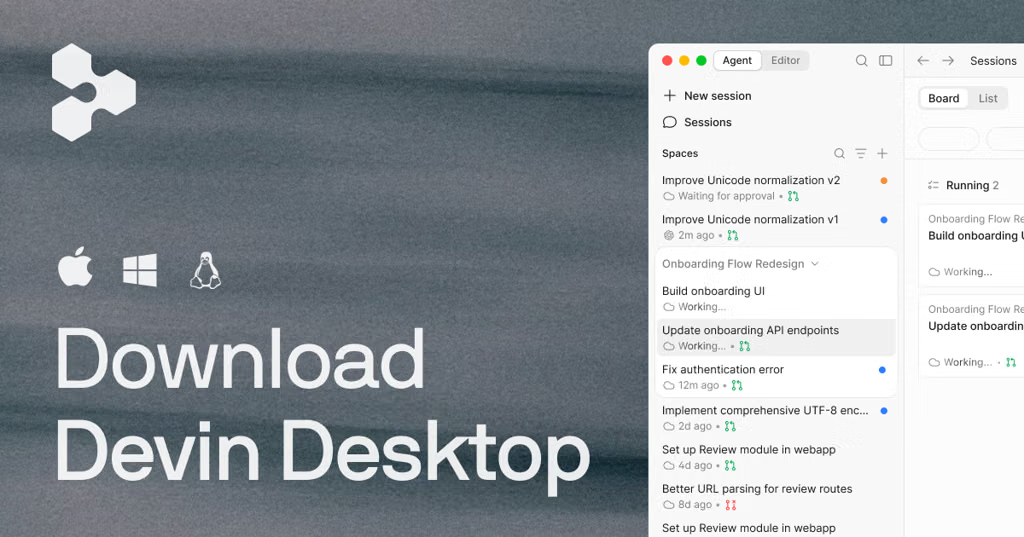
Devin AI : Marketed as an autonomous software engineer, Devin shines in heavy enterprise contexts like migrating legacy languages (e.g., COBOL or old procedural frameworks), restructuring monolithic directory layouts, and setting up cloud-native migrations. It can spin up sandboxed environments, run compilers, catch errors, and iterate until the code actually builds.
CAST Imaging : While not a traditional "code generator," CAST creates automated, interactive dependency and architecture maps of massive legacy codebases. Feeding these architectural knowledge graphs into an LLM or agent environment prevents the AI from making blind assumptions about cross-module calls.
Moderne (powered by OpenRewrite): Excellent for Java and major enterprise languages. It uses deterministic recipe-based refactoring combined with AI interpretation to safely execute large-scale, automated structural changes across thousands of files simultaneously without breaking syntax.
If you'd like, tell me:
What languages and frameworks your legacy codebase uses (e.g., Java, C++, COBOL, monolithic Python)?
Whether your team prefers an IDE plugin, a CLI terminal tool, or a fully autonomous agent?
I can help you narrow down the ideal tool stack and map out a safe, incremental modernization strategy.