For a tech-savvy homeowner, I’d rank the current smart Level 2 chargers less by raw charging speed—which is broadly similar—and more by app quality, automation access, energy management, and how well they fit into the rest of your smart home.
I'm looking for a home EV charger that offers great app control and works well with my existing smart home setup. What are the top options for a tech-savvy user?
I'm a tech-savvy homeowner looking for a home EV charger that offers top-tier app control and seamless integration with my smart home ecosystem. What are the best options?
This is my pick if integration and tinkering matter more than simplicity.
Wallbox provides Wi-Fi and Bluetooth, scheduling, adjustable charging current, power sharing and voice control through Alexa and Google Home. Its current Pulsar Plus also supports both J1772 and NACS variants.
The particularly interesting feature is its energy-management capability: adding Wallbox's Power Meter enables dynamic load management and solar charging, allowing the charger to adjust its output based on household consumption or surplus solar.
Why I'd choose it: it's one of the better choices when the charger is supposed to become an actual smart-home device, rather than merely having a phone app.
Caveat: some of the more advanced energy features require additional hardware.
If you want the nicest mainstream app experience, I'd give ChargePoint the edge.
The app handles scheduling around utility rates, charging reminders, cost/energy tracking, remote control and charging history. It also incorporates your home and public ChargePoint activity into one account.
Alexa integration is quite useful—you can start/stop charging, check whether the car is plugged in, see charging status and ask about spending.
The downside for a smart-home enthusiast is important: ChargePoint currently doesn't offer a native Google Home integration; iPhone users can use Siri Shortcuts instead.
Best if: you want sophisticated software without having to tinker.
🥉 Best for an energy nerd: Emporia
Emporia is unusually compelling if your definition of "smart home" includes understanding and optimizing the entire house's electricity use.
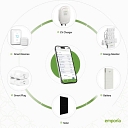
Its app brings EV chargers, Vue energy monitors, smart plugs, batteries and other Emporia devices into one dashboard. With a Vue monitor, you can go down to circuit-level energy consumption.
Emporia's current automation capabilities include off-peak EV charging and directing surplus solar toward enrolled devices.
The tradeoff is UI: Car and Driver found the app powerful but somewhat cluttered if you're only interested in EV charging.
Best if: you have solar, time-of-use electricity, a battery, or simply enjoy analyzing your home's energy flows.
Tesla Universal Wall Connector — best integrated ecosystem
If you already have Tesla + Powerwall + solar, I'd seriously consider Tesla even if you're otherwise brand-agnostic.
The Tesla app gives you charging schedules, history, energy data and access controls.
More importantly, Tesla now offers Smart Charging with Powerwall, which can optimize charging around utility rates, solar forecasts and your desired departure time. It also works with supported non-Tesla EVs when paired with the appropriate Wall Connector/Powerwall setup.
The Universal version is particularly attractive for a multi-EV household because it supports both NACS and J1772 without requiring a separate adapter.
Best if: your home already lives inside the Tesla energy ecosystem.
Not my first choice: if your goal is maximum interoperability with arbitrary third-party home-automation systems.
Autel deserves a look if you're especially interested in charging controls and detailed data. Its app supports remote start/stop, monitoring and scheduling.
I'd put it behind Wallbox and Emporia for a deeply integrated smart home, though. The ecosystem story isn't quite as compelling as those two.
My buying decision
If I were building the house today:
🏆 Home Assistant / DIY automation:Wallbox Pulsar Plus
📱 Best polished app:ChargePoint Home Flex
☀️ Solar + whole-house energy geek:Emporia
🔋 Tesla + Powerwall + solar:Tesla Universal Wall Connector
🎛️ Feature-rich alternative:Autel MaxiCharger
One important distinction: Alexa/Google compatibility isn't the same thing as true smart-home integration. Voice commands are convenient, but for serious automation I'd prioritize local/API access, energy telemetry, dynamic current control, and an ecosystem that won't leave you stranded if a cloud service changes.
For that reason, Wallbox is my overall choice for a genuinely tech-savvy homeowner, while ChargePoint wins if "great app that just works" is the priority. Current comparisons likewise put ChargePoint ahead on app polish and Wallbox ahead on solar/automation flexibility.
If you tell me whether your smart-home stack is Home Assistant, Apple Home, Google Home, Alexa, or SmartThings, I can narrow this to the best 2–3 chargers and show exactly what automations each can and can't do.
For a tech-savvy homeowner looking for deep local control, comprehensive metrics, and robust smart-home platform integrations (like Home Assistant, Alexa, or custom local APIs), a few standout EV chargers dominate the ecosystem.
The top recommendations tailored specifically to app experience and automation capabilities include:
App Experience: Exceptionally detailed, though it can feel a bit data-dense. It tracks real-time power draw, historical cost analysis, and synchronizes seamlessly with time-of-use (TOU) utility rates.
Smart Home & Ecosystem Integration: The gold standard for open/local data enthusiasts. It features a stellar, community-maintained local integration for Home Assistant that pulls every telemetry metric imaginable without relying purely on cloud webhooks. Pairing the Pro variant with the included Vue energy monitor unlocks dynamic load balancing and whole-home solar/grid tracking.
Best For: Energy nerds and Home Assistant users who want to track every watt.
App Experience: Clean, polished, and exceptionally reliable via the Tesla mobile app. Setting up schedules, viewing session stats, and handling over-the-air firmware updates is frictionless.
Smart Home & Ecosystem Integration: Offers Wi-Fi connectivity and local HTTP endpoints (LAN API), allowing advanced users to poll inverter/charger statistics locally. The built-in J1772 adapter (on the Universal variant) makes it future-proof for mixed-fleet households.
Best For: A sleek app interface and universal vehicle compatibility (NACS + J1772).
App Experience: Highly responsive app supporting Wi-Fi and Bluetooth, excellent scheduling features, and intuitive lock/unlock controls to prevent unauthorized neighborhood plug-ins.
Smart Home & Ecosystem Integration: Features native integrations with Amazon Alexa, Google Home , and a well-documented cloud and local API/Eco-Smart feature set that allows it to easily trigger routines or throttle charging based on excess solar production.
Best For: Compact physical footprint paired with out-of-the-box mainstream smart assistant integration.
App Experience: Robust commercial-grade heritage boiled down to a smooth consumer app interface (Autel Charge ). Offers precise amperage adjustments down to the single amp right from your phone.
Smart Home & Ecosystem Integration: Supports OCPP 1.6J (Open Charge Point Protocol), making it uniquely modular for local backend servers or advanced custom setups. It also features robust RFID card support if you want manual physical locks integrated with digital logs.
Best For: Homeowners who want semi-commercial open protocols (OCPP) and granular hardware control.[3][4]
If you want to narrow this down, tell me:
Are you running a local automation hub like Home Assistant , or do you prefer Google/Alexa cloud ecosystems?
Do you plan to integrate solar panels or require dynamic load management to avoid upgrading your electrical panel?