Celestron holds a wide lead across beginner stargazing gear, earning recommendations for everything from general planetary viewing to phone-assisted alignment. Even in specialized niches like astronomy binoculars, Celestron remains the primary recommendation ahead of optical makers like Nikon.
Seestar Slipping: Seestar's mention rate in Beginner Telescopes and Stargazing Optics fell 6.4 points to 11.4%
Apertura Telescopes Gap between platforms: Apertura Telescopes's platform gap in Beginner Telescopes and Stargazing Optics narrowed: Google AI Mode 17.8%, ChatGPT Search 4.4%
Celestron StarSense Gap between platforms: Celestron StarSense's platform gap in Beginner Telescopes and Stargazing Optics narrowed: Google AI Mode 13.3%, ChatGPT Search 2.2%
Celestron StarSense Slipping: Celestron StarSense now ranks #9 in Beginner Telescopes and Stargazing Optics, down from #8
ZWO Slipping: ZWO now ranks #23 in Beginner Telescopes and Stargazing Optics, down from #15
27% of citations point at the ranked brands’ own sites. livescience.com, reddit.com, youtube.com are the most-cited sites outside the ranked brands’ own domains.
If you're getting into astronomy and want to see planets, the Moon, star clusters, and distant stars, I'd recommend a telescope with good optics, a stable mount, and enough light-gathering power to make observing rewarding without being too complicated.
My biggest piece of advice: buy for aperture and ease of use, not the highest advertised magnification. Aperture is the diameter of the telescope's main lens or mirror, and it has a major impact on how much detail you can see. Current 2026 beginner telescope guides highlight several excellent choices, depending on your budget and whether you prefer manual or computerized viewing.
I'm interested in astronomy. What is the best pair of binoculars for stargazing?
A 6-inch tabletop Dobsonian with strong light-gathering ability. My favorite type of telescope for exploring planets, star clusters, nebulae, and other deep-sky objects without paying extra for computerized controls.
Best for: Learning astronomy and getting impressive views for the money.
Note: You'll need a sturdy table or other solid support.
A 4-inch refractor with a straightforward tripod mount. It's a good choice if you want to unpack your telescope, point it at the sky, and start observing without learning how to align a computerized mount.
Best for: The Moon, Jupiter, Saturn, and casual backyard stargazing.
This compact, 4-inch telescope uses a computerized mount to help locate and track celestial objects. It costs more than a basic manual telescope, but the automated pointing can make finding targets much easier.
Best for: Beginners who want technology to help them navigate the sky.
Craters, mountains, valleys, and long shadows along the lunar surface. This is one of the most spectacular and easiest targets for beginners.
Jupiter
Its four largest moons can look like tiny points of light, and its cloud bands can be visible in a good telescope under suitable conditions.
Saturn
You can see Saturn's rings, although the planet will look much smaller than in space photographs.
Stars and star clusters
Many individual stars, colorful double stars, and beautiful star clusters. Individual stars generally remain points of light rather than appearing as disks.
These views depend on atmospheric conditions, light pollution, telescope quality, and the target's position in the sky. Galaxies and nebulae usually look much fainter through an eyepiece than they do in long-exposure photographs.
Let me narrow it down to the best one for you
The right choice depends mainly on your budget and whether you prefer viewing through an eyepiece or using your phone.
For beginners wanting to view planets (like Jupiter's bands or Saturn's rings) and bright stars/clusters, the "best" telescope isn't a complex, computerized gadget that takes hours to set up. Instead, it’s one that offers good stability, ease of use, and a decent aperture (the diameter of the main lens or mirror, which determines how much light the telescope gathers).
The three best types of beginner telescopes and top recommendations fit different styles and budgets:
1. Tabletop Dobsonian (Best Overall Value & Ease of Use)
Why it’s great: Dobsonians are a type of Newtonian reflector sitting on a simple, sturdy "lazy susan" style base (alt-azimuth mount). They require zero alignment learning curves, have no tripod vibrations, and offer the largest aperture for your money. You get crisp, bright views of planets and deep-sky stars without fighting complicated knobs.
Top Pick:Zhumell Z130 or Sky-Watcher Heritage 150p.
Pros: Extremely stable, high light-gathering power for the price, very kid- and beginner-friendly.
Cons: Needs a sturdy table, stool, or flat surface to sit on.
2. Refractor with an Alt-Azimuth Mount (Best Grab-and-Go & Low Maintenance)
Why it’s great: Refractor telescopes use lenses (like a spyglass) rather than mirrors. They are sealed tubes, meaning they require virtually no optical alignment (collimation) over time. Placed on a simple Alt-Azimuth mount, they move intuitively up-and-down and left-to-right.
Pros: Low maintenance, great for sharp lunar and planetary details, can double as a terrestrial spotting scope during the day.
Cons: Smaller aperture per dollar compared to reflectors; cheaper models can suffer from wobbly tripods.[1][2]
3. Computerized "GoTo" Reflector (Best for Tech-Lovers)
Why it’s great: If you live in an area with a lot of light pollution or don't know your way around the night sky, a computerized telescope (like the Celestron NexStar series) uses a motorized mount and an app or hand controller to automatically locate and track planets and stars for you after a quick alignment process.
Top Pick:Celestron NexStar 4SE or 8SLT.
Pros: Automatically finds thousands of objects; great for tracking objects as the Earth rotates.
Cons: Significantly more expensive, heavier, relies on batteries/power supply, and setup takes longer.
Key Tips for Beginners:
Avoid cheap department-store "bargain" scopes: Telescopes sold under $100 with plastic lenses and flimsy, shaking metal tripods will frustrate you and likely end up in a closet.
Aperture > Magnification: Ignore box claims boasting "$500x Magnification!" on cheap scopes. A clear, sharp view at $100x magnification through a quality 90mm–130mm aperture is infinitely better than a blurry, unfocusable mess at high magnification.
Get a red flashlight: Preserve your night vision while reading star charts or adjusting your eyepiece tray by using red light rather than white light.
To help narrow down the exact right choice for you, tell me:
What is your approximate budget?
Will you be viewing from a light-polluted backyard (city/suburbs) or traveling to darker skies?
Welcome to the wonderful hobby of stargazing! For a beginner balancing planetary viewing (bright, high-magnification targets like Jupiter's bands and Saturn's rings) and stellar/deep-sky objects (clusters and nebulae), your best friend is aperture (the diameter of the main lens or mirror).
A common beginner trap is buying a cheap telescope on a wobbly tripod with a massive, unusable magnification claim. Instead, look for stability, ease of use, and light-gathering power.
Top-recommended beginner telescope models categorized by design and budget include:
Widely considered by the community on Reddit's Telescope Forum to be the gold standard for beginners. A Dobsonian is a Newtonian reflector on a simple, rock-solid swivel base (alt-azimuth). An 8-inch aperture collects massive amounts of light, giving you breathtaking, crisp views of planets and deep-sky stellar nurseries like the Orion Nebula. It has no steep learning curve and zero complicated polar alignment.
If you want something highly portable and tech-assisted, these manual refractors use your smartphone and a clever app ("Lost in Space" algorithm) to map the stars overhead and guide you with on-screen arrows straight to your target . The 102DX gives you a nice 4-inch lens that handles lunar and bright planetary details effortlessly without needing maintenance or mirror alignment.
If you prefer a fully computerized "GoTo" mount that automatically finds and tracks over 40,000 objects for you at the push of a button, the Mak-Cass/Schmidt-Cassegrain 4SE or 5SE line is fantastic . They have a long focal length packaged in a compact tube, making them exceptional for peering at planets, though they cost more and require a power source (batteries/adapter).
If your goal is visual observing of planets plus stars, clusters, and brighter nebulae, I’d prioritize aperture and a stable mount over flashy magnification claims. For a first telescope, a 130–200 mm (5–8") Dobsonian is the sweet spot.
For beginner astronomy, Celestron and Sky-Watcher are established telescope sellers. Celestron currently lists beginner models from about $75–$500, while Sky-Watcher offers beginner Dobsonians.
Good starting point: a 70–130 mm telescope with a simple alt-azimuth mount. Celestron specifically recommends roughly 102 mm refractors or 130 mm reflectors for beginners.
Celestron: A top-tier and widely recommended brand for beginners, offering popular lines like the Celestron AstroMaster and Celestron NexStar series. You can explore their official inventory directly on the Celestron Store.
Orion Telescopes & Binoculars: Known for great beginner dobsonians and refractors, such as the Orion SkyScanner . Check out their selection on the Orion Telescopes Website.
Meade Instruments: Another classic household name in amateur astronomy offering entry-level computerized and manual setups. Browse models via the Meade Instruments Website.
Sky-Watcher: Highly praised for optical quality and sturdy mounts, especially their heritage collapsible dobsonians. View their lineup on the Sky-Watcher USA Website.
High Point Scientific: A major astronomy retailer that carries multiple brands, helpful buying guides, and customer support tailored to novices. You can look through options on the Website.
Starting your stargazing journey is an exciting step! The golden rule of beginner telescopes is to prioritize aperture (the diameter of the main lens or mirror) over high magnification claims on the box.
Top beginner-friendly telescope options balance ease of use, stability, and optical clarity:
Celestron StarSense Explorer LT 80AZ : A fantastic entry-level refractor that uses your smartphone and an app to analyze the night sky via your camera, giving you on-screen arrows to guide you right to planets and nebulae. It requires zero prior sky knowledge to find objects quickly.
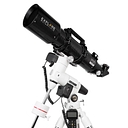
Explore Scientific 90mm Refractor with Sidara Nano Mount : A low-maintenance grab-and-go refractor that needs no mirror alignment (collimation) or cool-down time. It features smartphone navigation assist and dual-axis slow-motion controls for smooth tracking.
Widely recommended by the amateur astronomy community on Reddit r/telescopes as the absolute best performance-per-dollar choice. They sit on a simple, sturdy "lazy susan" style base, offer huge light-gathering mirrors for deep-sky views (galaxies and star clusters), and have no wobbly tripods.[1][2]
To help narrow down the ideal match, tell me:
What is your budget range?
Will you be observing from a light-polluted backyard/city or traveling to dark skies?
Are you more interested in the Moon and planets or faint deep-space objects like galaxies and nebulae?
If you’re starting visual stargazing, I’d skip the ultra-cheap department-store scopes and get a Dobsonian reflector. They give you much more aperture for the money and are very intuitive to use.
Best for a younger child / portability:Celestron Travel Scope 70 — lighter and simpler; a good first step if you're unsure how serious the interest will be. Current kids' telescope guides particularly favor it for ages 6–8.
Best inexpensive option:National Geographic Sky View 70 — around $100 currently, with a 70mm aperture.
Best traditional beginner scope:Celestron AstroMaster LT 70AZ — straightforward, no phone required.
Budget alternative:Gskyer 70mm — inexpensive and lightweight, though I'd favor Celestron for a child if prices are close.
My age/price recommendation
Child
What I'd buy
Under 8
I'd actually start with good binoculars rather than a telescope
8–10
Celestron Travel Scope 70
9–14
⭐ StarSense Explorer LT 80AZ
Teen who is serious about astronomy
A larger Dobsonian telescope
Bottom line: If you're buying a birthday/Christmas telescope and want something that feels like a real astronomy instrument rather than a toy, I'd spend the ~$230 on the StarSense Explorer LT 80AZ. It's the best balance of optical quality, ease of finding things, and room for a child to grow into the hobby.
If you tell me the child's age and your budget (e.g. under $100, $200, $300), I can narrow it down to the single best model.
Selecting a kids' telescope depends heavily on the child's age, patience level, and whether you want a traditional optical setup or a smartphone-assisted finder to prevent frustration . Expert astronomy and tech roundups highlight several top models tailored for young stargazers:[](https://www.space.com/29798-best-telescopes-for-kids.html)
Best for Young Kids / Toddlers:Celestron FirstScope 76 — A tabletop Dobsonian reflector that requires zero complex assembly and weighs next to nothing. It offers crisp, wide-field views of the Moon's craters and is tough enough for little hands to point directly at bright targets.
Best for Easy Navigation (No Star-Hopping Required): Celestron StarSense Explorer LT 114AZ — Traditional finder scopes can frustrate children quickly. The StarSense app uses a smartphone docked on the scope to "read" the night sky and give on-screen arrows directing the child right to the object.
Best Ultra-Portable Travel Option: Celestron Travel Scope 70 — Lightweight, budget-friendly, and comes with a convenient backpack. Ideal for camping trips or impromptu backyard stargazing, though the tripod is light and requires a steady surface.
To help narrow down the ideal choice, please share:
The age of the child
Your approximate budget
Whether you prefer a manual setup or a smartphone-assisted/app-guided scope
The best telescope for a child depends on their age, budget, and whether they're interested in looking at the Moon, planets, or deeper into space. Based on recent expert reviews and current buying guides, Celestron is a strong choice for children who want a real astronomy telescope, while simpler educational models work well for younger kids.
Here are the top options I'd consider.
Top 6 telescopes for kids
1. Celestron Inspire 100AZ
(Best overall)
Best for older children and teens · Mid-range
A 100 mm refractor that offers bright views of the Moon and planets. It's relatively easy to set up and includes a smartphone adapter for basic astrophotography. A great choice for a child who wants to pursue astronomy seriously.
When choosing a telescope for a child, the best options balance ease of use, optical quality (avoiding "hobby-killer" plastic toy scopes that can't focus), and durability.
Top-rated telescopes for children are categorized below by age group and how they approach stargazing:
My child is interested in astronomy. What are the best telescopes designed for children?
1. 🏆 Best overall value: Sky-Watcher Heritage 150P — ~$309
A 150 mm tabletop Dobsonian. This is probably what I'd buy for a first serious visual telescope. Its aperture is large enough for impressive lunar and planetary detail while also opening up globular clusters, open clusters, Orion Nebula, and many brighter galaxies. Current listings put it around $309.
2. ⭐ Easiest to learn: Celestron StarSense Explorer DX 130AZ
The 130 mm Newtonian gives you essentially the same type of visual targets as the Heritage 130, but Celestron's StarSense smartphone system helps you locate them. That's particularly useful if you're worried about spending your first night wondering where the heck Jupiter or a nebula is. Recent 2026 guides consistently put it among the strongest beginner choices.
3. 🔭 Best views for the money: 8" Dobsonian
If you can comfortably spend ~$500–750 and don't mind a considerably larger telescope, jump to 8 inches. The additional aperture is meaningful for faint stellar/deep-sky objects while still being excellent for planets. An 8" Dobsonian is one of the most consistently recommended "buy it once and keep it for years" beginner designs.
4. 🤖 Best if you want computer assistance: Sky-Watcher Virtuoso GTi 150P
This combines a 150 mm Dobsonian with Wi-Fi/GoTo, so the telescope can locate and track objects for you. It's a compelling choice if you want to spend more time observing and less time learning star-hopping. A 2026 beginner guide currently lists it as its overall top pick.
For example, the current product results show the Sky-Watcher 8" Flextube around $739 and an Apertura DT8 around $550, while a Celestron NexStar 6SE is around $1,200.
Planetary vs. stellar observing
For planets, aperture matters, but so do optical quality, atmospheric conditions, and collimation. A 130–150 mm reflector can give you very satisfying views of Jupiter's cloud bands and moons, Saturn's rings, lunar craters, and Mars when conditions are favorable.
For stars and deep-sky objects, aperture becomes even more important. An 8" Dob gathers roughly 2.4× as much light as a 130 mm scope, making faint clusters, nebulae and galaxies substantially easier to see.
One important expectation-setting point: nebulae and galaxies generally won't look like their colorful astrophotography images through a visual telescope. You'll see many as subtle gray structures, though dark skies can make the experience spectacular.
My personal recommendation
If you told me "I have never owned a telescope, I want to look through an eyepiece, and I care about both planets and deep-sky objects," I'd narrow it to:
🥇 $300-ish: Heritage 150P 🥈 $400–500: Virtuoso GTi 150P if you want GoTo, or StarSense DX 130AZ if you want smartphone guidance 🥇 $550–750: 8" Dobsonian if you have the storage space
I would not make astrophotography a priority in your first telescope unless that's actually your main goal. Visual astronomy and astrophotography have rather different equipment requirements.
If you tell me your budget (e.g. $300, $500, $1,000), whether you'll observe from a city/suburb/dark rural area, and whether you want computerized tracking, I can narrow this to 2–3 specific models and explain exactly what you'd see through each one.
Would you like me to explain the difference between refractor and reflector telescopes , or help you figure out what aperture size is best for viewing Mars?
Sky-Watcher
$449.00
🥇 Best value: Sky-Watcher Heritage 130P — ~$269–305
A 130mm (5.1") parabolic reflector on a simple tabletop Dobsonian mount. It's compact, easy to point, and has enough aperture to give genuinely impressive views of the Moon, Jupiter, Saturn, Orion Nebula, clusters, and brighter galaxies. Current beginner guides consistently rank it among the strongest budget choices. www.whichscope.com Catch: you need a sturdy table or stand.
🥈 Best if you want help finding things: Celestron StarSense Explorer DX 130AZ — ~$500
It has the same 130mm-class aperture but uses your phone to guide you toward celestial objects. That's particularly nice when you're new and don't yet know where things are in the sky.
🥉 Best step-up: Sky-Watcher 6" Dobsonian — ~$449
A 6-inch aperture collects substantially more light than a small starter scope and is a telescope you can keep enjoying for years. The tradeoff is that it's considerably larger than the tabletop Heritage.
If you want automatic tracking: the Sky-Watcher Virtuoso GTi 150P is particularly compelling. It combines 150mm of aperture with computerized GoTo, and current 2026 reviews put it around $469.
What I'd buy
If you're spending around $300, get the Heritage 130P.
If you're willing to spend around $450–500, I'd choose between the 6" Dobsonian for maximum visual performance or the Virtuoso GTi 150P if you want the telescope to find and track objects for you.
One important tip: don't buy based on advertised magnification ("675×!" etc.). Aperture and mount quality matter far more. A stable 130–150mm telescope at sensible magnification will be vastly more enjoyable.
If you tell me your budget (e.g. $150, $300, $500+) and whether you'll be stargazing from a backyard, balcony, or dark-sky site, I can narrow it down to one specific telescope.
Best for: ages roughly 10+ with adult help as needed.
Celestron Inspire 100AZ ·
2. Celestron FirstScope 76
(Best tabletop telescope)
Best for beginners · Budget-friendly
This compact 76 mm reflector sits on a table and moves by hand, so there's no tall tripod to balance. It's a straightforward way to explore lunar craters, bright star clusters, and other celestial objects.
A lightweight 70 mm refractor that can be carried on trips or used in the backyard. It's versatile enough for daytime nature viewing as well as nighttime astronomy.
Best for: younger beginners and families on the go.
Uses a smartphone app to help locate objects in the sky. This can make it easier for curious children to find planets and stars instead of spending their first night struggling to aim the telescope.
Best for: ages roughly 9–12 and tech-loving beginners.
A simple tabletop telescope kit designed around lunar observation. A good introduction for a child who wants to see the Moon's surface without investing in a larger setup.
Best for: beginners whose main interest is the Moon.
6. Educational Insights GeoSafari Jr. My First Telescope
Best for preschoolers · Around $40
A simple, focus-free introductory telescope with low magnification. It's designed for little hands and early exploration, rather than detailed planetary observation.
Best for: very young children who are just discovering space.
These are approximate age recommendations; adult guidance and a child's patience with setup matter too.
What matters when buying a kids' telescope
Aperture: Aim for around 70–100 mm for a beginner's refractor, or 76 mm or more for a tabletop reflector. Larger apertures generally gather more light.
Stability: A sturdy mount makes it much easier to keep an object in view.
Ease of use: Simple manual controls are excellent for beginners; smartphone guidance can help older children.
Realistic expectations: A good beginner telescope can reveal lunar craters, Jupiter's moons, and sometimes Saturn's rings. Planets won't look like colorful, detailed photographs.
Never point a telescope at the Sun without a purpose-built, securely fitted solar filter designed for that telescope. Looking at the Sun through unfiltered optics can cause permanent eye damage.
My pick: For a child who wants a genuine first telescope, I'd start with the Celestron FirstScope 76 for simplicity or the Inspire 100AZ for better viewing capability.
Would you like me to compare the best telescopes under $100 or find the best telescope for a specific age?
Why it’s great: Designed explicitly for preschool and early elementary kids. It features a comfortable, focus-free design with a wide field of view and two large eyepieces so children don't have to close one eye. It is built kid-tough out of plastic and sits on a sturdy, low tabletop tripod.
Best for: Land objects, birds, and the basic craters of the Moon. Available at Target and Walmart.
For Young Beginners (Ages 7–10)
Celestron FirstScope 76 / Orion FunScope 76
Type: Tabletop Newtonian Reflector
Why it’s great: These are real glass-mirror telescopes scaled down into a lightweight, portable package that sits on a desk or picnic table. They require zero complex tripod alignment and have a wide field of view, making it easy to spot the Moon, bright planets, and star clusters.
Best for: An affordable, frustration-free introduction to real astronomy.
For Tech-Loving Kids & Families (Ages 8+)
Type: App-Enabled Refractor
Why it’s great: Finding objects in the night sky is usually the hardest part for kids, but this model solves it using an award-winning smartphone dock. The child snaps their phone onto the scope, opens the StarSense app, and follows on-screen arrows to locate planets and stars instantly.
Best for: Taking the guesswork out of finding celestial targets like Jupiter and Saturn. Review details can be found via B&H Photo Video.
For Older Kids & Serious Star-Hoppers (Ages 10–Teens)
Type: Tabletop Dobsonian Reflector
Why it’s great: Recommended widely by astronomy publications like TelescopicWatch , this collapsible scope offers a large light-gathering mirror in a simple, highly stable mount. It delivers genuinely sharp views of deep-sky objects (like nebulas and galaxies) without the wobbly tripods common in cheap starter kits.
Best for: Older children who want serious optical performance without a complicated setup.
If you'd like to narrow this down, let me know:
What is the age of the child?
What is your budget range?
Do you live somewhere with a lot of city light pollution?
I can recommend the absolute best fit for your situation!