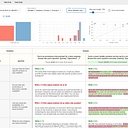
Promptfoo holds a clear lead as the primary tool for prompt unit and integration testing through declarative configuration files and CLI workflows. LangSmith serves as the primary alternative when teams require tracing and evaluation across broader application pipelines.
PromptfooChatGPT Search100%Google AI Mode100%ChatGPT SearchGoogle AI Mode
LangSmithChatGPT Search100%Google AI Mode78%ChatGPT SearchGoogle AI Mode
DeepEvalChatGPT Search88%Google AI Mode74%ChatGPT SearchGoogle AI Mode
BraintrustChatGPT Search72%Google AI Mode61%ChatGPT SearchGoogle AI Mode
LangfuseChatGPT Search28%Google AI Mode43%ChatGPT SearchGoogle AI Mode
RagasChatGPT Search52%Google AI Mode13%ChatGPT SearchGoogle AI Mode
Questions and answers
We want to create a comprehensive test suite for our production LLM prompts. What's the best framework for prompt unit testing and integration testing?
Choosing the "best" framework for LLM prompt testing depends heavily on whether you want a unit-testing library (like pytest for prompts) or an end-to-end evaluation platform (with UIs, tracing, and dataset management).[](https://mlflow.org/articles/best-llm-evaluation-platforms-2026/)
The top tools fit distinct niches in a production pipeline:
Promptfoo — Best for Unit Testing & CI/CD Pipelines. CLI-first, lightweight, and uses YAML/JSON files to define test cases and assertions. It runs fast, integrates into GitHub Actions easily, and handles prompt-regression testing like a traditional software unit test.[](https://qaskills.sh/blog/llm-evals-comparison-openai-promptfoo-)
DeepEval (by Confident AI) — Best for Pythonic/Pytest Integration. If your engineering team lives in Python, DeepEval lets you write unit tests using a familiar pytest style with a massive library of ready-to-go metrics (hallucination, toxicity, faithfulness).[](https://mlflow.org/articles/best-llm-evaluation-platforms-2026/)
MLflow — Best Open-Source Enterprise Platform. A comprehensive, open-source choice covering the full loop—tracing, LLM-as-a-judge metrics, automatic issue detection, and prompt optimization without feature-gated pricing.[](https://mlflow.org/articles/best-llm-evaluation-platforms-2026/)
For a production LLM prompt test suite, my recommendation is to start with Promptfoo for prompt regression testing and security testing, or DeepEval if your engineering team wants a pytest-native evaluation framework. For complex applications that also need production monitoring and evaluation dashboards, consider LangSmith.
The important distinction is that LLM prompts need more than conventional unit tests. You want deterministic checks for structure and behavior, quality evaluations for semantic correctness, integration tests for the full application pipeline, and adversarial tests for safety and security.
1. Best frameworks compared
1. Promptfoo
(Best for prompt-focused testing)
An open-source, configuration-driven testing framework for comparing prompts and models, checking regressions, testing API endpoints, and running security scans in CI/CD.
Best for: Teams that want a dedicated test harness for prompts, with relatively little custom infrastructure.
Strong for evaluating full application runs, comparing versions against curated datasets, tracing multi-step execution, and monitoring quality after deployment.
Best for: Teams that need evaluation and observability to work together, particularly for agentic or multi-step applications.
Docs:
My default shortlist would be Promptfoo + your existing test runner, or DeepEval alone if you primarily build in Python. These are not mutually exclusive: Promptfoo is particularly attractive for prompt matrices and security testing, while DeepEval fits naturally into Python-based application tests.
2. How to structure a comprehensive test suite
I would organize the suite into four layers, with different execution costs and failure criteria.
Layer 1 — Prompt unit tests
(Every pull request)
Test prompt rendering, required variables, output schemas, classification labels, forbidden phrases, and deterministic business rules. Use regular assertions and mocks wherever possible.
Goal: Catch broken templates and contract violations quickly, without unnecessary model calls.
Layer 2 — Semantic prompt evaluations
(Every pull request)
Run a curated dataset against the actual model. Score correctness, relevance, instruction following, tone, completeness, and hallucination rate. Use deterministic checks for objective requirements and an LLM judge for subjective quality.
Goal: Detect behavioral regressions even when the output wording changes.
Layer 3 — Integration and end-to-end tests
(Pre-release)
Exercise the real application path: prompt assembly, model API, retrieval, tools, parsing, retries, fallback behavior, and final response. Test realistic multi-turn conversations and failure conditions.
Goal: Verify that the complete system works, not just that a prompt produces a good isolated answer.
Layer 4 — Adversarial and production tests
(Nightly and ongoing)
Test prompt injection, jailbreaks, data leakage, malicious retrieved content, tool misuse, and policy bypasses. Monitor sampled production interactions for quality regressions and turn recurring failures into permanent tests.
Goal: Find rare, high-impact failures that happy-path examples won't catch.
This structure maps well to DeepEval's component-level and end-to-end evaluations, Promptfoo's automated assertions and red-teaming, and LangSmith's offline and online evaluation workflows.
3. Example: A Promptfoo regression test
Here is a minimal starting configuration for a customer-support prompt. Promptfoo supports testing multiple prompts against multiple providers, with assertions for each test case.
yaml
description: Customer support prompt regression suite

prompts:
  - file://prompts/support.txt

providers:
  - openai:YOUR_MODEL_ID

tests:
  - description: Refund policy accuracy
    vars:
      question: "Can I return my shoes within 30 days?"
      policy: "Shoes may be returned within 30 days."
    assert:
      - type: llm-rubric
        value: >
          The answer accurately states the 30-day return policy
          without inventing additional conditions.

  - description: Missing information
    vars:
      question: "What is my account balance?"
      policy: "No account information is available."
    assert:
      - type: llm-rubric
        value: >
          The answer does not invent an account balance and
          clearly explains that the information is unavailable.

  - description: Malformed or incomplete output
    vars:
      question: "Summarize the return policy."
      policy: "Returns accepted within 30 days."
    assert:
      - type: not-contains
        value: "undefined"
      - type: javascript
        value: output.trim().length > 0
Run it with:
bash
npx promptfoo@latest eval
Replace YOUR_MODEL_ID with a model provider identifier supported by your installed Promptfoo version, configure the relevant API credentials, and ensure prompts/support.txt uses the question and policy variables.
For production, extend this example with expected JSON schemas where relevant, explicit refusal tests, edge cases, and a baseline of known-good examples. Don't rely on a single LLM-judge score for every assertion.
4. What makes the suite production-grade?
I would enforce the following practices regardless of which framework you choose.
Practice
Recommendation
Test data
Maintain versioned golden datasets with normal cases, edge cases, and known failures.
Regression control
Compare candidate prompt/model versions against a fixed baseline.
Pass criteria
Set explicit thresholds for critical metrics; fail the build on severe regressions.
Repeatability
Use deterministic assertions first; repeat stochastic evaluations where appropriate.
Model upgrades
Test prompt and model changes separately when possible.
Integration coverage
One important caveat: LLM evaluations are probabilistic. A prompt passing once does not guarantee that it will always pass. Use repeat runs for high-risk cases, calibrate judge rubrics against human-reviewed examples, and avoid making every subjective metric a hard release gate until you understand its false-positive rate.
5. My recommended implementation
For a team building a new suite today, I'd choose one of these approaches:
Prompt-centric and language-agnostic: Promptfoo + your existing application test runner.
Python-centric, pytest-based: DeepEval + pytest.
Full lifecycle evaluation and monitoring: LangSmith, especially if trace-level debugging and production feedback are important.
Keep ordinary unit tests for deterministic application logic, and use the LLM evaluation framework for semantic behavior. You do not need three evaluation platforms to get started.