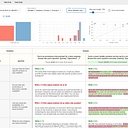
Braintrust has a clear lead for evaluating the factual accuracy of language model outputs at scale. Arize Phoenix offers a related option for tracing production traffic and using reusable judge evaluators.
If you don't have good evaluation data, you are facing the classic "cold start" problem in LLM development. Fortunately, modern LLM-as-a-judge platforms excel at bootstrapping evaluation by helping you generate synthetic test datasets, defining programmatic/LLM-based criteria, and running comparative experiments.
The best platforms depending on your workflow and infrastructure preferences are organized below:
If your main problem is not having good evaluation data, I’d start with a platform that helps you turn real user interactions into evaluation datasets, use an LLM-as-a-judge to score them, and identify failures you can turn into regression tests.
My first shortlist would be Braintrust, LangSmith, and Arize Phoenix. They overlap, but their strengths differ: Braintrust is particularly appealing for an evaluation-first workflow, LangSmith is a strong choice for LangChain/LangGraph applications, and Phoenix is attractive if you want an open-source, self-hostable option.
My top picks
1. Braintrust
(My first pick)
Best if you want to build an evaluation dataset from scratch or from production data, then systematically improve your application.
Collect production generations and turn them into versioned datasets.
Score outputs using model-based graders and human review.
Compare experiments to see whether changes improve quality.
Its dataset workflow directly addresses your problem of not having enough good examples.
The important distinction: generating data vs. judging it
An LLM-as-a-judge platform doesn't automatically give you a trustworthy benchmark. If your dataset is weak, the judge may confidently score outputs against the wrong criteria.
I'd build your evaluation workflow in this order:
1. Collect real examples
Gather user questions, model responses, relevant context, and examples of failure. Include difficult and unusual cases, not just successful interactions.
2. Define a scoring rubric
Specify what counts as correct, useful, grounded, complete, or safe for your particular application.
3. Calibrate the judge against humans
Have a person label a representative sample. Compare the judge's decisions with those labels and refine the rubric when they disagree.
4. Turn failures into regression tests
Add verified failures and edge cases to your dataset so every future model or prompt change can be tested against them.
Let me narrow it down to the best platform for you
What are you evaluating?
RAG / knowledge assistant
Agent with tools
General chatbot or LLM feature
Structured extraction or classification
What evaluation data do you currently have?
Production logs or traces, but few labels
A small hand-labeled dataset
Synthetic data only
Almost no examples at all
What matters most?
Automatically discover failure cases
Generate synthetic evaluation data
Reliable judge scores and human calibration
Regression testing before deployment
Hosting preference
Hosted SaaS is fine
Must be self-hosted
Open-source preferred, but hosted is okay
[Recommend the best fit]
My initial recommendation is Braintrust if you want an end-to-end evaluation workflow, but if the hardest part is generating representative test cases rather than scoring them, your application type and existing data will determine whether another tool or a dedicated synthetic-data workflow is a better fit.
Yes. There’s now a fairly mature ecosystem for LLM-as-a-judge evaluation. For your specific problem—“is this generated answer factually correct?”—I’d separate the options into two categories: general LLM-eval frameworks and observability/evaluation platforms.
Framework / platform
LLM-as-judge
Factuality / hallucination
RAG / grounding
Production monitoring
Open source
DeepEval
Strong
Yes
Yes
Yes, via Confident AI
Yes
Ragas
Strong
Yes
Excellent
Yes
Yes
Arize Phoenix
Yes
Yes
Excellent
Yes
Yes
TruLens
Yes
Yes
Strong
Yes
Yes
Promptfoo
Yes
Yes
Yes
Strong for testing
Yes
LangSmith
Yes
Yes
Yes
Excellent
No
Braintrust
Yes
Yes
Yes
Excellent
No
Giskard
Yes
Yes
Yes
Yes
Yes
A few distinctions matter quite a bit.
1. DeepEval
deepeval.com is probably the most direct fit if you want a developer-oriented evaluation framework.
It has built-in LLM judges for hallucination, faithfulness, answer relevancy, correctness, etc., plus custom G-Eval metrics. Its hallucination evaluator can compare an answer against a trusted context, while its faithfulness evaluator checks an answer against retrieved context in a RAG pipeline.
It also supports custom criteria through G-Eval, so you're not limited to predefined metrics.
2. Ragas
docs.ragas.io is particularly attractive if your system is RAG-heavy. Its evaluation philosophy decomposes quality into things like faithfulness, context relevance, context recall, and answer correctness.
For example, instead of asking the judge:
“Is this answer good?”
you can ask more targeted questions:
“Are the claims in the answer supported by the retrieved documents?”
That decomposition generally makes an automated judge much more useful for diagnosing failures.
3. Arize Phoenix
phoenix.arize.com is worth considering if you want evaluation tied closely to traces and production observability.
It's particularly useful when you want to move from:
Phoenix supports LLM-based evaluation alongside tracing and RAG/agent evaluation.
4. TruLens
trulens.org takes a similar approach: evaluate individual components and traces rather than treating the entire application as a black box.
This is useful if “factual accuracy” actually means something more specific such as:
Did the answer stay grounded in retrieved documents?
Did retrieval find the right evidence?
Did the model use that evidence correctly?
Did the final answer contradict the evidence?
5. Promptfoo
promptfoo.dev is especially interesting if your immediate problem is testing models/prompts before deployment.
It's oriented toward evaluation suites, assertions, comparisons, red-teaming, and regression testing. The same evaluation set can be run against different models or prompts.
6. LangSmith / Braintrust
If you want a more complete hosted evaluation + observability platform, look at:
These are less “here's a Python evaluation library” and more “here's infrastructure for datasets, experiments, traces, evaluators, human feedback, and production monitoring.”
The important caveat about factual accuracy
An LLM judge doesn't magically establish factual truth.
If you give a judge:
Question: Who founded Company X?
Answer: Jane Smith founded Company X.
and ask another LLM:
Is this factually correct?
you're essentially asking one model to adjudicate another model's claim. The judge can itself be wrong.
For scalable factuality evaluation, the stronger architecture is:
LLM answer
     │
     ▼
extract factual claims
     │
     ├── "X happened in 2019"
     ├── "Y founded the company"
     └── "Z has 10 offices"
             │
             ▼
       retrieve evidence
             │
             ▼
       LLM-as-a-judge
             │
       ┌─────┴─────┐
     supported  contradicted
       │             │
       └──────┬──────┘
              ▼
       factuality score
This is where frameworks such as DeepEval become useful: its faithfulness/hallucination metrics explicitly compare generated claims against supplied context rather than relying purely on the judge's world knowledge.
What I'd shortlist
If your core requirement is “we need to measure factual correctness at scale”, I'd evaluate these three first:
DeepEval — easiest starting point for building a factuality evaluator into your test/CI pipeline.
Ragas — particularly compelling if the answers come from RAG.
Arize Phoenix — particularly compelling if you need production traces + evaluation + observability.
And I would benchmark the judge itself against a human-labeled evaluation set before trusting its scores. Otherwise you can end up with a beautifully automated system that consistently measures the wrong thing.
If you tell me whether your LLM outputs are RAG answers, free-form chatbot answers, summaries, or something else, I can narrow this down to the 2–3 architectures that fit and show what a production-scale factuality eval would look like.
Question: Who founded Company X?
Answer: Jane Smith founded Company X.
and ask another LLM:
Is this factually correct?
you're essentially asking one model to adjudicate another model's claim. The judge can itself be wrong.
For scalable factuality evaluation, the stronger architecture is:
LLM answer
     │
     ▼
extract factual claims
     │
     ├── "X happened in 2019"
     ├── "Y founded the company"
     └── "Z has 10 offices"
             │
             ▼
       retrieve evidence
             │
             ▼
       LLM-as-a-judge
             │
       ┌─────┴─────┐
     supported  contradicted
       │             │
       └──────┬──────┘
              ▼
       factuality score
This is where frameworks such as DeepEval become useful: its faithfulness/hallucination metrics explicitly compare generated claims against supplied context rather than relying purely on the judge's world knowledge.
What I'd shortlist
If your core requirement is “we need to measure factual correctness at scale”, I'd evaluate these three first:
DeepEval — easiest starting point for building a factuality evaluator into your test/CI pipeline.
Ragas — particularly compelling if the answers come from RAG.
Arize Phoenix — particularly compelling if you need production traces + evaluation + observability.
And I would benchmark the judge itself against a human-labeled evaluation set before trusting its scores. Otherwise you can end up with a beautifully automated system that consistently measures the wrong thing.
Phoenix (by Arize AI): Built for ML observability, Phoenix offers powerful evals functionality specifically designed to leverage LLMs to evaluate RAG applications and agent pipelines for hallucination, QA correctness, and toxicity.
MLflow : Offers native evaluation tools supporting built-in LLM-as-a-judge metrics, custom judge definitions, and tracking across various prompt variants and model versions.
DataRobot / IBM watsonx : Enterprise AI platforms that incorporate automated guardrails and LLM evaluation scoring as part of their governance suites.[](https://mlflow.org/llm-as-a-judge/)
If you'd like to narrow this down, tell me:
Are you looking for an open-source library to run locally/in CI/CD, or a hosted enterprise platform?
What specific core dimensions are you trying to measure (e.g., hallucinations/groundedness, security/red-teaming , or domain-specific tone)?