
Loading articles

Put your agents to work growing your AI visibility.

Research, act and build on what your team has tried, with Parse keeping the shared record.

Sign up
Parse

Index

  • Brands
  • Markets
  • Topics
  • Sources
  • Volatility
  • How we measure

For agents

  • Parse MCP
  • Docs
  • Connect
  • Workflows
  • llms.txt

Parse

  • Use cases
  • For agencies
  • Pricing
  • Research
  • Blog
  • Compare

Company

  • About
  • Contact
  • Corrections
  • Work with us

© 2026 Parse, Inc. All rights reserved.

Privacy PolicyTerms of Service
Parse
IndexPricing
Sign inSign up
  1. Blog
Blog
What predicts AI brand recommendations across 199,811 brands (not Core Web Vitals or llms.txt)

What predicts AI brand recommendations across 199,811 brands (not Core Web Vitals or llms.txt)

Published Nov 23, 2026Updated Nov 24, 2026

On this page
  • What LightGBM and TreeSHAP actually rank across 199,811 brands
  • The 29× Chrome traffic staircase (and why Core Web Vitals invert)
  • Why Wikipedia, developer mindshare, and real SaaS footprint show up so strongly
  • Why llms.txt shows a negative correlation in 2026
  • Where to put your next quarter of effort
  • Scope and methodology
  • Sources
  • More in AI visibility

By Parse Editorial

Reviewed by

Dimitry ApollonskyFounder, Parse

What reviewed means

Teams spend weeks chasing technical AI-SEO checklists: shipping /llms.txt, tuning Core Web Vitals, and pasting FAQPage schema onto landing pages. When we tested those signals against 199,811 unique active brand domains in Parse's November 2026 index, none of those checkboxes moved the needle on their own. Real human demand and organizational footprint dominated every model we fit.

Across the full 199,811-brand population, Chrome User Experience Report (CrUX) traffic rank created a 29× monotonic staircase in Parse AI visibility score (averaging 21.98 for top-10K sites down to 0.76 for unranked domains), while passing all three Core Web Vitals actually inverted (44.8% pass rate in the top 10K vs 69.4% in the 500K-1M tier). Meanwhile, verified /llms.txt files correlated negatively (r = -0.519) because small-business CMS plugins now auto-generate them at scale.

AI visibility gradient from Chrome top-10K brands (21.98 avg score) down to unranked domains (0.76)

29×
Parse + CrUX, Nov 2026

Top TreeSHAP driver: Chrome traffic rank (log10), vs 0.0094 for passing all three Core Web Vitals

0.671
Parse LightGBM Audit, Nov 2026

Live domains (86,079 of 207,519) serving verified markdown /llms.txt, negatively correlated with score (r = -0.519)

41.5%
Parse Live Census, Nov 2026

AI visibility lift for brands with >1M 2026 Wikipedia views (17.53 avg score) vs <10K views (6.40)

2.7×
Parse + Wikimedia, Nov 2026

What LightGBM and TreeSHAP actually rank across 199,811 brands

To test technical site signals directly against real-world brand demand without guesswork, we joined Parse's November 20, 2026 index snapshot (199,811 unique active brand domains) with October 2026 CrUX popularity and Core Web Vitals, November 2026 HTTP Archive markup and schema detection, DNS TXT SaaS fingerprints, 2026 English Wikipedia pageviews (30,113 matched brands), 12-month Hacker News and GitHub mindshare (78,661 domains), and live /llms.txt verification.

We excluded partial-coverage features (such as our top-12K Playwright audit) from the full-population regression so missingness could never leak brand prominence into feature importance. Here is the clean, unleaked TreeSHAP ranking across all 199,811 active brands:

RankFeature (full-population unleaked model)Signal categoryMean |SHAP|Correlation with Parse score
1log10_crux_rank (Chrome traffic rank)Human demand0.6710-0.768 (better rank = higher score)
2dns_saas_tool_count (DNS-verified SaaS tools)Org maturity0.5660+0.883
3dns_has_dmarc (active DMARC record)Org maturity0.5030+0.828
4dns_enterprise_saas_count (enterprise stack)Org maturity0.3480+0.895
5desktop_density (Chrome desktop share)Audience mix0.2750+0.623
6log_wiki_views_2026 (Wikipedia views)Human demand0.2560+0.830
7log_hn_points (Hacker News points)Dev mindshare0.1880+0.611
8log_github_stars (GitHub repository stars)Dev mindshare0.1030+0.895
-has_valid_llms_txt (verified /llms.txt)Technical checkbox0.0670-0.519
-cwv_good_all_three (LCP + INP + CLS pass)Technical checkbox0.0094Negative across top tiers
-has_schema_faq (FAQPage JSON-LD)Technical checkbox0.0052Near zero
-has_schema_product (Product JSON-LD)Technical checkbox0.0001Near zero

Look at the gap between row 1 and the technical checkboxes at the bottom: Chrome traffic rank carries 71× the explanatory weight of passing all three Core Web Vitals (0.671 vs 0.0094) and 129× the weight of FAQPage schema (0.0052).

The 29× Chrome traffic staircase (and why Core Web Vitals invert)

Grouping all 199,811 active brands by their October 2026 CrUX popularity bucket shows a clean, unbroken staircase with zero exceptions:

Chrome CrUX rank tier (Oct 2026)Active brandsAverage Parse AI visibility scorePass all three Core Web Vitals
Top 10,0001,13321.9844.8%
10,001 to 50,0002,51215.8650.9%
50,001 to 100,0002,36514.2256.4%
100,001 to 500,00013,1669.9164.5%
500,001 to 1,000,00011,6157.2969.4%
Below 1,000,000 (ranked)112,9902.7567.6%
Unranked in CrUX56,0300.76Not measured

Why does Core Web Vitals pass rate go down as AI visibility goes up? Large, widely recommended software and commerce brands run complex interactive storefronts, analytics, and multi-region personalization, while tiny single-page sites score 100/100 in Lighthouse yet earn zero third-party mentions. Speed still helps human conversion, but AI engines do not rank brands by LCP or CLS.
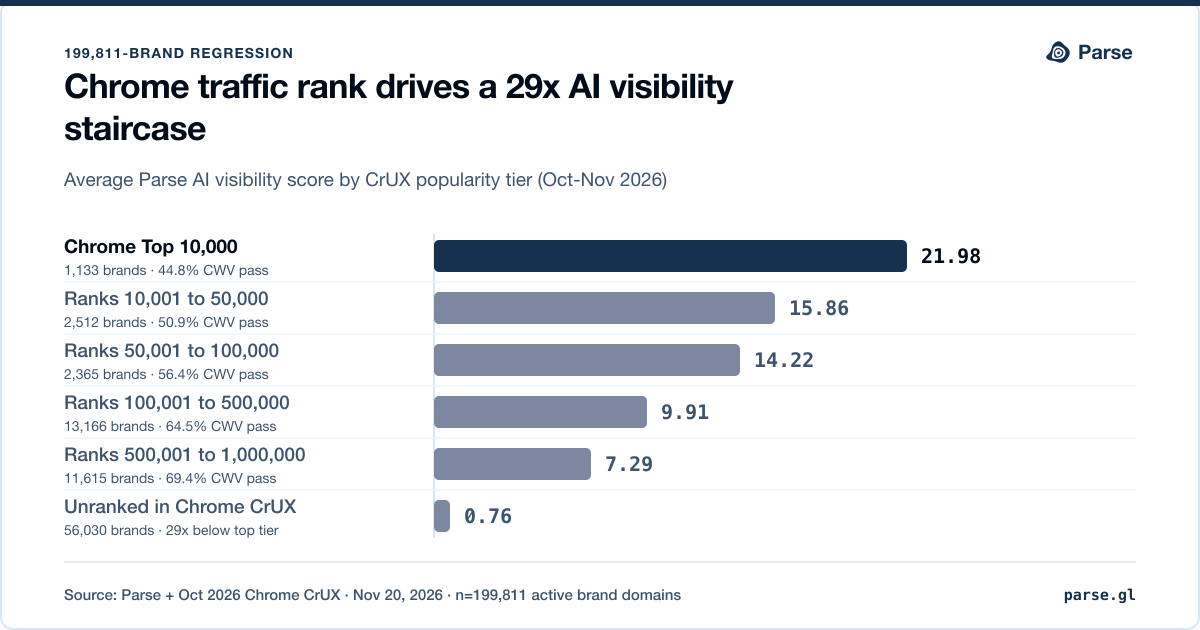
Ranked horizontal bars showing average Parse AI visibility score falling monotonically across Chrome CrUX rank tiers: Top 10,000 at 21.98, 10,001 to 50,000 at 15.86, 50,001 to 100,000 at 14.22, 100,001 to 500,000 at 9.91, 500,001 to 1,000,000 at 7.29, and unranked domains at 0.76 (a 29x gap).

Source: Parse + Oct 2026 Chrome CrUX · Nov 20, 2026 · n=199,811 active brand domains

Check how ChatGPT and Google AI Mode recommend your brand

Look up your public Parse page free to see rankings, cited sources and verified issues.

Why Wikipedia, developer mindshare, and real SaaS footprint show up so strongly

Real brand prominence leaves independent footprints everywhere buyers look. Across the 30,113 active brands matched to English Wikipedia articles in 2026, human reading volume tracks AI recommendations cleanly:

2026 English Wikipedia human pageviews (10-month total)Matched brandsAverage Parse AI visibility score
Over 1,000,000 views13817.53
100,000 to 1,000,000 views2,46012.37
10,000 to 100,000 views7,41311.10
Under 10,000 views20,1026.40

Why did dns_saas_tool_count, dns_has_dmarc, and dns_enterprise_saas_count sit right behind CrUX rank? Obviously ChatGPT does not inspect your DNS TXT records. Those records are an unbiased proxy for organizational scale: real companies with marketing teams, customer support desks (Zendesk, HubSpot, Salesforce), and engineering groups (Atlassian, Stripe, Anthropic/OpenAI APIs) earn the third-party reviews, guides, forum threads, and documentation links that actually drive AI recommendations. As our 6.2M-citation recommendation study showed, third-party publications and communities carry the overwhelming share of recommendation evidence.

Why llms.txt shows a negative correlation in 2026

Our earlier llms.txt AI visibility analysis found no evidence that adding /llms.txt boosts citations on its own. Our November 2026 live sweep across 207,519 live domains explains why the raw correlation turned sharply negative (r = -0.519): 86,079 live domains (41.5%) now serve verified markdown /llms.txt files (83,471 with three or more links), overwhelmingly because WordPress SEO plugins and SMB website builders began auto-generating /llms.txt by default during 2026.

That does not make /llms.txt harmful. For JavaScript-heavy SaaS sites whose raw HTML hides product details, a clean /llms.txt gives lightweight HTTP agents an accurate fact sheet. It simply means /llms.txt is a readability hygiene file, never a ranking hack.

info

Technical SEO work only pays off when it removes a concrete readability failure on pages buyers ask about: fixing a silent CDN block, server-rendering hidden pricing tables, or redirecting a broken cited URL. Once crawlers can read your facts cleanly, recommendation gains come from third-party source coverage and product demand.

Where to put your next quarter of effort

Stop burning engineering sprints on FAQPage markup or squeezing 80 ms off LCP hoping ChatGPT will recommend your product more often. Put that time into the levers the data actually supports:

  1. Clear real access blockers first. Verify OAI-SearchBot and ClaudeBot pass your CDN without 403/402 blocks and verify your /pricing page renders prices in plain HTML.
  2. Win the third-party pages AI already cites in your category. Use Parse's pitch-finding workflow or run search_cited_pages via Parse MCP to list every frequently cited comparison guide, review site, and directory citing your competitors without naming you.
  3. Keep entity facts consistent across authoritative hubs. Maintain accurate product summaries, pricing tiers, and official links across your own docs, GitHub repositories, review profiles, and (where notable) Wikipedia and Wikidata.

Scope and methodology

This study covers 199,811 unique active brand domains from Parse's November 20, 2026 index snapshot (4,150,782 AI answers across ChatGPT Search and Google AI Mode). External features joined October 2026 CrUX (143,781 ranked active brands and 56,030 unranked), November 2026 HTTP Archive (138,139 matched active brands), live DNS TXT/DMARC queries (199,811 brands), 2026 10-month Wikimedia human pageviews (30,113 brands), all-time Hacker News and deps.dev GitHub stats (78,661 domains), and live November 23 /llms.txt fetches (207,519 live domains). TreeSHAP values were computed from a LightGBM regression restricted strictly to full-population features to eliminate missingness-induced selection bias. Observational correlations establish predictive structure rather than direct causality.

Want to see who AI recommends in your market and which sites shape those answers? research your market with Parse.

Sources

  1. Does llms.txt improve AI visibility? (Parse) (opens in a new tab) · accessed November 23, 2026
  2. What sources back AI brand recommendations? (Parse) (opens in a new tab) · accessed November 23, 2026
  3. Chrome User Experience Report (CrUX) dataset (Google) (opens in a new tab) · accessed November 23, 2026
  4. HTTP Archive November 2026 dataset (opens in a new tab) · accessed November 23, 2026
  5. Wikimedia Pageviews dataset (2026) (opens in a new tab) · accessed November 23, 2026

More in AI visibility

  • AI citation link rot and JavaScript blindness across 621,952 cited URLs
  • The 2024 to 2026 AI web census: from GPTBot blocks to /.well-known/ucp
  • The silent AI block: 4.2× more sites block crawlers at their CDN than in robots.txt

See how AI recommends your brand, and what to fix next

Start with one free weekly brand and open index access. Pay as you go from $20 when you act.

Sign upLook up a brand
For agents: this page as Markdown, https://parse.gl/blog/what-actually-predicts-ai-brand-recommendations.md. JSON, MCP · free for the last 90 days, checks from $0.01
Open in ChatGPT (opens in a new tab) Open in Claude (opens in a new tab)

This page

As Markdown: https://parse.gl/blog/what-actually-predicts-ai-brand-recommendations.md
Reuse: Figures and tables on this page are free to republish with attribution: a link to https://parse.gl/blog/what-actually-predicts-ai-brand-recommendations beside them. A standard followed link (dofollow) is preferred.

Read and search

Any brand's shares and rivals, with 95% ranges: GET https://agent.parse.gl/v1/tools/check_brand?subject=%3Cbrand-domain%3E
Sample answers in a market: GET https://agent.parse.gl/v1/tools/search_answers?args=%7B%22filter%22%3A%7B%22market%22%3A%5B%22%3Cmkt_id%3E%22%5D%7D%7D
Cited pages in a market: GET https://agent.parse.gl/v1/tools/search_cited_pages?args=%7B%22filter%22%3A%7B%22market%22%3A%5B%22%3Cmkt_id%3E%22%5D%7D%7D
Search the index: GET https://parse.gl/api/public/search?q=<words>

Connect

Connect an assistant: https://agent.parse.gl/mcp

An agent can save work before signup: POST https://agent.parse.gl/v1/workspaces

What it costs

No account: Public figures and up to 5 examples per list, about 120 brands a day per address.
Free account: 90-day Parse Index reads, your brand's first check (20 buyer questions), and a free weekly check.
Prepaid credits (from $20): Exports, deeper search results, live checks, verified contacts, and daily tracking.
Live checks: $0.01 per question per engine ($0.05 on Gemini and Claude).
Full public answers and pages: 25 free per day, then $0.005 each.
Public answers older than 90 days: $0.001 each the first time your workspace counts or lists one, then yours.

Prices: https://parse.gl/pricing.md

Map of the site: https://parse.gl/llms.txt