If you want a smart home hub that can connect to and control devices from different manufacturers, I'd focus on Matter, Thread, Zigbee, Z-Wave, and Wi-Fi compatibility rather than choosing a hub based on its app or brand alone.
The best choice depends on how many third-party sensors and devices you want to integrate, whether you want local control without the cloud, and how much automation flexibility you need.
The best smart home hubs to consider
1. Home Assistant Green
(Best overall flexibility)
Best for mixing brands, advanced automations, privacy, and long-term control.
Integrates a huge range of third-party products through software integrations.
Strong local control, customizable dashboards, and powerful automation rules.
Limitation: Zigbee and Z-Wave require compatible USB radios or other supported hardware.
Best for: enthusiasts who want one central brain for the whole home.
These are the strongest candidates for different needs, rather than a guarantee that every device will work with every hub. Protocol support and device-specific integration are separate issues.
What compatibility should you look for?
Technology
What it connects
Why it matters
Matter
Compatible devices across major ecosystems
Best starting point for newer cross-brand devices
Thread
Low-power sensors and smart devices
Requires a compatible Thread border router
Zigbee
Many sensors, bulbs, plugs, and switches
Common in affordable smart home devices
Z-Wave
Sensors, locks, switches, and security devices
Important for many existing home automation installations
Wi-Fi / LAN
Plugs, appliances, cameras, and cloud integrations
Often depends on manufacturer integration support
A key detail: Matter does not automatically make every device compatible, and a hub with a Zigbee radio may not support every manufacturer's Zigbee products. Verify compatibility for your exact devices before buying.
My recommendation
Maximum flexibility: Home Assistant Green.
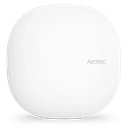
Easy setup with established third-party devices: Aeotec Smart Home Hub V3, especially if you need Z-Wave.
Sensor-focused setup: Aqara Hub M3.
Local automation and reliability: Hubitat Elevation C-8 Pro.
Broad protocol support in one premium box: Homey Pro.
Let’s narrow it down to the right hub
The most useful question is: Which brands or types of devices do you already own, or plan to connect?
When looking for a smart home hub to anchor mixed third-party devices and sensors, your best options depend heavily on whether you want a turnkey consumer ecosystem (like Samsung or Apple) or a deeply customizable, privacy-focused power user setup (like Home Assistant or Hubitat).
The industry standard relies heavily on Matter and Thread for cross-platform compatibility alongside legacy protocols like Zigbee and Z-Wave.
Top Smart Home Hub Options
Home Assistant (Yellow, Green, or DIY Hardware)Widely considered the ultimate choice for third-party integration. It is entirely local-first (no cloud required) and supports thousands of components, brands, and custom integrations out of the box. It bridges Zigbee, Z-Wave, Matter, and Wi-Fi seamlessly.
A stellar mainstream consumer choice. It offers native radios for Zigbee, Z-Wave, and Matter, meaning you can mix and match contact sensors, smart plugs, and switches from hundreds of third-party brands into a single user-friendly mobile app.
Built specifically for heavy-duty local automation. It features built-in Zigbee, Z-Wave, and Matter support and handles complex conditional routines entirely offline, ensuring high speed and complete privacy without chewing up your internet bandwidth.
Perfect if you are deeply entrenched in the Apple ecosystem. Modern Apple TV and HomePod models function as full Matter controllers and Thread border routers, allowing third-party Matter-over-Thread sensors (from brands like Eve or Aqara) to connect instantly and securely.
A versatile brand-specific gateway that acts as a Matter controller and Thread border router, while also bridging traditional Zigbee Aqara sensors and offering an IR blaster to control third-party appliances like AC units and TVs.
To help me narrow down the ideal hub for your space, could you tell me:
What specific third-party brands or sensor types (Zigbee, Z-Wave, Wi-Fi) do you already own or plan to buy?
Are you comfortable with a DIY/tech-forward setup (like Home Assistant) or do you prefer a plug-and-play consumer app (like SmartThings or Apple Home)?
The Home Assistant Green, Aeotec Smart Home Hub (SmartThings) , and Aqara Hub M3 are the top central hubs for integrating external devices and third-party ecosystems seamlessly.[1][2]
Choosing the right hub depends on your technical comfort level and how deeply you want to mix local control with cloud ecosystems.
Watch this video for a breakdown comparing the top smart home hubs and their ideal use cases:
The premier open-source choice for ultimate customization and local privacy. It runs on Home Assistant OS and connects natively to thousands of third-party brands, platforms, and local protocols (Zigbee, Z-Wave, Matter, and Thread via optional dongles) without data leaving your house.
The easiest mainstream ecosystem hub to set up. It acts as a robust multi-protocol gateway supporting Zigbee, Z-Wave, and Matter, while bridging effortlessly with mainstream voice assistants like Amazon Alexa and Google Assistant.
An exceptional choice for a bridge-heavy home. It functions as a powerful Matter controller and Thread border router, featuring robust infrared (IR) control and local automation capabilities that tie multiple ecosystems together smoothly.[2][3]
Comparison of Features
Hub
Best For
Supported Protocols
Ecosystem Integration
Home Assistant Green
Maximum privacy & deep automation
Matter, Thread, Zigbee, Z-Wave (via USB)
Practically universal (thousands of open-source integrations)
Aeotec Smart Home Hub
Plug-and-play ease & mainstream support
Zigbee, Z-Wave Plus, Wi-Fi, Matter
SmartThings app, Alexa,
If you can share which specific third-party devices or brands (like Hue, Ring, or Apple Home) you plan to use, I can recommend the exact hub that offers the smoothest compatibility.
If you want a central hub that brings together smart-home devices from different manufacturers and ecosystems, I’d focus on compatibility, local control, and flexibility rather than choosing a hub tied to a single brand.
The key is finding a system that lets your lights, locks, sensors, thermostats, cameras, and voice assistants work together—even when they come from different manufacturers.
My top smart-home hub recommendations
1. Home Assistant Green
(Best overall flexibility)
Best if you want to combine devices from many manufacturers and build sophisticated automations.
Huge integration ecosystem and customizable dashboards.
Strong support for local control and cross-brand automation.
Can connect to Matter, Zigbee, and Z-Wave devices with the appropriate compatible hardware and setup.
Trade-off: More setup and maintenance than a mainstream consumer hub.
Unifying a smart home with devices from a wide array of third-party brands requires a hub that supports multiple communication protocols (Zigbee, Z-Wave, Thread, Wi-Fi, and Bluetooth ) alongside the universal Matter standard.
The top smart home hubs for multi-brand interoperability, ranked by flexibility, local control, and ecosystem support, include:
Home Assistant (via hardware like Home Assistant Yellow or a dedicated mini PC)
Best for: Absolute maximum compatibility and power users.
Why it shines: It features over 1,000 localized integrations spanning practically every smart device brand on earth. It runs completely locally (no cloud dependency), making it fast, private, and endlessly customizable.
Homey Pro
Best for: Premium, plug-and-play multi-protocol bridging.
Why it shines: Supports Wi-Fi, Zigbee, Z-Wave, Bluetooth LE, Infrared, 433MHz, Matter, and Thread out of the box. It connects over 50,000 products from 1,000+ brands in a polished, user-friendly app interface.[1][2]
Samsung SmartThings / Aeotec Smart Home Hub
Best for: Mainstream DIY simplicity with broad radio support.
Why it shines: The Aeotec Smart Home Hub natively integrates Zigbee, Z-Wave, Wi-Fi, and Matter-over-Thread. SmartThings bridges thousands of mainstream commercial brands (Philips Hue, Ring, ecobee, Yale) into a single app and execution engine.
Hubitat Elevation (Model C-8)
Best for: Local-processing speed and local automation reliability.
Why it shines: Handles Zigbee, Z-Wave, and Matter natively without relying on an active internet connection. It is heavily favored by users who want robust multi-brand automation locally while keeping their data private.
Aqara Hub M3
Best for: Multi-protocol versatility with strong Matter/Thread bridge capabilities.
Why it shines: Acts as a Matter controller, Thread border router, and Zigbee/IR bridge. It allows classic non-Matter/Zigbee accessories to cross over into other major third-party platforms.
To help narrow down the ideal choice, tell me:
What specific brands or device types (e.g., Z-Wave locks, Zigbee bulbs, proprietary sensors) do you already own?
Are you comfortable with a technical DIY setup (like Home Assistant), or do you prefer a ready-to-go commercial app?
If your goal is to unify smart-home sensors and devices from different brands, focus on protocol compatibility, local automation, and how many third-party devices the hub can actually control — not just whether it works with Alexa or Google Home.
The strongest options to compare are Home Assistant, Aeotec SmartThings, Hubitat Elevation, Homey Pro, and Aqara Hub M3. They serve different needs, from broad DIY compatibility to easier, more polished control.
Helps compatible devices work across Apple, Google, Amazon, and other ecosystems.
Thread
Connects compatible low-power devices; a Thread border router may be required.
Zigbee
Supports many existing lights, plugs, and sensors.
Z-Wave
Important for many smart locks, switches, and security sensors.
Local control
Keeps supported automations running without an internet connection.
One important caveat: no hub supports every device automatically. Matter doesn't guarantee that every device feature transfers between platforms, and some products still require their own bridge or cloud integration.
My recommendation
I'd start with Home Assistant Green if maximum third-party compatibility is your priority. Choose Aeotec SmartThings if you value easier setup, or Hubitat if local automation is especially important.
To narrow this down to the best option for your home, I have one question:
Which ecosystem and devices do you already use or plan to connect?
Best for people who want to combine many brands and build detailed automations.
Extensive integrations for sensors, lights, switches, thermostats, and other devices.
Strong local control and customizable dashboards.
Can coordinate devices across different ecosystems.
Trade-off: More setup and maintenance; Zigbee, Z-Wave, and Thread may require additional hardware depending on your configuration.
Explore:
2. Aeotec Smart Home Hub
Best for a mixed-brand household that wants a mainstream app rather than a DIY project.
SmartThings platform supports many third-party devices and automations.
The older V3 model supports Zigbee and Z-Wave, useful for existing sensors, locks, and switches.
Integrates with compatible Matter and Wi-Fi devices.
Trade-off: Some functionality depends on cloud services. Check the exact model: newer SmartThings hub hardware may not support Z-Wave.
Explore:
3. Hubitat Elevation C-8 Pro
Best for advanced sensor rules and reliable local automation.
Built-in Zigbee and Z-Wave radios.
Can trigger actions from motion, contact, temperature, and other compatible sensors.
Most core automations can run locally, reducing dependence on internet services.
Trade-off: Its interface and automation setup can take more learning than SmartThings.
Explore:
4. Homey Pro
Best for a premium, more visual automation experience.
Broad protocol and brand support, including Zigbee, Z-Wave, Wi-Fi, and Matter on supported hardware.
Visual automation flows for linking sensors and devices.
Designed to consolidate compatible devices into one interface.
Trade-off: Higher upfront cost, and some integrations or services may depend on the cloud. Verify the generation and regional model before buying.
Explore:
5. Aqara Hub M3
Best for an easy-to-manage Matter and Zigbee setup, particularly if you already own Aqara sensors.
Zigbee support for compatible Aqara accessories.
Matter controller and bridge functionality for supported integrations.
Thread border-router capabilities and local automations.
Trade-off: No Z-Wave radio, and its native sensor compatibility is more limited than a general-purpose platform such as Home Assistant.
Explore:
What matters most when choosing
Technology
What it means for you
Matter
Helps compatible devices from different manufacturers work across ecosystems.
Zigbee
Common in battery-powered sensors, bulbs, plugs, and switches.
Z-Wave
Important for many existing door locks, contact sensors, and home-security devices.
Thread
A low-power networking technology used by many newer smart-home devices; a Thread border router is needed for the relevant network setup.
Local control
Lets supported automations work without relying on a vendor's cloud, though remote access may still need the internet.
These standards are complementary, not interchangeable. A hub that supports Matter doesn't automatically support every Zigbee or Z-Wave device, and compatibility may vary by device model and available features.
Let's narrow it down to your setup
The most useful next step is to match the hub to your existing hardware.
1. Which brands do you already have?
2. What types of sensors or wireless protocols do you use?