
AI-generated images and SEO need to be evaluated at the page level. An image can pass a detector and still add nothing to a search result. It can also carry an AI watermark and help a reader understand a difficult subject. Before paying to change either signal, decide what you want to improve: the image, its search eligibility, or the answers that mention your brand.
The practical question is often narrower than “does Google like AI images?” A team has a generated hero, a supplier has promised to remove SynthID, and somebody wants to know whether that work will improve rankings. We reviewed the relevant Google documentation to separate published requirements from assumptions. The result is a measurement plan, not a claim that watermark removal changes search performance.
Do AI-generated images hurt SEO?
Google's guidance on generative AI content emphasizes accuracy, relevance and value. It does not establish a blanket ranking penalty for every generated image. Nor does it promise that an attractive synthetic image will rank. For an SEO lead, the useful decision is whether the image improves the page and whether the page meets the requirements of its destination.
An illustration of how heat moves through a building can explain something that stock photography cannot. A generated picture of a product that misrepresents its controls can make the page less useful. The production method alone does not answer that difference.
Treat “remove the AI signal to recover rankings” as a hypothesis requiring evidence. A detector screenshot is not a Search Console report. If an agency proposes this work, ask which search outcome it expects to change, which pages it will compare, and what else will change during the test. That turns an ambiguous promise into something your team can assess.
What do Google's published requirements actually cover?
Our October 9, 2026 document review compares four primary Google guides. We selected one for each relevant decision: general generated content, image presentation, AI search eligibility and shopping imagery. This is an original classification of published guidance, not an experiment on Google's ranking systems.

| Document reviewed | What it helps you decide | What it does not establish |
|---|---|---|
| Generative AI content | Whether generated material adds accurate, useful information | A ranking benefit from passing an image detector |
| Image SEO | How images are embedded, described and made accessible | A universal SynthID removal requirement |
| AI features | Eligibility to appear as a supporting link in AI search | A detector score that qualifies a page for citation |
| Merchant Center image requirements | Which product-image rules the shopping feed must meet | Permission to strip required AI-origin metadata |
None of these four documents instructs publishers to pass a third-party AI-image detector as an SEO prerequisite. That is a finding about this bounded document set, not proof that we know every ranking signal. Keep that boundary in the brief: published requirements first, proposed experiments second.
How are SynthID, Content Credentials and detector scores different?
SynthID is a watermark signal. Content Credentials describe provenance. A generic image detector estimates whether an image resembles generated content. A result from one cannot stand in for the others, and none directly measures whether a page gets retrieved for a buyer's question.
Google DeepMind describes SynthID as an invisible watermark embedded in generated content. The C2PA explainer describes a signed record of an asset's history. These are different kinds of evidence.
Three separate checks: image origin, search eligibility and observed visibility. Each needs its own evidence.
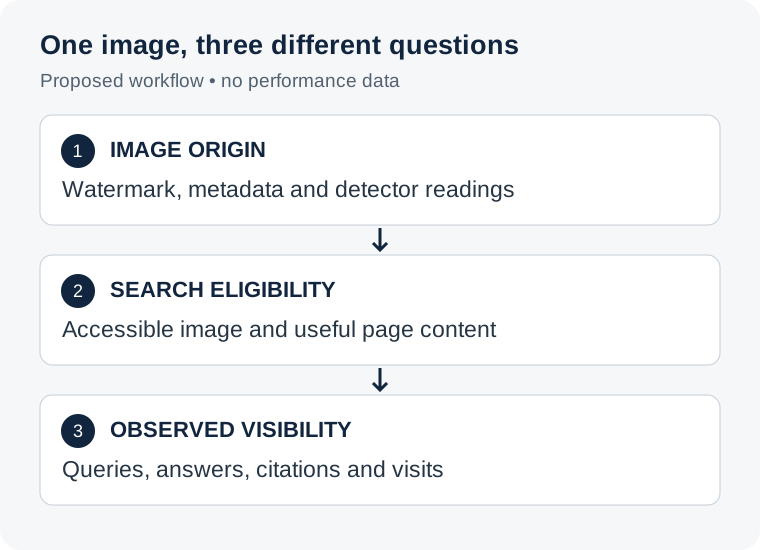
For example, removing a supported metadata container may change what a file inspector reports. It does not establish that a watermark carried in the image disappeared. A generic detector might also return a different score after re-encoding, without telling you anything about the watermark.
Record these findings in separate fields. The moment they become one “AI cleanliness” score, the team loses the ability to tell what improved or what the processing actually did.
Does stripping SynthID improve rankings or AI citations?
The sources reviewed here do not establish that causal link. A product may change an image's detectable signals; a search system may choose different pages for a query. Connecting the two requires a study that controls other explanations. One before-and-after screenshot cannot do that work.
Deprint is a product from our founder that offers supported metadata cleanup and experimental redraw processing aimed at reducing SynthID signal. It is a relevant tool to evaluate when the question is how an image changes. Its positioning is not evidence of an SEO effect. The current processing guide describes the modes and their limits; no watermark-removal or detector-pass guarantee should be inferred.
A useful trial saves the original, the processed copy and the actual detector responses. A separate search trial records page-level outcomes. If a tool changes logos, labels or a product detail to lower a score, that output can be a worse publishing asset even when the score looks better. Your acceptance decision should include both technical results and editorial accuracy.
Which AI image metadata should ecommerce teams preserve?
Google Merchant Center explicitly tells merchants to retain AI-origin metadata in generated images, including the relevant IPTC DigitalSourceType information. That makes shopping imagery a distinct workflow. A blanket “strip all metadata before publishing” instruction is not suitable for every destination. Read the image requirements.
Build the export decision around where the file will go:
| Destination | Check before export | Evidence to retain |
|---|---|---|
| Editorial article | The image explains the subject accurately | Source file, editing notes and useful caption |
| Product feed | Required AI-origin metadata survives | Exact submitted file and metadata inspection |
| Client evidence or case study | The image still supports the factual claim | Original capture and approval history |
| Social post | The platform's disclosure rules are met | Final asset, caption and disclosure decision |
The file appropriate for a blog illustration may not be appropriate for a product feed or a case-study photograph. Use named exports with a destination, rather than one supposedly clean master. Keep rights and provenance decisions visible to the person approving the image.
What image work is worth doing for search?
Fix known publishing defects before experimenting with detector outcomes. Google's image SEO guide covers ordinary image elements, relevant surrounding text, descriptive filenames and alt text, and accessible image URLs. Those are concrete implementation checks your team can complete and inspect.
The next review is editorial. Does the image show something the paragraph cannot explain as quickly? Is small text readable on a phone? Does the caption help a reader interpret the figure? Are charts based on real data? A diagram of a workflow is useful when its labels match the actual steps; a decorative dashboard with invented numbers is not evidence.
For a generated image, inspect the parts that carry meaning. A misspelled control label in a software tutorial is more consequential than a minor texture artifact in the background. If those details need extensive repair, replace the image with a real screenshot or a simpler diagram.
Our AI visibility audit checklist places technical access in the wider review. Treat image production as one part of that process, with its own acceptance checks.
How should you measure an image-processing experiment?
Choose the success measure before producing variants. If the proposed benefit is a lower detector score, test that. If the benefit is search traffic, the unit of analysis becomes the page and query. If the benefit is more brand recommendations, collect the relevant answers over time. Do not report one as another.
This worksheet keeps those outcomes apart:
| Outcome | Observation to save | Common interpretation error |
|---|---|---|
| Watermark result | Named verifier, exact response, date, file hash | Calling a generic AI score a SynthID result |
| Image usefulness | Reviewer decision, dimensions, meaningful visual changes | Treating a lower score as better quality |
| Search visibility | Query/page impressions and clicks, search type, dates | Attributing seasonal demand to an image edit |
| AI visibility | Fixed buyer questions, system, answer and cited URLs | Treating one favorable answer as durable lift |
Parse measures brand visibility in AI answers; it does not certify image watermark removal. Use the AI visibility experiment guide to structure the answer-level comparison. Keep the image test log as a separate supporting artifact so another reviewer can reproduce your interpretation.
How do you keep the test from answering the wrong question?
Avoid changing the image, headline, copy, internal links and promotion plan at the same time, then calling the result an image effect. That may be a worthwhile page refresh, but it cannot isolate the contribution of image processing. Choose between a controlled test and a broader editorial improvement before work begins.
For a small site, a carefully documented case series may be more realistic than a convincing causal study. Select comparable pages, record baseline demand, preserve an unchanged comparison group where practical, and note concurrent releases. Set the observation window before reviewing results. There is no universal number of days that makes a low-traffic test conclusive.
Suppose two updated pages gain impressions while all comparable pages gain too. That is a reason to investigate the shared change, not to credit a watermark tool. If detector readings change but search results do not, report both. “The tested files changed under this verifier; visibility did not show a clear change” is a useful result, and it prevents an unsupported sitewide rollout.
What should go into the final recommendation?
Give the decision-maker a small set of artifacts: the exact originals and exports, the file-level results, the page-level observations and the known confounders. Recommend expansion only for the benefit demonstrated. A useful compression workflow can ship without becoming a claim about AI detection; a detector experiment can continue without becoming an SEO promise.
Separate the cost of processing from the cost of review. A cheap export that takes twenty minutes to check may be expensive at scale. Track time per accepted asset, rework and rejected outputs alongside credits or subscription fees. These are proposed operating measures, not results from a Deprint trial.
The practical order is to make the page useful, meet the destination's requirements, then test uncertain improvements. If your specific goal is to investigate SynthID reduction, evaluate Deprint against that goal with a named verifier and a saved original. If your goal is search visibility, require search evidence before declaring the work successful.
Method note: sources and product descriptions were reviewed on October 9, 2026. The tables are editorial synthesis and proposed measurement templates. We did not run a Deprint efficacy benchmark, measure keyword volumes or test a ranking effect for this article.
If you want to see how AI engines describe your own brand, run a free brand check.