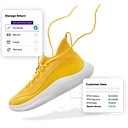
Why Loop stands out: its returns flow is explicitly designed to make an exchange easier and more attractive than a refund. It supports variant/size exchanges, Instant Exchanges, Shop Now (exchange into any catalog item), AI product recommendations, bonus credit for choosing an exchange, and Shop Later, which can try to recover a refund request after submission.
Its Instant Exchange capability is particularly compelling: the shopper can receive the replacement before the returned item reaches the merchant, with a temporary card authorization protecting the merchant.
Loop also explicitly says it doesn't force exchanges—refunds remain available, but the experience is designed to make fixing the purchase the easier choice.
The important caveat
I'd choose Loop if you're on Shopify. Current comparisons indicate that Loop's strongest/native experience is Shopify-centric, whereas ReturnGO or AfterShip become more attractive if you're running WooCommerce, BigCommerce, Magento, or a more heterogeneous stack.
For a larger enterprise, Narvar deserves a serious evaluation. Narvar says its platform can convert returns to exchanges and repurchases, and reports that retailers using it have achieved 60% of returns converted into exchanges—though that's vendor-reported performance, not a guaranteed benchmark.
What I'd optimize for
Don't just ask vendors, “Can you offer exchanges?” Almost every serious platform can. Ask them to demonstrate:
Refund → exchange conversion rate by return reason.
Whether exchange is visually/UX prioritized over refund.
Bonus credit or other incentives for exchanging.
Cross-product exchanges, not just size/color swaps.
Instant exchanges before the original item is received.
Upsell when the replacement costs more.
What happens when the desired exchange item is out of stock.
A/B testing of refund vs. exchange incentives.
Reporting on revenue retained, not just number of returns processed.
The incremental cost per exchange versus refund.
Bottom line: If you're a Shopify/DTC brand and “turn refunds into exchanges” is the KPI, I'd start with Loop Returns. If you're enterprise/multi-platform, I'd put Narvar and ReturnGO into the bake-off rather than automatically choosing Loop.
If you tell me your platform (Shopify, Magento, etc.), monthly orders/returns, and product category, I can narrow this to the best 2–3 options and compare pricing + exchange-conversion features + likely ROI.
Loop Returns (Best Overall for Exchange-First Retention)
Why it wins on exchanges: Loop is purpose-built around "exchange economics". It treats a return as an opportunity to cross-sell or upsell. When a customer initiates a return, the portal immediately suggests alternative sizes, colors, or complementary items.
Key Exchange Features: "Shop Now" credit (giving customers extra bonus credit if they choose an exchange or store credit instead of a refund), instant exchanges triggered before the original item is even shipped back, and automated workflow rules that incentivize keeping the money in your ecosystem.
ReturnGO (Best for Configurable Exchange & Policy Rules)
Why it wins on exchanges: ReturnGO offers a heavily customizable workflow engine. You can set granular, rule-based logic—for example, making exchanges completely free or automated, while charging a handling fee or restocking fee only if the customer strictly opts for a cash refund.
Key Exchange Features: Variant exchanges (easy size/color swaps), advanced policy enforcement, and customized portal layouts that steer users toward store credit options.
AfterShip Returns (Best for Growing & International Brands)
Why it wins on exchanges: AfterShip integrates robust tracking and post-purchase communication with an intuitive returns portal. It allows you to recapture revenue by seamlessly offering product exchanges and partial refunds alongside automated eligibility rules.
Key Exchange Features: Automated cross-selling in the return portal, localized international experiences, and low-friction product swaps.
Return Prime (Best Lean/Budget Option for Shopify)
Why it wins on exchanges: A lighter-weight alternative that focuses heavily on fast setup and encouraging store credit and exchanges. It makes variant swapping seamless for the customer without overwhelming them with enterprise features.
Instant Exchanges: Process and ship the replacement item immediately once the customer scans the return label at a drop-off bar or post office, reducing the friction of waiting.
Frictionless Swaps: Make size and color changes a literal 1-click process within the portal so it feels faster than asking for a refund.
To help narrow down the exact right fit, tell me:
What e-commerce platform are you using (Shopify, Magento, custom, etc.)?
What is your monthly return volume or average order value?
Best returns and exchange management software for e-commerce in 2026
For an e-commerce manager, the best returns management software should do more than generate shipping labels. It should automate return approvals, encourage exchanges instead of refunds, reduce customer service workload, synchronize inventory, and give you clear data on why products are being returned.
Based on current product information and 2026 comparisons, I'd start with Loop Returns, AfterShip Returns, ReturnGO, Narvar, and Happy Returns. They address different needs, from Shopify-focused brands to large omnichannel retailers.
The shortlist at a glance
1. Loop Returns
(Best for Shopify brands)
Designed to make exchanges and store credit more attractive than refunds. Offers instant exchanges, product swaps, and return-policy automation. Particularly worth evaluating for direct-to-consumer (DTC) brands focused on revenue retention.
Website:
2. AfterShip Returns
(Best all-rounder)
Combines branded self-service returns, automated labels, configurable eligibility and routing rules, refunds, exchanges, analytics, and carrier integrations. A strong candidate if you want to connect returns with broader shipping and tracking operations.
Website:
3. ReturnGO
(Best for configurable workflows)
Worth shortlisting if you need detailed return rules and flexibility across multiple commerce platforms. Evaluate its handling of exceptions, exchanges, store credit, integrations, and warehouse routing against your actual workflows.
Website:
4. Narvar
(Best for enterprise retail)
Consider it for complex retail operations that need coordinated post-purchase experiences, returns, tracking, and customer communications across channels. Request a tailored quote and validate integration coverage before committing.
Website:
5. Happy Returns
(Best for in-person drop-offs)
Especially relevant if you want US customers to return eligible items without boxes or printed labels at participating drop-off locations. Its physical return network is the key differentiator; check geographic coverage and warehouse processes.
Website:
Feature comparison: which platform fits your operation?
Capability
Loop
AfterShip
ReturnGO
Narvar
Happy Returns
Exchange-first workflows
Excellent
Strong
Strong
Available; validate plan
Available; validate plan
This is a high-level shortlist, not a claim that every feature is included in every plan. Verify plan restrictions, geographic coverage, and integration requirements with each vendor.
Pricing: what should you budget?
Publicly listed starting prices reviewed in October 2026. Actual costs depend on return volume, contract terms, and add-ons.
Important: Do not compare monthly subscription prices alone. Check return-volume allowances, overage fees, shipping labels, implementation costs, and the cost of integrations. AfterShip, for example, publishes included return allowances and additional-return charges on its pricing page.
How I'd make the final decision
Prioritize exchanges over refunds? Start with Loop and AfterShip. Compare how easily shoppers can exchange for another size, a different product, or store credit.
Have complicated policies or multiple storefronts? Evaluate AfterShip and ReturnGO first, then test the workflows against your actual rules.
Operate at enterprise scale across channels? Include Narvar and assess API depth, warehouse integrations, security, and implementation support.
Receive many US returns and want to simplify drop-offs? Evaluate Happy Returns and confirm that its locations are convenient for your customer base.
Before signing, run a pilot using real scenarios: an eligible refund, an exchange with a price difference, an out-of-stock replacement, a late return, a suspected abusive return, and a return that needs manual warehouse inspection. Measure processing time, support tickets, exchange conversion, refund turnaround, and total cost per return.
Let me narrow this down for your business
The best option depends heavily on your commerce platform and the complexity of your operation.
1. Which e-commerce platform do you use?
Shopify / Shopify Plus
BigCommerce
WooCommerce
Magento / Adobe Commerce
Multiple platforms or marketplaces
2. Approximately how many returns do you process monthly?
Under 100
100–500
500–2,000
Over 2,000
3. What is your main goal?
Increase exchanges and retain revenue
Automate manual work and reduce support tickets
Reduce return shipping and processing costs
Improve analytics, fraud controls, and warehouse workflows
If you're evaluating returns and exchanges as an e-commerce operation, I’d shortlist the solution based on your stack and priorities rather than simply picking the most feature-rich platform.
Main options to evaluate
Platform
Particularly suited to
Key strengths
Loop Returns
Shopify brands focused on exchanges
Exchange-first flows, store credit, branded portal, Shopify integration
Returns plus broader post-purchase/customer-experience infrastructure
ReturnGO
Multi-platform merchants
Configurable return workflows and integrations
Shopify itself has also expanded native returns capabilities, including refunds, exchanges, store credit, return rules and workflow automation, so smaller operations may not need a dedicated platform immediately.
What I'd evaluate
For an e-commerce manager, I'd compare vendors on these six dimensions:
Exchange conversion — Can the system encourage a customer to exchange rather than refund?
Automation — Rules for eligibility, return reasons, approval, routing, refunds and restocking.
Inventory handling — Particularly whether exchanged inventory can be reserved intelligently.
Analytics — Return rate by SKU, reason, customer segment, carrier and geography.
Total cost — Software + return labels + processing + warehouse labor + lost margin.
The distinction between platforms becomes more important as volume grows: Shopify's current guidance specifically highlights automation, end-to-end return tracking, analytics and integration with fulfillment systems as important evaluation criteria.
A practical shortlist: if you're Shopify-centric, put Loop and AfterShip through a hands-on evaluation; if physical drop-off is important, add Happy Returns; if you're an enterprise/multichannel operation, include Narvar. Current 2026 comparisons describe these products as having substantially different strengths rather than being interchangeable.
If you tell me your platform (Shopify/Shopify Plus, WooCommerce, Magento, etc.), monthly order volume, approximate return rate, countries served, and whether you want exchanges or refunds to be the primary outcome, I can build a feature + pricing comparison tailored to your operation.
Choosing the best returns and exchange solution depends heavily on your platform (e.g., Shopify vs. custom/headless), order volume, and whether your primary goal is retaining revenue through exchanges or streamlining logistics.
The top returns management software options on the market sort into distinct categories based on what they do best:
AfterShip Returns — Best for fast-deploying, multi-platform branded portals . A great fit if you need a reliable, cost-effective self-serve portal across WooCommerce, BigCommerce , or Shopify without heavy enterprise overhead.[]()
Automated return rules
Yes
Yes
Yes
Enterprise-focused
Yes
Branded self-service portal
Yes
Yes
Yes
Yes
Yes
Multi-carrier / global returns
Check requirements
Strong
Check carrier coverage
Enterprise-focused
Primarily known for US drop-offs
Physical box-free drop-offs
Partner network
Partner options
Verify coverage
Partner options
Core strength
Best-fit business
Shopify DTC
Growing and scaling brands
Flexible workflows
Large retailers
Convenient in-person returns
The best software options on the market vary depending on your platform, order volume, and business model:
ReturnGO – Best for high customizability and complex routing logic. ReturnGO is built around an "item-for-anything" exchange engine and extensive rule-based decision trees. It is ideal if you have intricate return policies that change based on product categories, vendor drop-shipping rules, or specific warehouse destinations.[](https://getperspective.ai/blog/best-returns-management-software-2026-why-behind-the-return)
Happy Returns(by PayPal) – Best for box-free, in-person drop-off experiences. Famous for its nationwide network of "Return Bars," Happy Returns lets shoppers drop off items label-free and box-free for an instant refund or exchange. It provides a stellar local customer experience and heavily cuts down on reverse logistics and shipping costs for high-volume merchants.[](https://www.gartner.com/reviews/market/returns-management-systems)
Narvar Returns – Best for large-scale enterprise and global brands. Narvar provides enterprise-grade post-purchase experiences, blending high-end branded tracking and intuitive return workflows designed for massive catalog sizes and complex omnichannel operations.[](https://refundid.com/item/redo-alternatives-for-ecommerce-returns-in-2026)
To help narrow down which option fits your setup best, could you tell me:
What e-commerce platform are you currently using (Shopify, WooCommerce, custom, etc.)?
Roughly what is your monthly return volume?
Is your primary goal maximizing exchanges or streamlining global shipping/logistics?
Happy Returns — Best for offering a box-free, label-free customer experience via their physical "Return Bar" drop-off network across the U.S., which dramatically boosts local convenience.
ReverseLogix — Best for enterprise-level or high-volume operations where returns function less like a simple customer portal and more like a heavy warehouse and reverse-logistics workflow.[](https://letsengaige.com/blog/best-returns-software-ecommerce/)
To help narrow down the ideal fit, could you share:
What e-commerce platform are you using (Shopify, Adobe Commerce, custom, etc.)?
What is your approximate monthly return volume?
Is your main bottleneck customer experience/retention or warehouse processing and logistics?