Prisync narrowly leads Competera for real-time competitor price tracking and monitoring. For price optimization that combines competitor activity with demand modeling, Competera is recommended.
The capability you’re looking for is called hotel rate shopping combined with revenue management automation. It tracks your competitive set (comp set), compares competitor rates in real time or at scheduled intervals, and uses market conditions to recommend rate changes.
The key distinction: a basic rate shopper tells you what competitors charge; a revenue management system (RMS) also recommends what your property should charge and may automatically update your rates.
Tools worth evaluating
1. Lighthouse Pricing
(Strong match)
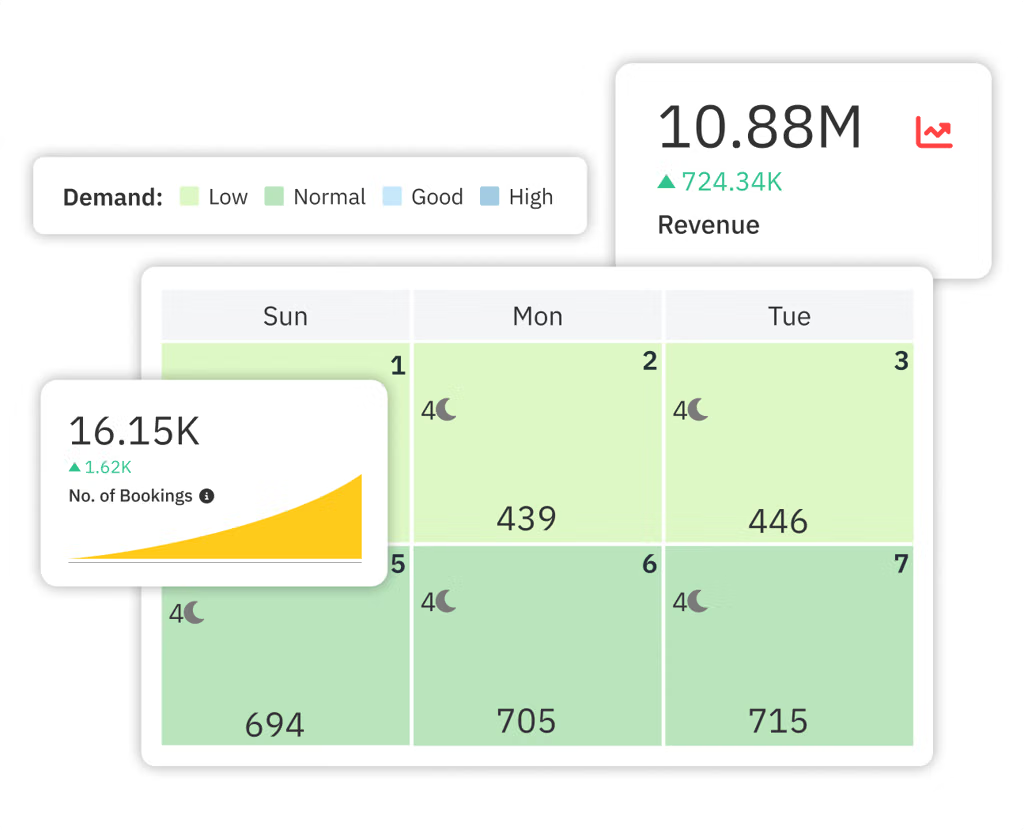
Combines live competitor rate shopping with your booking pace, occupancy and forward demand to recommend optimal rates. Recommendations include explanations, and your team can override them.
Best for: AI-assisted pricing based on real-time market conditions.
Offers pricing recommendations, competitor intelligence, demand and event signals, and rate updates across connected channels. Supports both individually approved changes and automated pricing.
Best for: Hotels wanting pricing and distribution in one platform.
Tracks competitor rates, demand and rate parity, with AI-assisted insights that help revenue teams identify pricing opportunities. It is primarily a market-intelligence tool, so confirm which revenue management system will execute the rate changes.
Best for: Detailed competitive intelligence across hotel portfolios.
Your own performance: Occupancy, booking pace, pickup and remaining inventory.
Market demand: Local events, seasonality and forward-looking demand.
Revenue objectives: Whether to raise ADR, improve occupancy or maximize RevPAR.
For example, if your competitors raise weekend rates while your booking pace accelerates, the system should consider recommending a rate increase rather than waiting for your hotel to sell out. Lighthouse specifically describes combining these signals in its pricing recommendations.
My recommendation
Start by evaluating Lighthouse Pricing and SiteMinder Dynamic Revenue Plus. Both address the full workflow from competitor monitoring to actionable pricing, rather than just providing a rate-comparison dashboard.
One important question before choosing: What type of property are you pricing?
Watch how your comp set behaves 30, 60, and 90+ days out. Are they filling up faster than you? If your comp set suddenly closes lower categories 60 days out, it's a signal to raise your rates due to rising market compression.
Tools That Shop the Comp Set & Suggest Rate Changes
What it does: Industry leader in real-time market data processing billions of data points daily. It combines live rate shopping with AI-driven pricing recommendations, multi-length-of-stay analysis, and short-term rental data tracking.[](https://www.mylighthouse.com/resources/blog/hotel-rate-shopping-tool)
What it does: Known for lightning-fast real-time data refreshes (often under a minute). It tracks parity breaches, competitor rate movements, and provides actionable alerts ("Narratives") when a competitor shifts their pricing strategy.
Yes. There are several vendors that combine competitor-price scraping/monitoring with dynamic repricing. The main distinction is whether you want a turnkey pricing platform or the underlying scraping/data infrastructure.
Prisync — Competitor price/stock monitoring plus rule-based dynamic pricing. It is particularly oriented toward e-commerce and offers automated competitor tracking.
Competera — Enterprise pricing optimization using competitive intelligence, demand modeling and automated pricing recommendations.
Wiser Solutions — Enterprise retail intelligence, competitor pricing, market intelligence and pricing recommendations; it also offers API access to pricing data.
Minderest — Multi-market competitor price monitoring and price intelligence, aimed heavily at retailers and brands.
Omnia Retail — Particularly interesting if you specifically need direct scraping of retailer websites and frequent/continuous competitive monitoring. Omnia says its platform monitors competitors 24/7 and feeds the data into pricing decisions.
Price2Spy — URL-based competitor monitoring with repricing capabilities; a more self-service option than the enterprise platforms.
Pricefy — Competitor monitoring, AI product matching and automatic repricing across e-commerce channels.
tgndata — Explicitly offers direct competitor scraping, AI product matching and near-real-time competitor price updates, including large catalogs.
Import.io — More infrastructure-oriented: extracts competitor pricing/availability data in real time and can feed it into your own pricing systems, dashboards or warehouse.
If you mean truly real-time
I'd separate the market into three categories:
What you need
Vendors to investigate
Ready-to-use dynamic repricing
Prisync, Pricefy, Competera
Enterprise competitor intelligence + pricing
Wiser, Omnia, Intelligence Node, Minderest
Actual scraping/data infrastructure to build your own pricing engine
Import.io, tgndata
One important caveat: "real-time" is used pretty loosely in this market. Some vendors scrape continuously or near-real-time, while others update once or several times per day. For example, Omnia explicitly advertises 24/7 monitoring, whereas Prisync's update frequency depends on the plan/data source.
If you're looking to build a system that automatically scrapes Amazon/Walmart/competitor sites → matches SKUs → calculates your price → changes your prices automatically, I can narrow this down to the 5 vendors that actually support that workflow, including approximate pricing and APIs.
Numerous software providers specialize in dynamic pricing, competitor price tracking, and automated repricing by scraping market data in real-time or near real-time.
Here are the top providers categorized by your specific business model and needs:
Competera : Best for mid-to-large omnichannel retailers. It continuously scrapes competitor prices, promotions, and stock levels to provide real-time AI-driven pricing recommendations and automated rule execution.
Create pricing rules — e.g. “stay 2% below Competitor A, but never below $X margin.”
Test the changes — measure conversion, revenue, margin, and market position rather than blindly matching competitors.
Platforms that do this
prisync.com is probably the closest match to what you described. It scrapes competitor websites for prices and stock, provides historical/competitive analysis, and has a dynamic-pricing engine. Its newer Competitive Pricing Recommendation feature can automatically recommend or apply a rule based on the lowest competitor price, while allowing minimum/maximum price and markup constraints.
Other platforms worth evaluating include:
Competera — more enterprise-oriented pricing optimization and pricing management.
Wiser Solutions — competitive intelligence, price monitoring, and retail analytics; its own 2025 comparison covers Wiser alongside Competera, Intelligence Node, DataWeave, Price2Spy, Prisync, and others.
Intelligence Node — large-scale retail/e-commerce competitive intelligence and pricing data.
DataWeave — competitive pricing and assortment intelligence at retailer/enterprise scale.
The important distinction
There are really three levels of software:
Level
What it does
Price monitoring
“Amazon is $4 cheaper than us.”
Price intelligence
“We're 7% above the competitive median, and this has changed over 30 days.”
Dynamic pricing
“Lower SKU X by 3%, but don't go below our $42 margin floor.”
If your goal is specifically “scrape competitors → analyze the market → tell me what my price should be → optionally change it automatically,” I'd focus on the latter two rather than a basic scraper.
For example, Prisync explicitly supports competitor scraping, price-position analysis, and automated pricing rules; its current pricing pages list plans starting at $99/month for up to 100 products, with dynamic pricing appearing in higher tiers.
If you tell me what you sell (e.g. SaaS, Amazon products, DTC, wholesale, hotels, etc.), roughly how many SKUs, and where you sell, I can narrow this down to the 3–5 platforms that actually fit your use case and compare their scraping, AI recommendations, dynamic repricing, API, and pricing.
Analyzing competitor pricing is a systematic process of gathering, cleaning, and evaluating market data to position your products effectively.
Identify Key Competitors : Categorize competitors into direct (selling identical/similar products), indirect (solving the same problem differently), and substitute alternatives.
Determine the Scope of Data : Track not just the sticker price, but the total cost structure—including shipping fees, tier-based volume discounts, subscription cadences, hidden fees, and promotional frequencies.
Map Product Equivalencies : Standardize your SKUs or service tiers against theirs to ensure you are comparing an apples-to-apples value proposition.
Analyze Historical Trends : Look at how competitor prices fluctuate over time (e.g., holiday drops, clearance cycles, or aggressive undercutting phases) rather than just taking a single snapshot.
Evaluate Value Perception : Correlate price points with customer reviews, brand equity, and feature sets to see if competitors command a premium or compete purely on volume.
Intelligence Platforms That Scrape and Suggest Price Adjustments
Several automated tools specialize in scraping competitor sites, tracking market shifts, and leveraging AI/algorithmic rules to suggest or auto-apply optimal price adjustments:
Competera : An AI-driven retail pricing platform focused on processing massive streams of competitor data to generate automated, margin-optimized pricing recommendations.
For a pricing analyst, competitive intelligence (CI) relies on a mix of direct price-scraping feeds, qualitative market shifts, and macro-financial data . The best data sources are generally categorized by how directly they feed into pricing models and strategic decisions:
1. Dedicated Price Intelligence & Web Scraping Platforms
Competitor Monitoring Tools: Platforms like Price2Spy, Prisync , and Minderest specialize in automated daily or hourly tracking of SKU-level pricing across e-commerce and retail channels.
Enterprise Retail & Analytics Suites: Platforms like Competera and DataWeave offer advanced digital shelf analytics, tracking not just prices, but also discount depths, promotions, and assortment shifts.[](https://pricetweakers.net/best-tools-for-pricing-intelligence/)
When analyzing B2B, SaaS, or large enterprise competitors, public filings reveal margin trends, discounting pressures, and average revenue per user (ARPU) shifts that spot prices won't show.
SEC/Regulatory Filings (10-Ks, 10-Qs): Use platforms like AlphaSense or SEC EDGAR to track gross margin compressions, which often signal aggressive competitor discounting or rising input costs.
Earnings Call Transcripts: Competitors frequently discuss pricing power, packaging overhauls (e.g., shifting from perpetual to subscription or usage-based pricing), and win/loss rates against your product during quarterly calls.
3. Digital Footprint & Traffic Intelligence
Understanding a competitor’s web traffic and conversion funnel helps contextualize why they might be altering their prices (e.g., a drop in traffic leading to a defensive promotion).
Similarweb: Useful for tracking competitor digital strategies, estimating their online demand, and observing how organic versus paid search shifts align with promotional periods.
Semrush: Excellent for tracking competitor paid search ad copy and historical bidding behavior on high-intent commercial keywords, which often highlights promotional messaging.
4. Qualitative Market & GTM Intelligence
Pricing is deeply psychological and tied to product positioning. Capturing market perception ensures you aren't just reacting to a low price with a lower price.
Competitor Go-to-Market Trackers: Tools like Crayon aggregate changes to competitor pricing pages, terms of service, and product launch announcements automatically.
Customer Reviews & Community Sentiment: Platforms like G2, Capterra, or niche forums help analysts gauge whether competitors are able to command a price premium or if customer dissatisfaction with value is rising.
For a pricing analyst, I’d think about competitive intelligence as a stack rather than a single source. The most useful sources depend on whether you’re trying to answer “What are competitors charging?”, “Why are they changing prices?”, or “What can customers actually get for that price?”
My recommended competitive-intelligence stack
Source
Best for
Data quality
Cost
Competitor websites & checkout flows
Actual list prices, tiers, promos, bundles
⭐⭐⭐⭐⭐
Free
Web scraping / price-monitoring tools
SiteMinder
Insights
Dynamic Revenue Plus
What it does: Combines morning competitive rate shopping (Insights ) with automated pricing recommendations (Dynamic Revenue Plus ) sent directly to your device. You can review and adjust rates across hundreds of channels with one click.
Pricefy : Offers automated competitor price monitoring and dynamic repricing with pre-built integrations for Shopify, WooCommerce, and Magento, letting you set strict profit margin guardrails.[](https://www.pricefy.io/)
Repricer.com : Built specifically for marketplace sellers on Amazon, Walmart, and eBay. It tracks competitor shifts constantly and updates listings in real-time to win the Buy Box.[](https://www.yieldigo.com/blog/best-dynamic-pricing-software/)
Bright Data : If you are building an in-house dynamic pricing engine rather than using off-the-shelf software, Bright Data provides the underlying e-commerce web scraping APIs and proxy infrastructure to pull competitor prices live without getting blocked.
To help narrow down the best choice, tell me:
What industry or platform are you selling on (e.g., Shopify, Amazon, custom enterprise site)?
Prisync : A popular e-commerce-focused competitor tracking tool that offers smart dynamic pricing features and explicit price recommendations based on your margin constraints.
Price2Spy : A robust monitoring and alert engine that tracks competitor price movements across e-commerce channels and marketplaces, widely used for pricing optimization and MAP (Minimum Advertised Price) compliance.
Skuuudle : Excellent at deep SKU matching and retail benchmarking, extracting clean competitor data to inform pricing strategy.
Customer sentiment and anecdotal pricing intelligence
⭐⭐⭐
Free
1. Competitor websites — the foundation
For most pricing teams, this should be the first-party source of truth for advertised prices.
Capture more than just the headline price:
List price
Promotional price
Quantity breaks
Subscription vs. one-time price
Product configuration
Shipping/fees
Bundles
Free trials
Minimum commitment
Geographic differences
Price-per-unit
Changes over time
For ecommerce, I'd maintain a competitor price panel that snapshots the same SKUs/configurations every day or week.
The important distinction is that you're measuring comparable offers, not merely comparing numbers.
2. Automated price monitoring
If your competitive set is large, manually checking websites doesn't scale. Price-monitoring/scraping systems can turn competitor websites into a historical dataset.
The key capability isn't simply scraping. Look for:
SKU/product matching
Historical price storage
Promotion detection
Stock/availability tracking
Variant/configuration matching
Change alerts
Geographic/IP coverage
API or data export
There are dedicated competitive-intelligence platforms as well as specialized price-monitoring products. Current competitive-intelligence offerings include tools such as Similarweb, Crayon, Klue and Prisync, although their strengths differ substantially.
For a pricing analyst, historical price data is much more valuable than a one-time competitor-price scrape.
3. Your own win/loss and sales data
This is arguably the most underrated source.
If your sales organization captures competitive information, you can build a dataset like:
Customer → our price → competitor → competitor price → product configuration → outcome
Then you can analyze:
Competitive price premiums/discounts
Win rate by price gap
Win rate by competitor
Discount required to win
Price sensitivity by segment
Competitive substitution patterns
Which products customers perceive as substitutes
This is much closer to realized competitive pricing than website prices.
I'd actually prioritize this over buying another external CI tool if the underlying CRM data is good.
4. Customer reviews and review sites
These are excellent for understanding what customers think they're getting for the money.
Look at:
G2
Capterra
Trustpilot
Amazon/retailer reviews
App stores
Industry-specific review sites
Reddit and relevant forums
You're looking for language such as:
"Too expensive"
"Worth the price"
"Cheaper alternative"
"We switched because..."
"Price increased"
"Hidden fees"
"Enterprise pricing"
"Discounted heavily"
The resulting dataset can be surprisingly useful for identifying perceived value, which is something competitor price lists can't tell you.
5. Public-company filings and earnings calls
If your competitors are public companies, this is one of the best sources for understanding pricing strategy rather than just price.
SEC EDGAR provides free access to millions of company filings, including 10-Ks, 10-Qs and 8-Ks, and the SEC also provides machine-readable APIs and datasets.
Search filings and earnings transcripts for:
"Price increase"
"Pricing"
"Price realization"
"Volume/mix"
"Revenue per customer"
"ARPU"
"Net retention"
"Discounting"
"Promotional activity"
"Elasticity"
"Competitive environment"
For example, if a competitor reports that revenue grew while unit volume was flat, that's potentially a useful pricing/mix signal even though it doesn't reveal their exact price changes.
6. Digital-intelligence data
Tools such as Similarweb can provide competitor traffic, engagement, audience and channel information. Similarweb's current competitive-intelligence offering includes traffic/engagement, customer demographics, marketing-channel information and competitor alerts.
For pricing, the interesting application is context.
For example:
Competitor raises price 8%
↓
Their traffic doesn't decline
↓
Paid-search activity increases
↓
Customer mix shifts toward higher-value segments
That's much more informative than knowing the 8% price increase alone.
7. Government data
Don't overlook government datasets. They're particularly valuable for separating competitive price movements from broader market inflation.
For the U.S., BLS's CPI is built from roughly 100,000 monthly commodity/service price observations, including prices collected from physical stores, websites and apps.
BLS import/export price data can also provide useful category-level benchmarks; BLS now incorporates administrative trade records covering a substantial share of merchandise trade value.
Useful for:
Inflation adjustment
Category price trends
Input-cost context
Import/export pricing
Commodity benchmarks
Separating industry inflation from competitor-specific pricing
8. Industry-specific sources
Depending on your industry, these can be extremely powerful.
Retail/ecommerce
Retailer websites
Marketplace data
NielsenIQ
Circana
Numerator
Shopper panels
SaaS/software
G2
Capterra
BuiltWith/Wappalyzer
Similarweb
Review sites
Competitor pricing pages
Sales-call intelligence
Travel/hospitality
OTA sites
Airline/hotel websites
STR
Amadeus
Sabre
Google Hotels/Flights
Financial services
Regulatory filings
Rate sheets
Bank websites
CFPB/public regulatory datasets
Deposit/loan rate databases
B2B/industrial
Distributor catalogs
RFQs
Procurement databases
Import/export data
Sales win/loss data
Industry associations
The data architecture I'd build
For a serious pricing function, I'd combine these into four layers:
Win/loss → transaction price → competitor → customer segment → volume → churn
That lets you answer much better questions than "What does Competitor X charge?"
For example:
"Competitor X is 6% cheaper on the headline SKU, but 3% more expensive after adjusting for configuration and service. Their price increased 4% over six months, while category prices increased 2%. Our win rate against them falls sharply once our price premium exceeds ~8%."
That's the kind of competitive intelligence that can actually feed a pricing decision.
If I were prioritizing sources
For most pricing teams, I'd start with:
Competitor websites / automated price collection
Internal transaction + win/loss data
Customer/review data
Public filings and earnings calls
Industry-specific syndicated data
Government price/cost benchmarks
Digital-intelligence data such as Similarweb
News, social and job postings as supplementary signals
The important point is that no single external source gives you "the competitor's price." The strongest setup triangulates observed prices + actual customer behavior + competitor financial disclosures + market-level price movements.
If you tell me your industry (e.g. SaaS, retail, manufacturing, travel, healthcare) and whether you're pricing B2B or B2C, I can narrow this down to the 10–15 highest-value data sources/tools, including specific vendors, APIs, approximate costs, and what each one can actually tell a pricing analyst.