We need climate risk analytics for facilities, supply chains, and insurance exposure. What products should we evaluate?
Data as of Sep 21, 2026 · Based on 50 AI responses from ChatGPT Search and Google AI Mode · See how Parse measures this
Data as of Sep 21, 2026 · Based on 50 AI responses from ChatGPT Search and Google AI Mode · See how Parse measures this
Source | Citation share |
|---|---|
 Climate Risk Assessment Tools: A Complete Overviewhttps://netzeroinsights.com/resources/climate-risk-assessment-tools-a-complete-overview/ | 3% |
 Model Climate Risk Impact on Physical Assets - FIShttps://www.fisglobal.com/products/climate-risk | 3% |
Top 10 Climate Risk Data Providers in 2026 - Correnticshttps://www.correntics.com/top-10-climate-risk-data-software-providers/ | 2% |
 Physical Climate Risk Solution | S&P Globalhttps://www.spglobal.com/sustainable1/en/solutions/physical-climate-risk-solutions | 2% |
 Physical & Transition Risk Management - Moody'shttps://www.moodys.com/web/en/us/capabilities/physical-transition-risk.html | 2% |
Continuuiti | Climate Risk Intelligence Platform & APIhttps://continuuiti.com/ | 2% |
 Jupiter Intelligence | Climate Resilience Expertshttps://www.jupiterintel.com/ | 2% |
Physical & Transition Risk Management – Moody’shttps://www.moodys.com/web/en/us/capabilities/physical-transition-risk.html | 2% |
 Climate Risk: An Essential Element of Supply Chain Risk Mapping in 2026https://climate.ai/blog/climate-risk-and-supply-chain-risk-mapping/ | 1% |
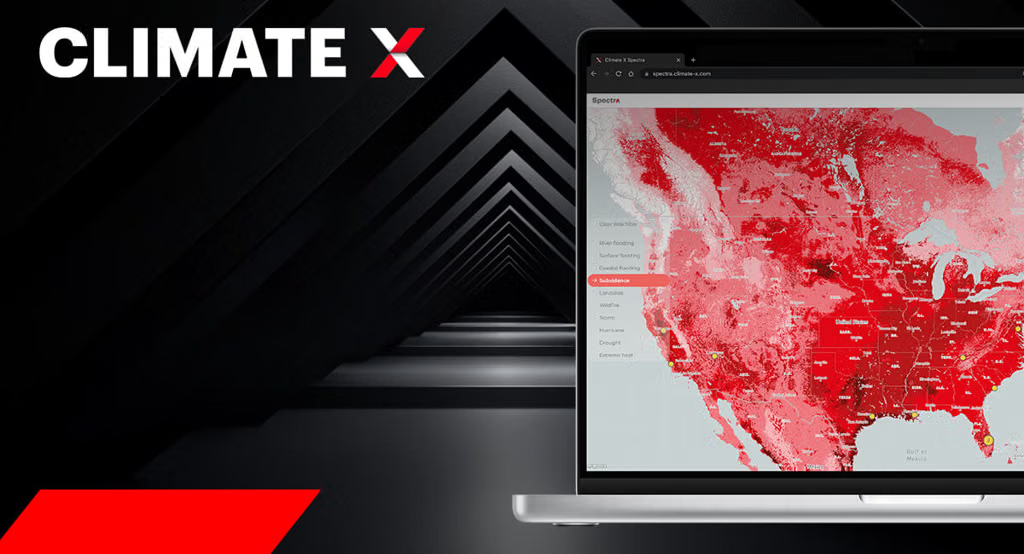 Climate X: Climate Risk Analytics to Build Resiliencehttps://www.climate-x.com/ | 1% |
Evaluating climate risk analytics requires balancing **asset-level precision** (for specific facilities), **network/geospatial mapping** (for complex supply chains), and **catastrophe/actuarial modeling** (for insurance exposure). The market features established financial data giants, specialized climate-science SaaS…
Evaluating climate risk analytics requires balancing asset-level precision (for specific facilities), network/geospatial mapping (for complex supply chains), and catastrophe/actuarial modeling (for insurance exposure).
The market features established financial data giants, specialized climate-science SaaS platforms, and property-catastrophe experts.
When setting up proof-of-concepts (PoCs), test each vendor against your specific use cases:
To help narrow down this list, could you share:
Sust Global
If the goal is **enterprise climate-risk analytics spanning owned facilities, supply-chain nodes, and insurance exposure**, I’d evaluate a mix of broad physical-risk platforms and insurance/catastrophe-model specialists rather than assuming one product will do everything. ## Shortlist Product | Facilities | Supply…
If the goal is enterprise climate-risk analytics spanning owned facilities, supply-chain nodes, and insurance exposure, I’d evaluate a mix of broad physical-risk platforms and insurance/catastrophe-model specialists rather than assuming one product will do everything.
| Product | Facilities | Supply chain | Insurance / underwriting | Financial-loss modeling | Why evaluate |
|---|---|---|---|---|---|
| Jupiter ClimateScore Global | Strong | Strong | Strong | Strong | High-resolution, multi-peril physical risk with business/financial impact translation |
| S&P Global Climanomics / Physical Risk | Strong | Strong | Moderate–strong | Strong | Broad enterprise coverage and portfolio aggregation |
| MSCI Physical Risk + Supply Chain Intelligence | Strong | Very strong | Strong | Strong | Particularly interesting if supplier mapping and portfolio analytics are priorities |
| Moody’s Climate Solutions / RMS | Strong | Moderate | Very strong | Very strong | Worth evaluating for insurance-grade catastrophe and hazard analytics |
| Verisk / AIR catastrophe modeling | Moderate | Moderate | Very strong | Very strong | Important benchmark if insurance exposure is a major requirement |
| Climate X | Strong | Moderate | Strong | Strong | Asset-level physical-risk analytics; useful challenger in a vendor bake-off |
| Cervest / Marsh McLennan climate intelligence | Strong | Strong | Strong | Strong | Enterprise asset intelligence and risk/resilience use cases |
I'd put this near the top of the enterprise bake-off. Jupiter's current ClimateScore Global offering provides asset-level, multi-peril projections and translates physical risk into financial metrics such as loss, credit and cash-flow impacts. Its supply-chain product explicitly covers manufacturing, warehousing, distribution and supplier networks.
It also offers higher-resolution analysis for engineering, resilience and insurance decisions, which is useful if you need to move from screening → financial quantification → mitigation decisions.
A strong enterprise comparison point. S&P says its physical-risk dataset covers 9 hazards, 4 climate scenarios, 2020s–2090s, more than 4 million asset locations, and financial-impact modeling across hundreds of asset types.
Its positioning explicitly spans corporations, supply chains, counterparties and financial portfolios, making it particularly relevant if you want one data architecture rather than separate facility and supplier tools.
This is especially worth testing if supply-chain exposure is as important as facility exposure. MSCI's Supply Chain Intelligence maps Tier 1/Tier 2 relationships and combines them with geospatial asset intelligence; its physical-risk products provide asset-level hazard, damage and business-interruption analytics.
I'd include this specifically for the insurance side of the problem. The catastrophe-modeling heritage matters if you're trying to connect climate scenarios with insured loss, catastrophe exposure and underwriting workflows. This is less about simply producing a climate-risk score and more about testing whether the vendor's modeling can stand up to insurance/risk-modeling requirements.
Likewise, include Verisk/AIR if insurance exposure is material. The useful comparison isn't merely "whose climate score is highest"; it's whether their catastrophe models, hazard data, vulnerability functions and loss outputs integrate with your existing insurance/risk architecture.
Rather than comparing headline scores, give each vendor the same portfolio and require them to produce:
I'd start with Jupiter + S&P + MSCI + one insurance-native catastrophe model provider (Moody's/RMS or Verisk/AIR).
That gives you four materially different approaches:
The key question in the RFP should be "Can this platform turn our actual locations and supplier network into defensible financial-loss estimates?", rather than simply "Does it provide a climate risk score?" S&P and Jupiter, for example, both explicitly emphasize financial-impact modeling rather than exposure scores alone.
If you tell me roughly how many facilities, suppliers, countries, and insured assets you have, I can turn this into a vendor scorecard/RFP with weighted criteria, required data fields, and a pilot-test design.
A strong enterprise comparison point. S&P says its physical-risk dataset covers 9 hazards, 4 climate scenarios, 2020s–2090s, more than 4 million asset locations, and financial-impact modeling across hundreds of asset types.
Its positioning explicitly spans corporations, supply chains, counterparties and financial portfolios, making it particularly relevant if you want one data architecture rather than separate facility and supplier tools.
This is especially worth testing if supply-chain exposure is as important as facility exposure. MSCI's Supply Chain Intelligence maps Tier 1/Tier 2 relationships and combines them with geospatial asset intelligence; its physical-risk products provide asset-level hazard, damage and business-interruption analytics.
I'd include this specifically for the insurance side of the problem. The catastrophe-modeling heritage matters if you're trying to connect climate scenarios with insured loss, catastrophe exposure and underwriting workflows. This is less about simply producing a climate-risk score and more about testing whether the vendor's modeling can stand up to insurance/risk-modeling requirements.
Likewise, include Verisk/AIR if insurance exposure is material. The useful comparison isn't merely "whose climate score is highest"; it's whether their catastrophe models, hazard data, vulnerability functions and loss outputs integrate with your existing insurance/risk architecture.
For an enterprise looking at **climate risk analytics across facilities, supply chains, and insurance exposure**, I would evaluate vendors by capability area rather than looking for a single “climate platform.” The strongest stacks usually combine **asset-level physical risk**, **supply-chain intelligence**,…
For an enterprise looking at climate risk analytics across facilities, supply chains, and insurance exposure, I would evaluate vendors by capability area rather than looking for a single “climate platform.” The strongest stacks usually combine asset-level physical risk, supply-chain intelligence, catastrophe/insurance analytics, and enterprise reporting.
Evaluate these for: factories, warehouses, offices, data centers, real estate portfolios, critical infrastructure.
| Product | Best fit | Capabilities to evaluate |
|---|---|---|
| S&P Global Climanomics | Corporate climate risk, real estate, finance teams | Physical risk scenarios, financial impact estimates, asset/portfolio analysis, climate scenarios. S&P Global S&P Global Marketplace |
| Jupiter Intelligence | High-resolution physical risk modeling | Flood, wildfire, heat, storm, sea-level rise modeling and asset-level analytics |
| Moody's Corporation climate risk solutions | Financial and enterprise risk teams | Hazard exposure, portfolio analytics, financial risk integration |
| Esri ArcGIS climate solutions | Organizations with GIS capability | Spatial asset inventories, hazard overlays, scenario mapping, operational dashboards. Esri |
| MSCI Physical Risk Solutions | Investors, banks, large enterprises | Asset-level physical risk, climate scenarios, portfolio exposure. MSCI |
Key evaluation questions:
Evaluate these for: suppliers, Tier 2/3 dependencies, concentration risk, business interruption.
| Product | Best fit | Capabilities to evaluate |
|---|---|---|
| MSCI Supply Chain Intelligence | Mapping hidden supplier dependencies | Tier 1/Tier 2 relationships, geographic exposure, concentration analysis. MSCI |
| Marsh McLennan Sentrisk | Insurance + supply-chain resilience programs | Supplier mapping, disruption scenarios, geospatial risk overlays, insurance-oriented outputs. Marsh |
| Interos | Operational supply-chain monitoring | Supplier risk networks, disruption monitoring |
| Everstream Analytics | Real-time supply-chain disruption monitoring | Weather, logistics, geopolitical and supplier disruption alerts |
Key evaluation questions:
Evaluate these for: insured asset portfolios, PDBI/BI exposure, underwriting discussions, captives.
| Product | Best fit | Capabilities to evaluate |
|---|---|---|
| Moody's RMS | Catastrophe modeling | Probabilistic hazard modeling, loss estimates, insurance portfolio analytics |
| Verisk catastrophe solutions | Insurers and risk managers | Natural catastrophe models and exposure analytics |
| S&P Global Climanomics | Corporate risk transfer conversations | Climate financial impact analysis, insurance-adjusted loss concepts. S&P Global Marketplace |
| BlackRock Aladdin Climate | Investment and portfolio risk | Climate scenario analysis, stress testing, risk integration. BlackRock |
Key evaluation questions:
Useful if you need ongoing alerts after the initial assessment.
| Product | Use case |
|---|---|
| Continuity | Site intelligence, disruption monitoring, value-at-risk analysis. Continuuiti |
| NatureEdge | Operational climate monitoring and resilience workflows. NatureEdge - Climate Risk Analytics |
| ABGALIS | Broader enterprise risk intelligence combining climate and other emerging risks. ABGALIS |
Start with:
Start with:
Start with:
Weighting example:
Before selecting, run a pilot using:
That will usually reveal whether a platform is producing actionable risk intelligence or just hazard maps.
Evaluating climate risk analytics requires balancing physical asset granularity (for your facilities), multi-tier mapping (for your supply chains), and actuarial/portfolio loss modeling (for your insurance exposure). The top enterprise-grade products and platforms to evaluate span these exact use cases: - [Jupiter…
Evaluating climate risk analytics requires balancing physical asset granularity (for your facilities), multi-tier mapping (for your supply chains), and actuarial/portfolio loss modeling (for your insurance exposure).
The top enterprise-grade products and platforms to evaluate span these exact use cases:
To help narrow down this list, tell me:
Yes. I’d evaluate the market as **three overlapping product categories**, rather than looking for one “climate risk platform” to do everything. ### Shortlist Product | Facilities / asset risk | Supply-chain risk | Insurance / financial exposure | Best reason to evaluate
Yes. I’d evaluate the market as three overlapping product categories, rather than looking for one “climate risk platform” to do everything.
| Product | Facilities / asset risk | Supply-chain risk | Insurance / financial exposure | Best reason to evaluate |
|---|---|---|---|---|
| jupiterintel.com | ★★★★★ | ★★★★☆ | ★★★★★ | Strong end-to-end physical-risk → financial-impact workflow |
| moodys.com | ★★★★★ | ★★★★☆ | ★★★★★ | Particularly compelling if insurance, credit, or financial risk is central |
| msci.com | ★★★★☆ | ★★★★★ | ★★★★☆ | Excellent portfolio + supply-chain intelligence |
| spglobal.com | ★★★★★ | ★★★★☆ | ★★★★☆ | Strong asset-level financial impact and enterprise data ecosystem |
| climate-x.com | ★★★★★ | ★★★☆☆ | ★★★★☆ | Worth testing for high-resolution asset-level physical risk |
| verisk.com | ★★★★☆ | ★★★☆☆ | ★★★★★ | Important benchmark if actual catastrophe/insurance modeling matters |
| cervest.earth | ★★★★☆ | ★★★★☆ | ★★★☆☆ | Enterprise asset intelligence and climate-risk management |
Jupiter would be my first call if the objective is to connect facility exposure → operational/financial impact → adaptation → insurance/capital decisions. Its current platform explicitly covers assets, portfolios and supply chains, with financial-impact modeling, stress testing and adaptation ROI.
Moody’s is especially important if this ultimately feeds insurance underwriting, portfolio risk, credit, or enterprise risk management. Its physical-risk offering covers facility-level damage/disruption and integrates climate variables with financial and risk-management workflows; its insurance solution reports more than 10 million facilities with forward-looking damage-rate analytics across eight hazards.
MSCI deserves a head-to-head if supply chain is a major requirement. Its Supply Chain Intelligence maps Tier 1/Tier 2 dependencies, geographic exposure and concentration risk, while its broader platform adds physical-risk analytics and geospatial asset intelligence.
Don't evaluate them primarily on pretty hazard maps. Give every vendor the same test portfolio and require them to produce:
The distinction between hazard score and economic loss is particularly important. Jupiter, for example, explicitly positions its product around translating physical exposure into financial metrics and stress-test outcomes rather than stopping at exposure scores.
I'd add Verisk/AIR-style catastrophe modeling to the evaluation even if it isn't your primary climate platform. The question becomes whether you need climate-risk intelligence or an actuarial catastrophe model capable of supporting underwriting, pricing and capital decisions.
For example, Moody's current insurance offering combines physical-risk analytics with its broader insurance-risk ecosystem, while Jupiter explicitly markets physical-risk analytics for underwriting and insurance decisions.
I'd run a 6-vendor bake-off:
Then score them 25% facility-level physical risk, 20% financial-loss modeling, 20% supply-chain intelligence, 20% insurance/underwriting usefulness, and 15% data/API/methodology transparency.
The biggest strategic decision is whether you're building this primarily for corporate risk management, supply-chain resilience, or insurance underwriting/portfolio exposure. That choice changes the winner substantially.
Don't evaluate them primarily on pretty hazard maps. Give every vendor the same test portfolio and require them to produce:
When evaluating climate risk analytics across facilities, complex supply chains, and insurance/underwriting portfolios, you need solutions that combine **high-resolution physical hazard modeling** with **financial loss translation**.[](https://www.mitigasolutions.com/compare/earthscan-vs-jupiter)…
When evaluating climate risk analytics across facilities, complex supply chains, and insurance/underwriting portfolios, you need solutions that combine high-resolution physical hazard modeling with financial loss translation.
The market is divided into enterprise climate intelligence platforms, heavy-duty insurance/catastrophe modelers, and supply-chain-specific disruption mappers.
To help narrow down this list, could you share:
Adapt
**You should evaluate enterprise climate analytics platforms that specialize in geospatial asset-level hazard modeling, financial loss estimation, and supply chain cascading risk** **.** Selecting the right product depends on whether your focus is deep insurance underwriting, corporate facility resilience, or…
You should evaluate enterprise climate analytics platforms that specialize in geospatial asset-level hazard modeling, financial loss estimation, and supply chain cascading risk . Selecting the right product depends on whether your focus is deep insurance underwriting, corporate facility resilience, or multi-tier supply chain mapping.
| Product / Provider | Primary Strengths | Best Suited For |
|---|---|---|
Jupiter Intelligence (ClimateScore) | High-resolution physical risk analytics for flood, wind, heat, wildfire, and drought at the asset-level. | Insurance underwriting, banking portfolio stress-testing, and infrastructure. |
| Moody's RMS | Catastrophe modeling combined with forward-looking climate conditioning and physical risk analytics. | Property & casualty insurance, reinsurance, and deep financial loss modeling. |
Climate X (Spectre) | Visual, asset-specific risk metrics and financial loss estimates mapped across multiple climate scenarios. | Real estate portfolios, asset management, and organizations needing rapid, user-friendly deployment. |
| XDI (Cross Dependency Initiative) | Physical risk and financial cost quantification mapped directly to physical infrastructure assets. | Local governments, property portfolios, and heavy industry/infrastructure asset owners. |
Sustainalytics (Physical Climate Risk Metrics) | Geospatial facility-level analysis tracking direct physical loss and indirect business disruption metrics. | Corporate sustainability reporting, supply chain exposure screening, and investor due diligence. |
To help narrow down this list, could you share:
I can refine the recommendations and provide specific technical integration notes for your shortlisted options.
Yes. I’d evaluate the market as **three layers rather than looking for one “climate-risk platform”**: asset/facility intelligence, supply-chain/network disruption, and insurance/catastrophe analytics. ### Shortlist Vendor / product | Facilities & assets | Supply chain | Insurance / underwriting | Financial loss…
Yes. I’d evaluate the market as three layers rather than looking for one “climate-risk platform”: asset/facility intelligence, supply-chain/network disruption, and insurance/catastrophe analytics.
| Vendor / product | Facilities & assets | Supply chain | Insurance / underwriting | Financial loss modeling | Best reason to evaluate |
|---|---|---|---|---|---|
| Jupiter Intelligence — ClimateScore Global | ★★★★★ | ★★★★★ | ★★★★☆ | ★★★★★ | Strong enterprise physical-risk + business-impact orientation |
| MSCI — Physical Risk / GeoSpatial Asset Intelligence + Supply Chain Intelligence | ★★★★★ | ★★★★★ | ★★★★☆ | ★★★★☆ | Broadest combination of asset, company, portfolio and supply-chain analytics |
| S&P Global — Climanomics / Physical Risk Analytics | ★★★★★ | ★★★★☆ | ★★★★☆ | ★★★★★ | Strong asset-level financial-impact analytics and large coverage |
| Moody's — Physical & Transition Risk | ★★★★☆ | ★★★★☆ | ★★★★★ | ★★★★★ | Particularly interesting if credit, counterparty and insurance risk are central |
| Verisk — climate/catastrophe analytics | ★★★★☆ | ★★★☆☆ | ★★★★★ | ★★★★★ | Worth including for insurance-grade catastrophe modeling |
I'd put Jupiter near the top if your objective is “show me how climate hazards translate into operational and financial losses.” Its ClimateScore Global offering covers acute and chronic physical risk across supply and distribution networks, including manufacturing and warehousing, while its broader platform translates hazards into financial metrics.
Test it on: facility-level loss, business interruption, supplier disruption, scenario analysis, and whether its financial translation is credible enough for finance/risk committees.
MSCI is particularly compelling because it now combines GeoSpatial Asset Intelligence, Physical Risk Solutions and Supply Chain Intelligence. Its supply-chain product maps Tier 1/2 dependencies, while its physical-risk products can drill down to individual structures and incorporate damage and business-interruption estimates.
This is probably the best benchmark platform if you need one vendor to span facilities, counterparties, portfolios and supply chains.
S&P's Climanomics is explicitly designed to quantify financial impacts on physical assets and aggregate them to portfolio level. Its current physical-risk dataset covers 4M+ asset locations, nine hazards, four scenarios and multiple future decades.
I'd test it particularly hard on loss estimates and aggregation, rather than just hazard scores.
Moody's deserves a seat at the table if your climate-risk program touches credit, counterparties, lending or insurance. Its offering explicitly covers physical damage/disruption to facilities and customer assets and integrates physical/transition variables into financial-risk workflows.
I'd include Verisk even if it isn't your preferred enterprise climate platform. The reason is insurance-grade catastrophe modeling. If you're trying to understand insured loss, underwriting exposure, PML/AAL and catastrophe accumulation, you want a specialist benchmark against which to compare the broader climate platforms.
Don't ask vendors simply to demonstrate their dashboards. Give each the same test portfolio:
Then score vendors on five things:
If you want a tight 4-vendor bake-off, I'd start with:
Jupiter + MSCI + S&P Global + Verisk
Then add Moody's if credit/financial-counterparty exposure is a major requirement.
The interesting comparison isn't really “who has the best climate map?” It's who can most defensibly turn a facility or supply-chain exposure into a number your operations, treasury, risk, and insurance teams can actually use. MSCI's methodology, for example, explicitly separates asset mapping, hazard exposure, financial-impact modeling and present-value calculation—a useful framework for evaluating everyone else.
If you tell me whether you're evaluating this for a corporate risk team, insurer/broker, private-equity portfolio, or bank, I can narrow this to a vendor scorecard with pricing model, data coverage, APIs, scenarios, insurance use cases, and key diligence questions.
S&P's Climanomics is explicitly designed to quantify financial impacts on physical assets and aggregate them to portfolio level. Its current physical-risk dataset covers 4M+ asset locations, nine hazards, four scenarios and multiple future decades.
I'd test it particularly hard on loss estimates and aggregation, rather than just hazard scores.
Moody's deserves a seat at the table if your climate-risk program touches credit, counterparties, lending or insurance. Its offering explicitly covers physical damage/disruption to facilities and customer assets and integrates physical/transition variables into financial-risk workflows.
Yes. I’d evaluate the market as **three overlapping layers** rather than looking for one “climate-risk platform”: **asset/facility physical risk**, **supply-chain/network disruption**, and **financial/insurance loss modeling**. ### Shortlist to evaluate Product / vendor | Facilities | Supply chain | Insurance /…
Yes. I’d evaluate the market as three overlapping layers rather than looking for one “climate-risk platform”: asset/facility physical risk, supply-chain/network disruption, and financial/insurance loss modeling.
| Product / vendor | Facilities | Supply chain | Insurance / financial exposure | Best fit |
|---|---|---|---|---|
| Jupiter Intelligence | Excellent | Strong | Strong | Enterprise physical-risk + financial impact |
| MSCI Physical Risk + Supply Chain Intelligence | Excellent | Excellent | Strong | Integrated enterprise/portfolio analytics |
| Moody's Climate Solutions | Excellent | Good | Excellent | Insurance, credit, financial-risk use cases |
| Cervest EarthScan | Excellent | Strong | Good | Corporate asset + supply-chain resilience |
| Climate X | Excellent | Good | Strong | Asset-level physical-risk screening |
My first-round bake-off would be Jupiter + MSCI + Moody's + Cervest. Add Climate X if very granular asset-level modeling is a major requirement.
1. Jupiter — strongest candidate for operational decision-making
Jupiter is particularly interesting if your objective is more than disclosure: it offers high-resolution physical-risk projections, financial/operational impact modeling, and resilience/adaptation analysis. It explicitly supports facilities, infrastructure, supply chains and insurance-related decisions.
2. MSCI — strongest integrated portfolio/data option
MSCI has a particularly compelling combination: its Physical Risk Solutions can go down to individual assets/buildings, while Supply Chain Intelligence models Tier 1/Tier 2 relationships and geographic dependencies. That makes it attractive if you want one data ecosystem spanning corporate assets, portfolios and supply chains.
3. Moody's — strongest if insurance/financial risk is central
Moody's brings natural-catastrophe modeling and financial analytics together. Its climate offering covers floods, heat, wildfire, hurricanes, sea-level rise and water stress, with facility-level damage-rate analytics; it also has specific insurance capabilities including net-zero underwriting.
4. Cervest — strong corporate resilience alternative
Cervest's EarthScan is worth testing for asset-centric climate screening, scenario analysis, resilience planning, due diligence and supplier management. It's particularly relevant if the buyer is an enterprise risk/sustainability/operations team rather than primarily a bank or insurer.
If by “insurance exposure” you mean “Which of our facilities are likely to generate losses / become difficult or expensive to insure?”, the above platforms are highly relevant.
If you mean full catastrophe-modeling and insurance portfolio analytics—e.g. probabilistic loss curves, exceedance-probability curves, reinsurance structures, treaty analytics, underwriting pricing—I'd broaden the evaluation to dedicated catastrophe-model vendors such as Verisk, Moody's RMS, and Gallagher Re's modeling ecosystem. That's a somewhat different category from corporate climate-risk analytics.
This distinction matters because natural-disaster losses are increasingly creating both physical exposure and insurance-availability/affordability issues.
Give every vendor the same 100–500 real facilities + supplier locations and require them to produce:
If I were narrowing it to three: Jupiter for operational/physical risk, MSCI for enterprise portfolio + supply-chain breadth, and Moody's for insurance/financial risk. That trio should reveal pretty quickly which capability you actually need.
My first-round bake-off would be Jupiter + MSCI + Moody's + Cervest. Add Climate X if very granular asset-level modeling is a major requirement.
1. Jupiter — strongest candidate for operational decision-making
Jupiter is particularly interesting if your objective is more than disclosure: it offers high-resolution physical-risk projections, financial/operational impact modeling, and resilience/adaptation analysis. It explicitly supports facilities, infrastructure, supply chains and insurance-related decisions.
2. MSCI — strongest integrated portfolio/data option
MSCI has a particularly compelling combination: its Physical Risk Solutions can go down to individual assets/buildings, while Supply Chain Intelligence models Tier 1/Tier 2 relationships and geographic dependencies. That makes it attractive if you want one data ecosystem spanning corporate assets, portfolios and supply chains.
3. Moody's — strongest if insurance/financial risk is central
Moody's brings natural-catastrophe modeling and financial analytics together. Its climate offering covers floods, heat, wildfire, hurricanes, sea-level rise and water stress, with facility-level damage-rate analytics; it also has specific insurance capabilities including net-zero underwriting.
4. Cervest — strong corporate resilience alternative
Cervest's EarthScan is worth testing for asset-centric climate screening, scenario analysis, resilience planning, due diligence and supplier management. It's particularly relevant if the buyer is an enterprise risk/sustainability/operations team rather than primarily a bank or insurer.
If by “insurance exposure” you mean “Which of our facilities are likely to generate losses / become difficult or expensive to insure?”, the above platforms are highly relevant.
If you mean full catastrophe-modeling and insurance portfolio analytics—e.g. probabilistic loss curves, exceedance-probability curves, reinsurance structures, treaty analytics, underwriting pricing—I'd broaden the evaluation to dedicated catastrophe-model vendors such as Verisk, Moody's RMS, and Gallagher Re's modeling ecosystem. That's a somewhat different category from corporate climate-risk analytics.
This distinction matters because natural-disaster losses are increasingly creating both physical exposure and insurance-availability/affordability issues.
Give every vendor the same 100–500 real facilities + supplier locations and require them to produce:
To evaluate climate risk analytics across facilities, extended supply chains, and insurance portfolios, you should focus on `enterprise platforms that combine asset-level geospatial hazard data with financial and operational scenario modeling`.[](https://www.fisglobal.com/products/climate-risk)…
To evaluate climate risk analytics across facilities, extended supply chains, and insurance portfolios, you should focus on enterprise platforms that combine asset-level geospatial hazard data with financial and operational scenario modeling.
The top software products and data providers to evaluate include Moody’s Climate Solutions, MSCI Climate Risk Center, Correntics, Sustainalytics Physical Climate Risk Metrics , and the FIS Climate Risk Financial Modeler.
Top Climate Risk Analytics Products
| Product / Provider | Core Focus & Strengths | Best Suited For |
|---|---|---|
| Moody’s | Comprehensive physical and transition risk scoring, asset-level geocoding, and financial loss estimation. | Financial impact assessment, portfolio underwriting, and institutional risk management. |
| MSCI Climate Risk Center | Extensive climate value-at-risk (VaR) metrics, asset-level mapping, and regulatory alignment. | Enterprise portfolio screening, investment due diligence, and asset valuation. |
| Correntics | Real-time global supply chain mapping and climate-peril disruption tracking. | Supply chain resilience, vendor tier monitoring, and logistics risk mitigation. |
| Sustainalytics | Granular physical risk metrics covering 8 major hazards and direct/indirect disruption losses. | Corporate sustainability reporting, investor disclosures, and asset exposure screening. |
| FIS Climate Risk Financial Modeler | Scenario-based financial stress-testing tying physical asset damage directly to insurance and coverage structures. | Insurance contract analysis, "what-if" facility damage trends, and balance sheet resilience. |
Key Evaluation Criteria
If you'd like, let me know:
I can narrow down which platform fits your exact integration requirements.