What's the best platform for assessing physical climate risk to assets?
Data as of Sep 21, 2026 · Based on 50 AI responses from ChatGPT Search and Google AI Mode · See how Parse measures this
Data as of Sep 21, 2026 · Based on 50 AI responses from ChatGPT Search and Google AI Mode · See how Parse measures this
Source | Citation share |
|---|---|
 Top 5 Climate Risk Assessment Software Platforms in 2026https://www.socialsuitehq.com/articles/top-5-climate-risk-assessment-software-platforms-in-2026 | 4% |
 Portfolio and Asset Management | Jupiterhttps://www.jupiterintel.com/solutions/portfolio-asset-management | 3% |
Top 10 Climate Risk Data Providers in 2026 - Correnticshttps://www.correntics.com/top-10-climate-risk-data-software-providers/ | 3% |
 Physical & Transition Risk Management - Moody'shttps://www.moodys.com/web/en/us/capabilities/physical-transition-risk.html | 3% |
 The 9 Best Climate Risk Assessment Tools for 2025https://climate.ai/blog/top-climate-risk-assessment-tools/ | 3% |
 Physical Risk Solutions | MSCIhttps://www.msci.com/data-and-analytics/climate-solutions/physical-risk-solutions | 2% |
 Physical Climate Risk Metrics - Sustainalyticshttps://www.sustainalytics.com/investor-solutions/climate-solutions/physical-climate-risk-metrics | 2% |
How to Choose the Right Climate Risk Platform for Youhttps://www.mitigasolutions.com/blog/how-to-choose-climate-risk-platform | 2% |
 Environment, Climate & Nature Risks | S&P Globalhttps://www.spglobal.com/market-intelligence/en/solutions/products/physical-risk | 2% |
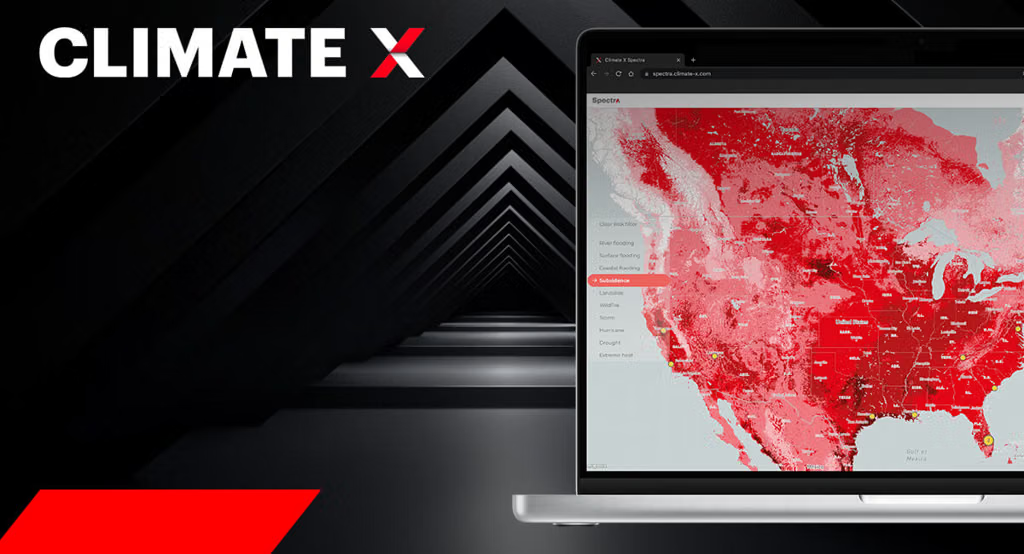 Climate X: Climate Risk Analytics to Build Resiliencehttps://www.climate-x.com/ | 2% |
There is no single "best" platform, as the right choice depends on whether your assets are corporate portfolios, real estate, or large-scale public infrastructure, but **XDI (Cross Dependency Initiative)**, **Climate X** , and **Moody's / Four Twenty Seven** are widely considered the **leading enterprise platforms**…
There is no single "best" platform, as the right choice depends on whether your assets are corporate portfolios, real estate, or large-scale public infrastructure, but XDI (Cross Dependency Initiative), Climate X , and Moody's / Four Twenty Seven are widely considered the leading enterprise platforms for asset-level physical climate risk.
Different platforms serve different organizational priorities, technical requirements, and budgets.
| Platform | Best Suited For | Core Strength | Key Hazards Covered |
|---|---|---|---|
| XDI (Cross Dependency Initiative) | Infrastructure, banking, and real estate | Translating physical hazard into monetary damage costs | Flood, wind, coastal inundation, heat |
| Climate X | Financial institutions & beginners | User-friendly SaaS with high-resolution asset mapping | Surface water, groundwater, coastal flooding, wind |
| Moody's (Four Twenty Seven) | Global investors & corporate reporting | Deep integration with financial credit ratings and macroeconomic data | Heat stress, sea level rise, hurricanes, wildfire |
| S&P Global Sustainable1 | Enterprise compliance & ESG disclosures | Massive corporate database linked to ownership structures | Multi-hazard asset screening |
To help narrow down the ideal platform, let me know:
If you mean **enterprise-grade platforms for assessing physical climate risk at individual asset/location level**, there isn't one universal “best.” The strongest choices depend on whether you care most about **financial loss modeling, geospatial hazard resolution, insurance/catastrophe modeling, or portfolio…
If you mean enterprise-grade platforms for assessing physical climate risk at individual asset/location level, there isn't one universal “best.” The strongest choices depend on whether you care most about financial loss modeling, geospatial hazard resolution, insurance/catastrophe modeling, or portfolio workflows.
| Platform | Particularly strong for | What stands out |
|---|---|---|
| Jupiter Intelligence | Asset owners, infrastructure, PE, banks | Very high-resolution modeling, asset-level multi-peril analysis, financial translation, and adaptation/ROI analysis. Jupiter says ClimateScore Global provides 90-meter analysis globally and projections through 2100. Jupiter Intelligence Jupiter Intelligence |
| S&P Global Climanomics | Large corporate/financial portfolios | Broad asset coverage and strong financial-impact framework. Its current offering covers millions of asset locations, multiple hazards/scenarios, and >250 asset types. S&P Global S&P Global |
| Moody's Climate on Demand | Financial institutions, insurance, risk teams | Particularly compelling if you want climate analytics integrated with catastrophe-modeling infrastructure. It combines climate models with Moody's RMS catastrophe models and offers financial-impact metrics at asset/facility level. RMS Developer Portal RMS Developer Portal |
For physical risk to a portfolio of real assets, I'd put Jupiter and S&P Global Climanomics at the top of the evaluation list, with Moody's Climate on Demand especially worth considering if your organization already uses Moody's/RMS catastrophe-risk infrastructure.
The distinction is important:
If you're actually selecting a vendor, I would not choose based on the headline risk score. I'd run the same 20–50 assets through each platform and compare hazard resolution → vulnerability assumptions → expected loss → tail loss → scenario sensitivity → financial translation → adaptation modeling. That's where the meaningful differences tend to emerge.
If you tell me what assets you're assessing (e.g. real estate, infrastructure, factories, data centers, renewable energy, or an investment portfolio), I can give you a much more specific comparison.
The distinction is important:
If by “best” you mean **best suited to assessing physical climate risk at the individual-asset level**, rather than simply producing a climate score, I’d put **Jupiter Intelligence, Moody’s, MSCI, and XDI** on the shortlist. There isn’t a universally best platform—the right choice depends heavily on whether you need…
If by “best” you mean best suited to assessing physical climate risk at the individual-asset level, rather than simply producing a climate score, I’d put Jupiter Intelligence, Moody’s, MSCI, and XDI on the shortlist. There isn’t a universally best platform—the right choice depends heavily on whether you need engineering-grade hazard analysis, financial-loss modeling, portfolio analytics, or disclosure workflows.
| Platform | Particularly strong for | Asset-level detail | Financial impact | Adaptation / resilience |
|---|---|---|---|---|
| Jupiter Intelligence | Corporates, infrastructure, banks, insurers, PE | Very high | Strong | Strong |
| Moody’s | Banks, insurers, credit & portfolio risk | High | Very strong | Moderate |
| MSCI | Institutional investors & portfolio analytics | High | Strong | Moderate |
| XDI | Detailed built-asset physical risk / engineering analysis | Very high | Strong | Strong |
Jupiter is probably the most compelling all-around platform for a large asset owner or financial institution. Its ClimateScore Global provides 90-meter global analysis, asset-level multi-hazard projections, scenario/time-horizon analysis, and financial metrics; Jupiter also has explicit adaptation/ROI capabilities.
Moody’s becomes particularly compelling when the climate assessment needs to feed directly into credit, insurance, portfolio, or financial-risk workflows. Its models combine hazard, exposure and vulnerability to estimate financial impacts, drawing on Moody’s RMS catastrophe-modeling capabilities.
MSCI is worth considering if you're already operating heavily in the institutional-investment/ESG data ecosystem. Its Physical Risk Metrics can assess individual assets or portfolios at an address/coordinate level and include damage estimates, business interruption and adaptation information.
XDI is especially interesting when your priority is granular physical damage to buildings and infrastructure, rather than primarily portfolio-level climate scoring. A 2026 Systemiq/C2ES review describes XDI as focused on highly granular asset-level risk and damage implications and on quantifying the financial benefits of resilience measures.
Don't compare them on the headline “risk score.” Ask each vendor to take the same 10–20 real assets and demonstrate:
That last group is important: two platforms can give very different answers even when they both call themselves “asset-level.”
If you tell me what kind of assets you're assessing (e.g. real estate, infrastructure, manufacturing sites, energy assets, loan collateral, or a PE portfolio), how many assets, and whether you need financial loss estimates vs. hazard screening, I can narrow this to 2–3 platforms and compare them on the dimensions that matter for your use case.
MSCI is worth considering if you're already operating heavily in the institutional-investment/ESG data ecosystem. Its Physical Risk Metrics can assess individual assets or portfolios at an address/coordinate level and include damage estimates, business interruption and adaptation information.
XDI is especially interesting when your priority is granular physical damage to buildings and infrastructure, rather than primarily portfolio-level climate scoring. A 2026 Systemiq/C2ES review describes XDI as focused on highly granular asset-level risk and damage implications and on quantifying the financial benefits of resilience measures.
Determining the "best" platform for assessing physical climate risk to assets depends heavily on your specific industry, portfolio scale, and whether you need high-level portfolio screening or deep engineering-level financial loss metrics. The market leaders are distinguished by their specific strengths: 1. **[Jupiter…
Determining the "best" platform for assessing physical climate risk to assets depends heavily on your specific industry, portfolio scale, and whether you need high-level portfolio screening or deep engineering-level financial loss metrics.
The market leaders are distinguished by their specific strengths:
To help narrow down which platform fits your workflow, tell me:
There is no single "best" platform, as the right choice depends heavily on your industry, portfolio size, and whether you need data translated into financial loss metrics or raw climate hazard scores.[](https://www.correntics.com/top-10-climate-risk-data-software-providers/)…
There is no single "best" platform, as the right choice depends heavily on your industry, portfolio size, and whether you need data translated into financial loss metrics or raw climate hazard scores.
The top platforms for asset-level physical climate risk assessment are categorized below by their core strengths:
To help narrow down the ideal platform, tell me:
If you mean **assessing physical climate risk at the individual asset/site level**—e.g., buildings, infrastructure, factories, real estate, or portfolio holdings—my current shortlist would be: Platform | Best for | My take --- | --- | ---
If you mean assessing physical climate risk at the individual asset/site level—e.g., buildings, infrastructure, factories, real estate, or portfolio holdings—my current shortlist would be:
| Platform | Best for | My take |
|---|---|---|
| Jupiter Intelligence | High-quality, forward-looking asset & portfolio risk | Best overall for serious physical-risk analysis |
| MSCI Physical Risk | Investors, banks, asset managers already using MSCI | Best for integration with financial portfolios |
| S&P Global Climanomics | Portfolio screening and financial impact | Strong, relatively straightforward option |
| Moody's | Insurance/property underwriting and natural-catastrophe risk | Particularly strong where catastrophe/insurance analytics matter |
Jupiter Intelligence is probably the platform I'd evaluate first if the objective is decision-grade physical climate risk at the asset level.
Its ClimateScore Global provides high-resolution projections across global locations, while its more detailed flood products can get down to asset-specific analysis. It supports multiple scenarios and time horizons and translates hazards into business/financial impacts rather than stopping at a simple "high/medium/low risk" score.
That's important because a useful asset-risk platform should answer questions like:
Jupiter is particularly strong on the last few questions.
MSCI is arguably the better choice if you're a financial institution already operating inside the MSCI ecosystem. Its current physical-risk offering combines geospatial asset identification with hazard, vulnerability, damage and business-interruption analytics, and can drill down to individual building footprints.
MSCI says its asset-level system covers 31 hazard types and millions of locations, which makes it attractive for large-scale portfolio screening.
If you're doing insurance underwriting / catastrophe modeling, I would not automatically pick Jupiter. I'd put Moody's/RMS and specialized catastrophe models into the evaluation because their value proposition is different from a general corporate climate-risk platform. Moody's, for example, emphasizes address-level property characteristics, condition intelligence, geospatial context and catastrophe-risk signals for underwriting.
If you tell me what kind of assets you are assessing (real estate, infrastructure, PE portfolio companies, manufacturing sites, utilities, etc.) and whether you need hazard scores vs. dollar loss/financial impact, I can give you a much more specific top 3 with pricing, resolution, hazards, scenarios, APIs, and pros/cons.
The "best" platform depends on your use case. There isn't a single leader across all industries, but there is a clear group of enterprise-grade platforms that consistently appear in large financial institutions, insurers, infrastructure investors, and Fortune 500 companies. Here's how I'd break it down: Use case |…
The "best" platform depends on your use case. There isn't a single leader across all industries, but there is a clear group of enterprise-grade platforms that consistently appear in large financial institutions, insurers, infrastructure investors, and Fortune 500 companies.
Here's how I'd break it down:
| Use case | Best choices | Why |
|---|---|---|
| Enterprise asset & portfolio risk | S&P Global Climanomics | Strong financial impact modeling, asset-level analysis, portfolio aggregation, scenario analysis. S&P Global S&P Global |
| Banks & asset managers | MSCI Physical Risk | Excellent integration with investment workflows, issuer analysis, building-level exposure, Climate VaR metrics. MSCI MSCI |
| Insurance & catastrophe modeling | Moody's RMS Climate on Demand | Built on decades of catastrophe modeling expertise, widely used in insurance. Earthian AI |
| Infrastructure & real estate | Climate X (Spectra) | High-resolution asset-level modeling with financial loss estimates and adaptation analysis. OECD Mitiga Solutions |
| Utilities & energy | Jupiter Intelligence | Strong physical hazard modeling and operational decision support. ReqoData Mitiga Solutions |
| Engineering & resilience planning | XDI | Detailed asset vulnerability and damage estimation for physical infrastructure. ReqoData Mitiga Solutions |
1. S&P Global Climanomics — Best overall
If I had to recommend one platform for most large organizations, this would be it.
Strengths:
It's especially strong if you're asking questions like:
S&P Global S&P Global### 2. MSCI Physical Risk
MSCI is particularly compelling for institutional investors.
Advantages include:
It's a favorite among pension funds, sovereign wealth funds, and asset managers.
Climate X has become one of the more innovative newer entrants.
Notable features:
If you're evaluating thousands of properties or infrastructure assets, it's worth a close look.
OECD Mitiga Solutions### 4. Moody's RMS
If your organization already relies on catastrophe models for insurance or lending, RMS is a natural extension.
Best for:
It has one of the longest histories in catastrophe risk modeling.
Earthian AI### Important evaluation criteria
When comparing platforms, I'd look beyond the marketing and ask about:
If you can share your context—for example, whether you're assessing manufacturing plants, commercial real estate, renewable energy assets, infrastructure, or investment portfolios—I can narrow the recommendation to the platforms that best fit that specific asset class and workflow.
There is **no single "best" universal platform** for assessing physical climate risk to assets, as the right choice depends heavily on your industry, asset type, and whether you need macro financial modeling or hyper-localized asset engineering data. Leading platforms specialize in different use cases, offering…
There is no single "best" universal platform for assessing physical climate risk to assets, as the right choice depends heavily on your industry, asset type, and whether you need macro financial modeling or hyper-localized asset engineering data.
Leading platforms specialize in different use cases, offering distinct advantages for asset-level evaluation.
| Platform | Best For | Core Strength |
|---|---|---|
| XDI (Cross Dependency Initiative) | Infrastructure & Real Estate | Quantifies physical risks explicitly in monetary/cost terms at the individual asset level. |
| Climate X | Ease of Use & Reporting | User-friendly SaaS platform mapping probabilities of multi-hazards up to 2100. |
| Moody's | Financial & Credit Risk Integration | Seamlessly blends physical hazard data with corporate credit, banking, and global regulatory frameworks. |
| Sustainalytics | Investor Portfolio Exposure | Aggregates facility-level data into broad company-wide exposure signals for equities and portfolios. |
To help narrow down the ideal platform for your organization, tell me:
`There is no single "best" platform` , as the right choice depends on your specific asset types, portfolio size, and whether you need financial loss quantification or regulatory reporting. Top-tier platforms excel in different core use…
There is no single "best" platform , as the right choice depends on your specific asset types, portfolio size, and whether you need financial loss quantification or regulatory reporting. Top-tier platforms excel in different core use cases.
Top Physical Climate Risk Platforms
| Platform | Best For | Core Strengths |
|---|---|---|
| XDI (Cross Domain Resilience Index) | Infrastructure & Real Estate | Quantifies physical risks directly in monetary damage terms at high resolutions. |
| Climate X | Ease of Use & Reporting | Intuitive SaaS interface providing forward-looking metrics for multi-sector portfolios. |
| Moody's (RMS / Climate on Demand) | Financial Risk & Credit Workflows | Deep integration with financial analysis, credit risk modeling, and extreme weather loss history. |
| FIS Climate Risk Financial Modeler | Corporate & Banking Portfolios | Scenario-driven modeling for financial exposure and asset valuation under various emissions pathways. |
How to Choose the Right Platform
To help narrow down the best choice, could you tell me:
There isn’t one universally “best” platform for physical climate risk assessment — the right choice depends on whether you care most about **asset-level engineering accuracy, portfolio analytics, financial impact, real estate, infrastructure, insurance, or disclosure reporting**. The leading enterprise platforms today…
There isn’t one universally “best” platform for physical climate risk assessment — the right choice depends on whether you care most about asset-level engineering accuracy, portfolio analytics, financial impact, real estate, infrastructure, insurance, or disclosure reporting. The leading enterprise platforms today are:
| Platform | Best for | Strengths |
|---|---|---|
| MSCI Physical Risk Solutions | Institutional investors, banks, real estate portfolios | Very strong asset-level geospatial analytics, financial-loss modeling, and portfolio aggregation; integrates physical risk into investment workflows. MSCI |
| S&P Global Climanomics | Corporates, investors, ESG/climate reporting | Strong scenario analysis, financial impact translation, and broad asset/company coverage. S&P Global S&P Global Marketplace |
| Jupiter Intelligence | Infrastructure owners, utilities, physical asset operators | Known for engineering-oriented hazard modeling and asset-level risk analytics. ReqoData |
| Climate X | Real estate and infrastructure screening | Strong global physical-risk modeling and adaptation-focused analytics. ReqoData OECD |
| First Street Foundation | U.S. property-level risk | Particularly strong for U.S. flood, wildfire, heat, and property-level hazard insights. ReqoData |
Top picks:
Look for:
Strong contenders:
Usually the leaders are:
A platform is materially better if it can answer:
For a large enterprise with thousands of assets, I would generally start with MSCI or S&P Global Climanomics for portfolio-level decision support, and add a more specialized engineering model (such as Jupiter or Climate X) if the assets are highly physical (plants, utilities, infrastructure, critical facilities).
If you tell me your asset type (real estate, manufacturing sites, infrastructure, energy, agriculture, investment portfolio) and geography, I can narrow this to a top 2–3 choice.