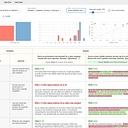
Data as of Sep 18, 2026 · Based on 347 AI responses from ChatGPT Search and Google AI Mode · See how Parse measures this
For collaborative prompt management and evaluation, several platforms stand out based on your team's specific requirements. 

Brands AI recommends here
Named in 71% of answers
Named in 67% of answers
Best for teams that need a visual, user-friendly CMS to track and version prompts. It allows non-technical team members to edit and collaborate on prompts, though it is less focused on deep production-level performance tracing.
Named in 48% of answers
The primary choice if your development team already uses LangChain or LangGraph. It provides tight integration for debugging, tracing, and versioning, but its greatest utility is maximized within the LangChain ecosystem.
Named in 39% of answers
Best for high-performance engineering teams focused on evaluation-driven development. It excels in automated testing and production monitoring, acting as an end-to-end platform for rigorous prompt validation.
Source | Citation share |
|---|---|
 Best Prompt Evaluation Tools in 2026 (Tested & Compared) - Articles - Braintrusthttps://www.braintrust.dev/articles/best-prompt-evaluation-tools-2025 | 3.8% |
 Prompt Management Systems Compared | Nearformhttps://nearform.com/digital-community/prompt-management-systems-compared/ | 2.9% |
 Top 5 AI Prompt Management Tools for 2026https://arize.com/blog/top-5-ai-prompt-management-tools-of-2025/ | 2.8% |
 5 LLM Evaluation Tools You Should Know in 2025https://humanloop.com/blog/best-llm-evaluation-tools | 2.6% |
Best LLM evaluation platforms 2025 - Articles - Braintrusthttps://www.braintrust.dev/articles/best-llm-evaluation-platforms-2025 | 2.6% |
 Top 9 Prompt Engineering Platforms to Improve LLM Responseshttps://medium.com/@kuldeep.paul08/top-9-prompt-engineering-platforms-to-improve-llm-responses-9b07997c06e0 | 2.1% |
7 best prompt management tools in 2026 (tested and compared)https://www.braintrust.dev/articles/best-prompt-management-tools-2026 | 2.1% |
 Top 5 Prompt Management Platforms in 2025: A Comprehensive Guide for AI Teamshttps://www.getmaxim.ai/articles/top-5-prompt-management-platforms-in-2025-a-comprehensive-guide-for-ai-teams/ | 2.1% |
8 Top Prompt Testing & Optimization Tools (2026) - Arize AIhttps://arize.com/blog/8-top-prompt-testing-and-optimization-tools-for-llms-and-multiagent-systems-2025/ | 2.0% |
 9 Best Prompt Management Tools for ML and AI Engineering Teams - ZenML Bloghttps://www.zenml.io/blog/best-prompt-management-tools | 1.8% |
For a development team, I’d shortlist **Braintrust, LangSmith, and Promptfoo**: - **Braintrust** — strong fit for a shared prompt/eval workflow: datasets, experiments, scorers, prompt playground, production traces, and CI/CD quality gates.…
For a development team, I’d shortlist Braintrust, LangSmith, and Promptfoo:
For your stated requirement—team-wide prompt management and evaluation—I’d start by evaluating Braintrust and LangSmith, then add Promptfoo if keeping evals in Git/CI and self-hostability are priorities.
Managing and evaluating prompts collaboratively across a development team requires a dedicated **LLMOps platform** that handles versioning, team workspaces, playgrounds, and CI/CD evaluation test…
Managing and evaluating prompts collaboratively across a development team requires a dedicated LLMOps platform that handles versioning, team workspaces, playgrounds, and CI/CD evaluation test suites.
The top platforms on the market fit different team workflows and infrastructure preferences:
To help narrow down the ideal platform for your team, tell me:
Yes. For a development team, I’d look for a **PromptOps / LLM evaluation platform**, rather than just a prompt library. The important workflow is: **draft → version → run against a shared dataset → evaluate → review → approve → deploy → monitor → roll back** That lets you treat prompts much more like software…
Yes. For a development team, I’d look for a PromptOps / LLM evaluation platform, rather than just a prompt library. The important workflow is:
draft → version → run against a shared dataset → evaluate → review → approve → deploy → monitor → roll back
That lets you treat prompts much more like software artifacts than snippets of text.
| Platform | Best fit | Why I’d consider it |
|---|---|---|
| braintrust.dev | Eval-driven engineering teams | Strong emphasis on datasets, experiments, scorers, prompt iteration, and CI/CD quality gates. Braintrust Arize AI |
| promptlayer.com | Prompt management + collaboration | Particularly good if you want a centralized prompt registry, visual editing, versioning, deployment, evaluations, and production tracing. PromptLayer |
| langfuse.com | Open-source / self-hosting | A strong choice if you want prompt management, tracing, datasets and evaluations while retaining more infrastructure control. Arize AI GitHub |
| smith.langchain.com | LangChain/LangGraph teams | Particularly compelling if your stack already uses LangChain or LangGraph; combines datasets, experiments, evaluators and production runs. Arize AI |
| phoenix.arize.com | Open-source observability + evals | Good when tracing and evaluating complex agents/RAG systems is as important as prompt management. Arize AI Arize AI |
If your primary requirement is "our developers need one place to manage prompts and systematically determine whether a change is better", I'd start by evaluating Braintrust and PromptLayer.
Whatever you buy, I'd make the vendor prove these capabilities in a trial:
That last part is critical: don't evaluate these platforms primarily on their prompt editor. The differentiator is whether they close the loop between prompt change → reproducible evaluation → release decision → production outcome. Current comparisons similarly distinguish the platforms by their evaluation, tracing, collaboration, and deployment workflows rather than simple prompt storage.
If you tell me roughly team size, whether you need self-hosting, your LLM stack (OpenAI/Anthropic/etc.), and whether you're building RAG/agents or mostly straightforward LLM calls, I can narrow this to 2–3 platforms and give you a concrete evaluation matrix.
You should use an **LLM engineering and observability platform** that provides centralized prompt registries, version control, and evaluation pipelines to manage prompts across a development team. Managing prompts across multiple developers and non-technical stakeholders requires separating text instructions and…
You should use an LLM engineering and observability platform that provides centralized prompt registries, version control, and evaluation pipelines to manage prompts across a development team.
Managing prompts across multiple developers and non-technical stakeholders requires separating text instructions and configurations from hardcoded application code. The leading platforms in this space offer collaborative playgrounds, version history, CI/CD regression testing, and production tracing.
To help narrow down the ideal platform for your stack, could you share:
Yes. For a development team, I’d look for something that treats prompts more like **versioned software artifacts** than a collection of playground snippets. ### My shortlist Platform | Best fit | Prompt management | Evaluations | Production/observability | Self-host
Yes. For a development team, I’d look for something that treats prompts more like versioned software artifacts than a collection of playground snippets.
| Platform | Best fit | Prompt management | Evaluations | Production/observability | Self-host |
|---|---|---|---|---|---|
| Braintrust | Best overall for engineering teams | Excellent | Excellent | Excellent | Enterprise |
| Langfuse | Best open-source/self-hosted option | Excellent | Excellent | Excellent | Yes |
| Promptfoo | Best for code/CI-first teams | Good | Excellent | Limited | Yes |
| LangSmith | Best if you're heavily invested in LangChain | Excellent | Excellent | Excellent | Enterprise options |
| Agenta | Best all-in-one open-source alternative | Excellent | Excellent | Good | Yes |
For your description, Braintrust is probably the platform I'd evaluate first.
It combines prompt experimentation, datasets, automated and human evaluations, production traces, and CI/CD quality gates. That means a developer can change a prompt, run it against your regression dataset, compare it with the previous version, and prevent a bad version from shipping.
It's particularly compelling if you expect the workflow to become:
prompt → experiment → eval → review → deploy → monitor → turn failures into new eval cases
rather than simply "store prompts somewhere."
Langfuse is a very strong alternative, especially if you want an open-source platform. It combines prompt versioning, experiments, datasets, LLM-as-a-judge/code evaluations, human feedback, and production tracing.
Its prompt-experiment workflow lets you run multiple prompt versions/models against the same dataset and compare their evaluation scores.
I'd favor it over Braintrust if data control, self-hosting, or avoiding vendor lock-in is a major requirement.
Promptfoo is more "testing framework" than "central prompt-management platform." It's open source, runs locally or in CI, supports automated scoring, model/prompt comparisons, and red-teaming.
It's excellent if your team wants prompts and eval definitions living alongside application code and being exercised on every PR.
I'd choose it when the philosophy is:
Prompts are code; evals are tests; Git/CI is the source of truth. I'd choose Braintrust/Langfuse when you also want a collaborative UI and production feedback loop.
If you're choosing one platform, I'd run a small proof-of-concept with:
The POC should use one real LLM feature, not a toy prompt. Give each platform ~20–50 representative test cases and evaluate:
The key architectural requirement I'd insist on is a persistent evaluation dataset. Without that, a "prompt management" tool can easily become another playground where developers say "this prompt seems better" without being able to prove it.
If you tell me roughly team size, cloud/self-hosting preference, which LLM providers you use (OpenAI/Anthropic/etc.), and whether you need CI/CD gates, I can narrow this to a 2–3 product recommendation and give you a concrete evaluation matrix.
prompt → experiment → eval → review → deploy → monitor → turn failures into new eval cases
rather than simply "store prompts somewhere."
Langfuse is a very strong alternative, especially if you want an open-source platform. It combines prompt versioning, experiments, datasets, LLM-as-a-judge/code evaluations, human feedback, and production tracing.
Its prompt-experiment workflow lets you run multiple prompt versions/models against the same dataset and compare their evaluation scores.
I'd favor it over Braintrust if data control, self-hosting, or avoiding vendor lock-in is a major requirement.
Promptfoo is more "testing framework" than "central prompt-management platform." It's open source, runs locally or in CI, supports automated scoring, model/prompt comparisons, and red-teaming.
It's excellent if your team wants prompts and eval definitions living alongside application code and being exercised on every PR.
I'd choose it when the philosophy is:
Prompts are code; evals are tests; Git/CI is the source of truth.
Managing and evaluating prompts collaboratively across a development team requires a dedicated **LLMOps / LLM engineering platform** that handles version control, playground experimentation, dataset testing, and automated evaluation.[](https://www.braintrust.dev/articles/best-prompt-management-tools-2026)…
Managing and evaluating prompts collaboratively across a development team requires a dedicated LLMOps / LLM engineering platform that handles version control, playground experimentation, dataset testing, and automated evaluation.
The top platforms tailored for prompt management and evaluation vary depending on your team's specific workflow:
To help narrow down the right fit, tell me:
For a development team building LLM-powered features, I’d look for a platform that treats prompts like software artifacts: **versioned, reviewed, tested, deployed, and monitored**. The right choice depends on whether your biggest need is prompt collaboration, rigorous evaluation, production observability, or…
For a development team building LLM-powered features, I’d look for a platform that treats prompts like software artifacts: versioned, reviewed, tested, deployed, and monitored. The right choice depends on whether your biggest need is prompt collaboration, rigorous evaluation, production observability, or self-hosting.
Here are the strongest options:
| Platform | Best fit | Key capabilities |
|---|---|---|
| Braintrust | Teams that need rigorous quality gates | Prompt experiments, datasets, automated evaluators, production traces, regression testing, CI/CD-style evaluation workflows. Braintrust |
| PromptLayer | Teams wanting a shared prompt CMS | Prompt registry, version history, visual editing, evaluations, deployment workflows, and collaboration between engineers and non-engineers. PromptLayer |
| LangSmith | Teams using LangChain/LangGraph | Prompt iteration, tracing, datasets, debugging, and evaluations integrated with the LangChain ecosystem. Brainforge |
| Langfuse | Teams wanting open source/self-hosting | Prompt management, tracing, analytics, and evaluation workflows with more infrastructure control. Braintrust |
| Promptfoo | Engineering-first teams | Git-friendly prompt tests, model comparisons, assertions, and CI integration. Brainforge |
For most product engineering teams:
A few questions would narrow this down:
Managing prompts and evaluations collaboratively across a development team requires moving away from shared documents or hardcoded strings into a dedicated **LLMOps / LLM engineering platform**. The leading platforms tailored for prompt versioning, team collaboration, and automated evaluations break down into a few…
Managing prompts and evaluations collaboratively across a development team requires moving away from shared documents or hardcoded strings into a dedicated LLMOps / LLM engineering platform.
The leading platforms tailored for prompt versioning, team collaboration, and automated evaluations break down into a few distinct categories depending on your team's workflow:
If you share a bit more about your stack, I can narrow this down:
Let me know so we can pick the exact tool that fits your team.
The best platforms for managing, versioning, and evaluating prompts across a development team include **Langfuse, LangSmith, PromptLayer, and Promptfoo**.[](https://www.truefoundry.com/blog/prompt-management-tools)…
The best platforms for managing, versioning, and evaluating prompts across a development team include Langfuse, LangSmith, PromptLayer, and Promptfoo.
As noted by TrueFoundry, “A good prompt management platform should offer version control, evaluation frameworks, observability, and collaboration features.”
Top Prompt Management and Evaluation Platforms
| Platform | Key Focus | Best For | Licensing |
|---|---|---|---|
| Langfuse | Open-source LLM engineering & observability | Teams wanting cost-effective, open-source prompt management with strong tracing. | Open Source / Cloud |
| LangSmith | Debugging, testing, and monitoring | Teams heavily building with LangChain and LangGraph ecosystems. | Proprietary / Cloud |
| PromptLayer | Prompt collaboration and version control | Non-technical and technical team co-management of prompt text and history. | Proprietary / Cloud |
| Promptfoo | CLI and CI/CD-native evaluations | Automated regression testing, security scans, and code-heavy workflows. | Open Source / CLI |
Core Features to Evaluate
If you tell me whether you prefer an open-source/self-hosted tool or a managed cloud service , and whether your stack relies on LangChain , I can recommend the exact platform to adopt.
Yes. For a development team, I’d look beyond a simple “prompt CMS” and choose something that gives you a full **prompt → eval → compare → deploy → monitor → regression-test** workflow. ### My shortlist Platform | Best fit | Strengths | Tradeoff
Yes. For a development team, I’d look beyond a simple “prompt CMS” and choose something that gives you a full prompt → eval → compare → deploy → monitor → regression-test workflow.
| Platform | Best fit | Strengths | Tradeoff |
|---|---|---|---|
| Braintrust | Best overall for an engineering org | Prompts, datasets, experiments, automated/LLM/human evals, production traces, CI/CD quality gates | More platform than you may need for a small team |
| Langfuse | Best open-source/self-hosted choice | Prompt versioning, tracing, evals, datasets, experiments; MIT licensed and self-hostable | Some sophisticated workflows may require more engineering |
| Humanloop | Best for cross-functional collaboration | Excellent prompt editor, version control, evaluations, human review, observability | More enterprise-oriented |
| Promptfoo | Best Git/CI-first approach | Open source, YAML/CLI, regression testing, red teaming, CI/CD | Less of a centralized collaborative prompt workspace |
These distinctions line up with current platform capabilities: Langfuse combines prompt management, evaluation, experiments and production observability; Humanloop emphasizes collaborative prompt editing/versioning plus automated and human evaluation; and Promptfoo is explicitly designed around test-driven, CLI/CI-based LLM evaluation.
I'd start by evaluating Braintrust and Langfuse side-by-side.
Don't judge these primarily on the prompt playground. Require:
The key architectural decision is whether prompts live primarily in Git or in the platform. If your developers want prompts reviewed like code, Promptfoo or a Git-integrated platform is attractive. If you want a shared “AI development control plane” for engineering + product + domain experts, Braintrust/Humanloop/Langfuse are stronger candidates. Current industry comparisons similarly distinguish Braintrust for the integrated eval/production loop, Langfuse for open-source control, Humanloop for collaboration, and Promptfoo for CLI-first workflows.
If you give me team size, languages/frameworks (Python/TypeScript/LangChain/etc.), cloud vs. self-hosted, and whether non-engineers need to edit prompts, I can narrow this to a 2–3 vendor recommendation with a concrete scoring matrix and suggested proof-of-concept test.