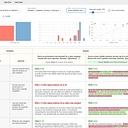
I want to create a "staging" environment for our prompts. What is the best platform that supports prompt lifecycle management (dev, staging, prod)?
Data as of Sep 26, 2026 · Based on 358 AI responses from ChatGPT Search and Google AI Mode · See how Parse measures this
For robust lifecycle management across development, staging, and production environments, Braintrust is a top choice. For teams needing self-hosted options, Agenta provides a flexible open-source alternative. Maxim AI is best suited for complex enterprise agent workflows requiring simulation and eval-gate controls. If your team prefers a no-code CMS workspace or is exclusively using the LangChain stack, and serve as optimal specialized solutions.
Best for enterprises building complex agentic systems. It offers an end-to-end platform that includes simulation and evaluation to ensure quality across the full prompt lifecycle.
Best for engineering teams needing reliable, environment-based deployment and quality gates. It is recognized as a leader in safely managing the transition of prompts from staging to production.
7 best prompt management tools in 2026 (tested and compared)https://www.braintrust.dev/articles/best-prompt-management-tools-2026
6%
5 Best Tools for Prompt Versioninghttps://www.getmaxim.ai/articles/5-best-tools-for-prompt-versioning/
4%
Best Prompt Versioning Tools for Production Teams (2026) - Articles - Braintrusthttps://www.braintrust.dev/articles/best-prompt-versioning-tools-2025
4%
Top 5 Prompt Versioning Tools for Enterprise AI Teams in 2026https://www.getmaxim.ai/articles/top-5-prompt-versioning-tools-for-enterprise-ai-teams-in-2026/
3%
Top 5 AI Prompt Management Tools of 2026https://www.getmaxim.ai/articles/top-5-ai-prompt-management-tools-of-2026/
3%
Top Open-Source Prompt Management Platforms 2026 — Agenta Bloghttps://agenta.ai/blog/top-open-source-prompt-management-platforms
2%
9 Best Prompt Management Tools for ML and AI Engineering Teams - ZenML Bloghttps://www.zenml.io/blog/best-prompt-management-tools
What is prompt management? Versioning, collaboration, and ...https://www.braintrust.dev/articles/what-is-prompt-management
2%
Top Prompt Engineering Management Software Tools | Snippets AIhttps://www.getsnippets.ai/articles/prompt-engineering-management-software
2%
Question: I want to create a "staging" environment for our prompts. What is the best platform that supports prompt lifecycle management (dev, staging, prod)?
Question: I want to create a "staging" environment for our prompts. What is the best platform that supports prompt lifecycle management (dev, staging, prod)?
Question: I want to create a "staging" environment for our prompts. What is the best platform that supports prompt lifecycle management (dev, staging, prod)?
Question: I want to create a "staging" environment for our prompts. What is the best platform that supports prompt lifecycle management (dev, staging, prod)?
Question: I want to create a "staging" environment for our prompts. What is the best platform that supports prompt lifecycle management (dev, staging, prod)?
Question: I want to create a "staging" environment for our prompts. What is the best platform that supports prompt lifecycle management (dev, staging, prod)?
Question: I want to create a "staging" environment for our prompts. What is the best platform that supports prompt lifecycle management (dev, staging, prod)?
Question: I want to create a "staging" environment for our prompts. What is the best platform that supports prompt lifecycle management (dev, staging, prod)?
Question: I want to create a "staging" environment for our prompts. What is the best platform that supports prompt lifecycle management (dev, staging, prod)?
If your main requirement is true prompt lifecycle management — dev → staging → prod — I’d shortlist two platforms: and .
Question: I want to create a "staging" environment for our prompts. What is the best platform that supports prompt lifecycle management (dev, staging, prod)?
Evaluation before promotion — you can run experiments against datasets and compare prompt versions before moving them to production.
Observability tied to prompt versions — useful for seeing whether a new prompt actually improves quality, latency, or cost.
Actual environments — Langfuse also supports development/staging/production environments for traces and evaluation data, so the lifecycle isn't limited to prompt text.
A typical setup could be:
                    Prompt v17
                       │
             ┌─────────┴─────────┐
             ▼                   ▼
          staging             production
         label=v17            label=v16
             │                   │
        run evaluations       live traffic
             │
             ▼
       approve/promote
             │
             └──────────────► production → v17
Your application code can remain essentially identical:
# development
prompt = langfuse.get_prompt("support-agent", label="latest")

# staging
prompt = langfuse.get_prompt("support-agent", label="staging")

# production
prompt = langfuse.get_prompt("support-agent", label="production")
That's a strong separation between prompt deployment and application deployment.
The important architectural choice
I'd structure it as:
Environment
Prompt reference
Purpose
Dev
latest
Rapid iteration
Staging
staging
Automated eval + QA
Production
production
Approved version only
Then add a CI gate:
Developer changes prompt
        ↓
new immutable version
        ↓
staging
        ↓
eval against regression dataset
        ↓
PASS?
   ┌────┴────┐
   NO        YES
   ↓          ↓
fix prompt   approval
               ↓
          production
Langfuse documents essentially this CI/CD pattern, including regression gates and protected production labels.
What I'd compare it against
The main alternatives I'd investigate are Braintrust, PromptLayer, Agenta, and Promptfoo. The right choice depends on whether your priority is prompt management itself, evaluations, observability, governance, or Git-centric workflows.
For specifically “I want prompts to have a dev/staging/prod lifecycle similar to software releases,” Langfuse is unusually well aligned with that mental model because environments and deployment labels are first-class concepts rather than something you have to construct yourself.
If you tell me whether you're self-hosting vs SaaS, and whether you need Git/PR approvals + automated eval gates, I can give you a concrete Langfuse vs Braintrust vs PromptLayer comparison and recommend an architecture for your staging environment.
Treating prompts as first-class infrastructure with explicit Dev, Staging, and Prod environments is the gold standard for robust LLM applications. Decoupling prompts from your application code lets you promote, test, and roll back prompt changes without deploying new code binaries.
The top platforms built specifically for prompt lifecycle management and environment promotion include:
Why it’s great for environments: Provides robust environment management natively. You can commit, tag, and promote prompt versions through distinct Staging and Production labels. It includes role-based access controls (prompt owners who can authorize promotions) and webhook triggers to notify services when a prompt changes in a specific environment.
Best feature: Deep integration with evaluation and tracing, allowing you to see how a staging prompt performed on real traces before clicking "promote."
Braintrust
Why it’s great for environments: Uses explicit environment tags (production, staging, development ) that allow you to programmatically load or pin prompts using SDKs like loadPrompt() . It treats prompt promotion like a release pipeline, complete with webhook-based update alerts.
Best feature: Exceptional focus on CI/CD alignment and automated evaluations—non-technical team members can safely iterate in playgrounds while engineering governs what hits staging and production.
PromptLayer
Why it’s great for environments: One of the earliest dedicated prompt registries, PromptLayer lets you tag prompt versions with release labels (like staging or prod ) and fetch them dynamically via API or SDK without changing application code.
Best feature: Simple, highly visual workspace that non-engineers love for tweaking variables, tracking request costs, and viewing latency side-by-side across versions.
LangWatch
Why it’s great for environments: Offers Git-friendly workflows (storing prompts as YAML) coupled with a centralized registry that cleanly separates development, staging, and production environments with instant rollbacks.
Best feature: Great lightweight option if you want to keep prompts in your own Git repository via CLI sync while still utilizing a cloud dashboard for environment pinning and runtime overrides.
Recommendation on How to Choose
Go with LangSmith if you are already building with complex agent loops (using LangChain/LangGraph) or want rigorous access-control policies around who can promote to production.
Go with Braintrust if your primary goal is tight data-driven evaluation loops where prompts must pass automated grading datasets before graduating from staging to prod.
If you'd like to narrow this down, tell me:
Are you already using a specific framework like LangChain, LlamaIndex, or pure Python/TypeScript SDKs?
Do you need non-technical team members (product managers, copywriters) to edit prompts in the staging UI?
The best platforms for prompt lifecycle management supporting explicit dev, staging, and production environments are Braintrust, LangSmith, and Maxim AI . These tools treat prompts as first-class, version-controlled assets that can be promoted across environments via slugs, tags, or API configurations without changing application code.
Top Platforms for Prompt Lifecycle Management
Platform
Core Strength
Environment & Promotion Support
Braintrust
Best overall for combining prompt editing, CI/CD evaluations, and data tracking.
Uses named slugs and explicit environment tags (dev, staging, prod ) to pull specific prompt pointers dynamically.
LangSmith
Best for deep integration with complex LLM workflows and tracing.
Offers robust tagging, release labeling, and commit histories to push prompts safely from test to production.
Maxim AI
Best for comprehensive evaluation gates and simulation test suites.
Built-in environment isolation allowing staging vs. production traffic governance and validation metrics.
Key Features to Utilize for Staging Prompts
Slug-based or Tag-based Fetching: Instead of hardcoding a specific version hash or text string in your codebase, your app calls a slug with an environment label (e.g., client.get_prompt("summarizer", version="staging")).
Evaluation Gates: Tie your staging environment to automated evaluation datasets. The prompt should only be promotable to prod if it passes regression and accuracy tests in staging.
Role-Based Access Control (RBAC): Restrict who can promote or modify tags in the production environment, allowing product managers or non-technical stakeholders to safely tweak prompts in dev/staging.
If you'd like, let me know:
Are you currently using a specific framework like LangChain, LlamaIndex, or raw API calls?
Do you prefer an open-source/self-hosted tool or a managed cloud SaaS platform?
I can provide a tailored setup guide or code snippet for your preferred stack.
If your main requirement is first-class prompt lifecycle management — dev → staging → prod — I’d pick Braintrust today, with Langfuse as the strongest alternative.
My ranking
Platform
Dev/Staging/Prod
Prompt versioning
Evals
Observability
Self-host
Best fit
Braintrust
⭐⭐⭐⭐⭐
⭐⭐⭐⭐⭐
⭐⭐⭐⭐⭐
⭐⭐⭐⭐⭐
Yes*
Best overall lifecycle
Langfuse
⭐⭐⭐⭐
⭐⭐⭐⭐⭐
⭐⭐⭐⭐
⭐⭐⭐⭐⭐
Yes
Open-source / data control
*Availability depends on Braintrust's deployment/plan options.
1. 🥇 Braintrust — my recommendation
Braintrust has an unusually direct mapping to what you're asking for. It has explicit environments, so you can create dev, staging, and production, pin prompt versions to each, and promote a tested version through the environments.
The important part is that the prompt is a deployable artifact, rather than something bundled into an application release. Braintrust explicitly supports promoting versions from development → staging → production and can notify systems when environment assignments change, which is useful for CI/CD.
The other big advantage is the evaluation loop: you can test prompt versions against datasets/evals before promotion rather than simply approving a textual diff.
I'd choose Braintrust if: you're building a serious LLM application and want prompt management, evaluations, experimentation, and production monitoring in one system.
2. 🥈 Langfuse — best if you want open source
langfuse.com is probably the alternative I'd investigate first.
Its model is elegantly simple:
Prompt versions
      │
      ├── latest
      ├── staging
      └── production
Every saved prompt gets an immutable version, while labels such as staging and production point to whichever version should be served. Moving the label effectively deploys the prompt, and moving it back gives you a rollback.
Prompt edit
    ↓
DEV
    ↓
Automated evals
    ↓
STAGING
    ↓
Regression tests
    ↓
Human approval
    ↓
PRODUCTION
    ↓
Online monitoring
    ↓
Rollback if regression detected
The key architectural principle is: don't make staging a copy of the prompt. Make it a pointer to a specific immutable prompt version.
That gives you very clean rollback:
production → v42

bad deployment detected

production → v41
No application deployment required.
Bottom line
For a new production system, I'd start with Braintrust. Its explicit environment model and tight coupling between prompt versions, evaluations, and deployment is almost exactly the lifecycle you're describing.
Choose Langfuse instead if self-hosting/open source and data control are important. Its version + label model is particularly clean for implementing dev → staging → prod.
If you tell me your stack (e.g. OpenAI API + Python/Node + GitHub Actions + Kubernetes) I can also sketch the exact dev/staging/prod architecture and CI/CD flow I'd use.
If your main requirement is true prompt lifecycle management — dev → staging → prod, with versioning, promotion, rollback, and evaluation — my top pick is braintrust.dev.
My ranking
Platform
Dev → Staging → Prod
Prompt versioning
Eval/testing
Observability
My take
Braintrust
✅ Native
✅
⭐⭐⭐⭐⭐
⭐⭐⭐⭐⭐
Best overall
LangSmith
✅ Staging/Prod
✅
⭐⭐⭐⭐⭐
⭐⭐⭐⭐⭐
Best if you're already in LangChain
PromptLayer
✅ Via release labels
✅
⭐⭐⭐⭐
⭐⭐⭐⭐
Great prompt-focused option
DIY Git + config
⚠️ Build it
✅
❌/DIY
❌/DIY
Fine for small teams
Why I'd choose Braintrust
Braintrust explicitly supports separate development, staging, and production environments, with specific prompt versions assigned to each environment. You can promote a version through the lifecycle without changing application code.
Your application can simply request the prompt for its environment:
const prompt = await loadPrompt({
  projectName: "my-app",
  slug: "customer-support",
  environment: process.env.APP_ENV, // dev | staging | production
});
Braintrust also lets you pin an exact prompt version, which is useful when you want completely deterministic production deployments rather than automatically picking up the latest version.
Most importantly, I'd make evals a gate between staging and production. For example:
PR
 ↓
new prompt version
 ↓
automated regression evals
 ↓
DEV
 ↓
staging evals + sampled real traffic
 ↓
human approval
 ↓
PRODUCTION
 ↓
monitor quality/cost/latency
 ↓
rollback if necessary
Braintrust is particularly compelling because the same platform covers prompt management + evaluations + production observability, rather than giving you a prompt registry that is disconnected from the evidence showing whether a prompt actually improved.
When I'd pick LangSmith instead
If your stack is already heavily based on LangChain/LangGraph, I'd seriously consider smith.langchain.com.
LangSmith has prompt commits, diffs, version history, and environment promotion. Its staging and production environments are represented by movable tags pointing at particular prompt commits.
The main distinction I'd make is:
Braintrust → best choice if you're designing an LLM platform around evals + prompts + observability.
LangSmith → best choice if you're already building around LangChain/LangGraph.
PromptLayer → best choice if you primarily want a dedicated prompt registry/release system. It supports versioning, release labels, evaluations, datasets, and observability.
So for a greenfield "prompt staging environment," I'd start with Braintrust. Its environment model maps unusually cleanly onto the software deployment model you're describing, including API/CLI-based promotion that you can put into CI/CD.
If you tell me your stack (OpenAI/Anthropic, Python/TypeScript, LangChain or not, Kubernetes/serverless, etc.), I can also sketch the exact dev → staging → prod architecture and CI/CD workflow I'd use.
Your application can simply request the prompt for its environment:
const prompt = await loadPrompt({
  projectName: "my-app",
  slug: "customer-support",
  environment: process.env.APP_ENV, // dev | staging | production
});
Braintrust also lets you pin an exact prompt version, which is useful when you want completely deterministic production deployments rather than automatically picking up the latest version.
Most importantly, I'd make evals a gate between staging and production. For example:
PR
 ↓
new prompt version
 ↓
automated regression evals
 ↓
DEV
 ↓
staging evals + sampled real traffic
 ↓
human approval
 ↓
PRODUCTION
 ↓
monitor quality/cost/latency
 ↓
rollback if necessary
Braintrust is particularly compelling because the same platform covers prompt management + evaluations + production observability, rather than giving you a prompt registry that is disconnected from the evidence showing whether a prompt actually improved.
When I'd pick LangSmith instead
If your stack is already heavily based on LangChain/LangGraph, I'd seriously consider smith.langchain.com.
Moving your prompts out of hardcoded application files and into a dedicated lifecycle management system is one of the best moves you can make for an LLM application.
The industry standard approach for prompt environments relies on immortal version history paired with mutable environment labels (like pointers for production, staging , and development ). This allows you to promote a prompt by moving a label in a UI rather than pushing a code commit.
The top platforms supporting robust prompt lifecycle management across dev, staging, and prod include the following:
Langfuse : The leading open-source (and hosted) LLM engineering platform. It handles environments using label-based version pointers (production, staging , etc.) or separate projects. You can edit and test prompts in their playground, promote them across stages instantly without code deployments, and seamlessly tie those prompt versions directly into traces, latency costs, and evaluations. Explore their approach via Langfuse Prompt Management.
Braintrust : Built explicitly for enterprise AI engineering with a heavy focus on evaluation-driven development. It treats prompts as configurable, version-controlled assets that cleanly separate staging and production workflows. It excels if your staging lifecycle involves running automated evals and regression testing before letting a label shift to production. Review features on the Braintrust Platform.
Humanloop : Great for collaborative workflows where non-technical domain experts or product managers tweak text, while engineering maintains governance. Humanloop supports environment labels for development, staging, and production and even allows you to store prompts as files in your codebase to bridge Git workflows with UI-based staging promotions. Check out Humanloop.
PromptLayer : One of the earliest dedicated prompt registries, offering a Git-like prompt registry that handles rollbacks, tracking, and staging-to-production tracking nicely alongside real-time production observability. Learn more at PromptLayer.
How to Choose:
Go with Langfuse if you want open-source flexibility, self-hosting options, or a tight, transparent connection between cost/latency telemetry and prompt versions.
Go with Braintrust if your primary bottleneck is robust evaluation—meaning you want your staging environment to automatically score prompt changes against test datasets before pushing to production.
If you'd like to narrow this down, tell me:
Do you prefer an open-source/self-hostable tool or a fully managed cloud SaaS?
Do you need non-technical team members (like PMs or copywriters) to edit prompts in the UI, or will this stay strictly within engineering/Git?
Yes. If your main requirement is prompts moving through dev → staging → production as independently deployable, versioned artifacts, I’d shortlist Braintrust, Langfuse, and PromptLayer.
My pick: Braintrust
For a production engineering team, Braintrust is probably the strongest fit today. It treats prompts as versioned artifacts and explicitly supports environment-based deployment across development, staging, and production, with evaluation integrated into the promotion workflow.
A good workflow would look like:
                 ┌─────────────┐
                 │   Prompt v23│
                 └──────┬──────┘
                        │
                 development
                        │
                  run evals
                        │
                        ▼
                    staging
                        │
              regression / approval
                        │
                        ▼
                   production
                        │
                 monitor + trace
                        │
              ┌─────────┴─────────┐
              │                   │
           rollback           next version
The important part is that your application code doesn't need to change just because the prompt changes.
How I'd compare the main options
Platform
Dev/Staging/Prod
Versioning
Evals
Observability
Self-host
Best fit
Braintrust
⭐⭐⭐⭐⭐
⭐⭐⭐⭐⭐
⭐⭐⭐⭐⭐
⭐⭐⭐⭐⭐
—
The interesting alternative: Langfuse
If you want open source / self-hosting, I'd seriously consider Langfuse.
Its model is particularly clean: every prompt save creates an immutable version, while labels such as staging, production, latest, or canary point to versions. Your application fetches the prompt by label.
Promoting staging to production is essentially moving the production label from v17 → v18. Rollback is just moving it back.
That's a very good abstraction for prompt CI/CD.
When I'd choose each
Braintrust → choose this if you're building a serious production AI system and want prompt management + evals + traces + CI/CD quality gates in one platform.
Langfuse → choose this if open source, self-hosting, data control, or avoiding vendor lock-in matters. Its prompt deployment model is excellent.
PromptLayer → choose this if your biggest requirement is a prompt CMS where PMs/domain experts can edit prompts without engineering involvement. It emphasizes visual editing, collaboration, versioning, and release labels.
LangSmith → particularly compelling if you're already heavily invested in LangChain/LangGraph.
What I'd implement
Regardless of platform, I'd establish this contract:
And importantly, don't use latest in production. Use an explicit environment/release pointer:
# dev
get_prompt("support-agent", label="latest")

# staging
get_prompt("support-agent", label="staging")

# production
get_prompt("support-agent", label="production")
That gives you reproducibility, controlled promotion, and instant rollback. Langfuse documents essentially this exact model.
Bottom line: if you want the best overall production workflow, I'd start with Braintrust. If you want the cleanest open-source prompt registry + environment model, I'd pick Langfuse.
If you tell me your stack (e.g. OpenAI API + Python/Node + GitHub Actions + Kubernetes/AWS), I can recommend a concrete dev → staging → prod architecture, including how prompts should be promoted and rolled back.
The interesting alternative: Langfuse
If you want open source / self-hosting, I'd seriously consider Langfuse.
Its model is particularly clean: every prompt save creates an immutable version, while labels such as staging, production, latest, or canary point to versions. Your application fetches the prompt by label.
The best platform for prompt lifecycle management depends entirely on your current engineering stack and team structure, as several specialized enterprise platforms natively support development, staging, and production environment separation.
The leading platforms explicitly designed for this multi-environment pipeline include:
Braintrust (Best Overall for Enterprise Lifecycle)
The Workflow:Braintrust is highly rated for full-lifecycle prompt management. It treats prompts like code assets, allowing you to run automated evaluations against datasets in dev, promote them to a staging tag, and seamlessly push them to production.
Key Advantage: It decouples prompts from application deployments. Your backend fetches the prompt pinned to the production or staging environment label at runtime, allowing instant rollbacks.
LangSmith (Best for LangChain/LangGraph Ecosystems)
The Workflow: If your application is built on LangChain or LangGraph, LangSmith is the most cohesive choice. Its Prompt Hub allows you to tag immutable prompt versions with distinct environment labels like dev, staging , and prod.
Key Advantage: It tracks deep telemetry (latency, token costs, and errors) grouped specifically by the environment and prompt version.
PromptLayer (Best for Cross-Functional Teams)
The Workflow: If non-technical stakeholders (Product Managers, Domain Experts) need to edit prompts alongside engineers, PromptLayer excels. It utilizes a visual registry with a Git-like release workflow to safely promote prompts between environments.
Key Advantage: Features built-in A/B testing and approval gates designed for collaborative governance.
Pezzo or LangWatch (Best for Open-Source/GitOps)
The Workflow: If you prefer keeping your prompts versioned as code (e.g., .yaml files in GitHub), platforms like LangWatch provide a Prompts CLI. This allows you to integrate prompt promotions directly into your existing CI/CD pipelines.
Key Advantage: Fits cleanly into a standard Git workflow, promoting prompts alongside your software containers.
Core Feature Comparison
Platform
Best For
Multi-Environment Support Type
Primary Integration
Braintrust
Enterprise scale & deep evaluations
Native environment tagging & CI/CD promotion
SDK / API
LangSmith
LangChain users & deep trace monitoring
Dynamic environment labels (staging, prod)
Recommended Implementation Strategy
To prevent prompt modifications from breaking live applications, implement a runtime-fetching pattern:
Initialize the SDK: Your application requests the prompt template dynamically from the management platform's registry API using an environment variable.
Configure Your Application Code: python```
Example pattern using an environment label
prompt = prompt_registry.get_prompt("customer_support_agent", label=process.env.PROMPT_ENV)
Use code with caution.
3. Set the Variables: Set PROMPT_ENV="staging" in your staging backend cluster and PROMPT_ENV="production" in your live user cluster.
4. Promote Seamlessly: When a prompt passes automated testing in dev , re-tag it to staging . Once human validation clears it, change the production tag to point to the new version ID—updating the live app instantly without a code redeployment.
To point you toward the ideal platform, what programming language or LLM framework (like LangChain or native SDKs) is your backend built on? Knowing if non-technical team members will edit prompts would also narrow down the best choice.
For a team building production LLM applications, Braintrust is probably the best fit if you want the staging environment to be part of a broader quality/release process.
It has explicit development, staging, and production environments, where you can pin particular prompt versions and promote the same tested version through the pipeline. It also ties environments to datasets, experiments, and evaluation results.
The important part is that promotion doesn't require changing your application code. Braintrust lets you assign a particular prompt version to an environment and promote that version from dev → staging → production.
Langfuse is the strongest alternative
langfuse.com is particularly attractive if you want open source/self-hosting, observability, and prompt management together.
Its model is elegant: every prompt change gets an immutable version, while labels such as staging and production point to the version that should be served.
You can promote or roll back by moving the label, without deploying application code.
How I'd choose
Requirement
Braintrust
Langfuse
Dev/staging/prod environments
Excellent
Excellent
Prompt versioning
Excellent
Excellent
Promotion workflow
Excellent
Excellent
Built-in evals
Excellent
Excellent
Production tracing
Excellent
Excellent
Git/CI integration
Excellent
Excellent
Self-hosting
—
Excellent
Open source
—
Yes
Simple prompt registry
Good
Good
Best for eval-driven releases
My pick
Very good
Best for OSS/data control
Good
My pick
One distinction matters: Braintrust has first-class environments, while Langfuse primarily achieves environment separation through labels/projects. Braintrust explicitly documents the dev → staging → production promotion workflow.
What I'd implement
If you're starting from scratch, I'd avoid treating "staging" as simply a second copy of your prompts.
I'd build this lifecycle:
Prompt draft → version → automated eval → staging → human/QA validation → production → monitoring → rollback
And I'd make the prompt version itself a deployable artifact, just like a Docker image or application release.
For example:
customer-support-v17

DEV
  ↓
  regression suite: 94.2%
  ↓
STAGING
  ↓
  human QA + production-like traffic
  ↓
PRODUCTION
  ↓
  monitor quality / latency / cost
  ↓
  rollback to v16 if necessary
This is where Braintrust has an advantage: its environment system is explicitly designed around this promotion model, and its experiments/evals can be used to validate versions before promotion.
Bottom line: if you specifically said "I need a staging environment for prompts" rather than merely "I need somewhere to store/version prompts," I'd start with Braintrust. If self-hosting, open source, or keeping the observability stack under your control is important, I'd choose Langfuse instead.
If you tell me your stack (OpenAI/Anthropic, Python/Node, GitHub/GitLab, Kubernetes, etc.), I can also sketch the exact dev → staging → prod architecture I'd use, including CI/CD and prompt promotion.
The best platform for prompt lifecycle management depends entirely on your current engineering stack and team structure, as several specialized enterprise platforms natively support development, staging, and production environment separation.
The leading platforms explicitly designed for this multi-environment pipeline include:
Braintrust (Best Overall for Enterprise Lifecycle)
The Workflow:Braintrust is highly rated for full-lifecycle prompt management. It treats prompts like code assets, allowing you to run automated evaluations against datasets in dev, promote them to a staging tag, and seamlessly push them to production.
Key Advantage: It decouples prompts from application deployments. Your backend fetches the prompt pinned to the production or staging environment label at runtime, allowing instant rollbacks.
LangSmith (Best for LangChain/LangGraph Ecosystems)
The Workflow: If your application is built on LangChain or LangGraph, LangSmith is the most cohesive choice. Its Prompt Hub allows you to tag immutable prompt versions with distinct environment labels like dev, staging , and prod.
Key Advantage: It tracks deep telemetry (latency, token costs, and errors) grouped specifically by the environment and prompt version.
PromptLayer (Best for Cross-Functional Teams)
The Workflow: If non-technical stakeholders (Product Managers, Domain Experts) need to edit prompts alongside engineers, PromptLayer excels. It utilizes a visual registry with a Git-like release workflow to safely promote prompts between environments.
Key Advantage: Features built-in A/B testing and approval gates designed for collaborative governance.
Pezzo or LangWatch (Best for Open-Source/GitOps)
The Workflow: If you prefer keeping your prompts versioned as code (e.g., .yaml files in GitHub), platforms like LangWatch provide a Prompts CLI. This allows you to integrate prompt promotions directly into your existing CI/CD pipelines.
Key Advantage: Fits cleanly into a standard Git workflow, promoting prompts alongside your software containers.
Core Feature Comparison
Platform
Best For
Multi-Environment Support Type
Primary Integration
Braintrust
Enterprise scale & deep evaluations
Native environment tagging & CI/CD promotion
SDK / API
LangSmith
LangChain users & deep trace monitoring
Dynamic environment labels (staging, prod)
Recommended Implementation Strategy
To prevent prompt modifications from breaking live applications, implement a runtime-fetching pattern:
Initialize the SDK: Your application requests the prompt template dynamically from the management platform's registry API using an environment variable.
Configure Your Application Code: python```
Example pattern using an environment label
prompt = prompt_registry.get_prompt("customer_support_agent", label=process.env.PROMPT_ENV)
Use code with caution.
3. Set the Variables: Set PROMPT_ENV="staging" in your staging backend cluster and PROMPT_ENV="production" in your live user cluster.
4. Promote Seamlessly: When a prompt passes automated testing in dev , re-tag it to staging . Once human validation clears it, change the production tag to point to the new version ID—updating the live app instantly without a code redeployment.
To point you toward the ideal platform, what programming language or LLM framework (like LangChain or native SDKs) is your backend built on? Knowing if non-technical team members will edit prompts would also narrow down the best choice.