Data as of Sep 19, 2026 · Based on 50 AI responses from ChatGPT Search and Google AI Mode · See how Parse measures this
Your brand can be here too.
Source | Citation share |
|---|---|
AI Meeting Assistant Stack Guide: Bot-Free Notes, CRM Follow-Up, Transcripts, Analytics, and Pricing (2026)https://www.tajo.io/blog/the-9-best-ai-meeting-assistants/ | 1.8% |
 9 Best AI Note-Taking Apps: I Tested and Ranked Them for 2026 | Lindyhttps://www.lindy.ai/blog/ai-note-taking-app | 1.2% |
 Best AI Meeting Note Takers in 2026: Hands-On Review of 8 ...https://www.simular.ai/alternatives/ai-meeting-note-takers | 1.2% |
Best AI Meeting Assistants 2026 | StackFYIhttps://www.stackfyi.com/guides/best-ai-meeting-assistants-2026 | 1.2% |
 Top 5 AI Assistants & Meeting Notetakers in 2026https://www.youtube.com/watch | 1.2% |
 12 Best AI Notetakers for Meetings in 2026 - AssemblyAIhttps://www.assemblyai.com/blog/top-ai-notetakers | 1.0% |
12 Best AI Note Taking App Choices for 2026: The Definitive Guidehttps://www.glinky.ai/blogs/best-ai-note-taking-app | 1.0% |
 AI Meeting Prep and Follow-Up for Sales | Breeze by HubSpothttps://www.hubspot.com/products/artificial-intelligence/use-cases/sales-meeting-prep-and-follow-up | 1.0% |
 Best AI note takers for client phone calls - Reddithttps://www.reddit.com/r/Entrepreneurs/comments/1se6068/every_best_ai_note_taker_list_recommends_meeting/ | 1.0% |
 AI Note Taking Tools: Weapon for Business Productivityhttps://www.wsiworld.com/blog/ai-notetakers-your-secret-weapon-for-maximizing-business-productivity | 1.0% |
Moving beyond passive transcription requires AI that understands context, identifies commitment, and executes workflows across external software. Instead of just asking "what was said?", these platforms ask "what needs to happen now?" and push those changes directly into your stack. The top tools engineered to turn…
Moving beyond passive transcription requires AI that understands context, identifies commitment, and executes workflows across external software. Instead of just asking "what was said?", these platforms ask "what needs to happen now?" and push those changes directly into your stack.
The top tools engineered to turn conversations into structured decisions, automated follow-ups, and active system updates include:
If you're looking to implement one of these, let me know:
I can help you narrow down which platform integrates best with your workflow.
AI note-taking has split into two categories: 1. **“Recorder + summarizer” tools** — capture audio, produce transcripts, summaries, and action items. 2. **“Meeting-to-workflow” tools** — extract decisions, assign follow-ups, draft communications, update CRMs/project tools, and trigger workflows.
AI note-taking has split into two categories:
If you’re looking for the second category, these are some of the stronger options:
| Tool | Goes beyond transcription by… | Best fit |
|---|---|---|
| Fathom | Extracting summaries, decisions, and action items; syncing meeting insights into CRM workflows such as HubSpot | Sales teams and customer-facing teams HubSpot Marketplace |
| Fellow | Turning AI notes, decisions, and action items into workflows through integrations (for example CRM, project tools, Slack-style channels via automation platforms) | Teams that already run structured meetings Fellow Fellow |
| Fireflies.ai | Capturing conversations and connecting meeting intelligence to business workflows (CRM, tasks, analytics) | Sales, recruiting, customer success |
| Otter.ai | Generating summaries and action items, with integrations and collaboration features | General meetings and education |
| Avoma | Covering pre-meeting agendas, notes, coaching insights, follow-ups, and CRM updates | Revenue teams |
| Grain | Turning conversations into clips, insights, and customer-facing follow-up materials | Customer research and sales |
| Quill | Sending meeting outcomes into tools like Notion, HubSpot, Salesforce, Jira, Todoist, and email workflows | Teams wanting automated routing into existing systems Quill |
| SitRep | Moving from notes to execution: turning decisions into tasks, documents, tickets, and tracked outcomes | Product/engineering/operations teams SitRep |
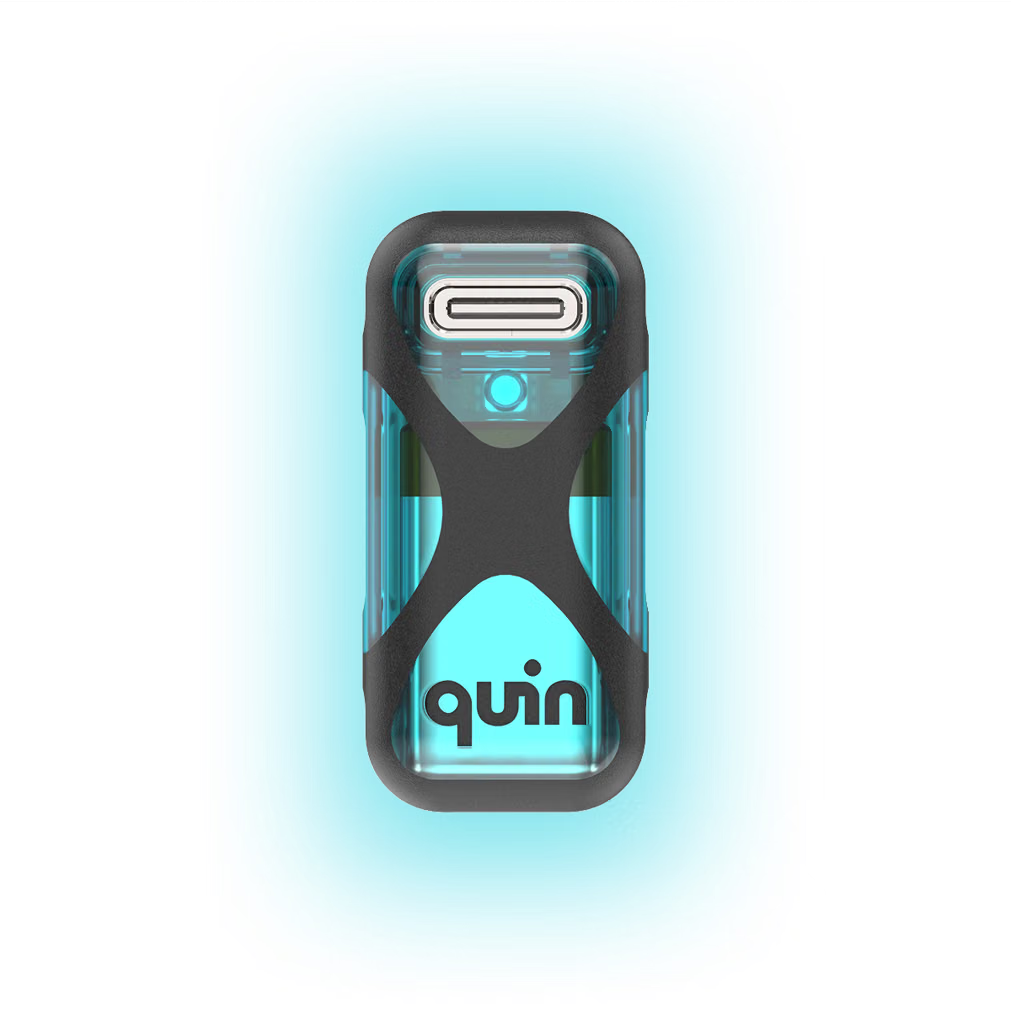
| Quin | Extracting commitments, updating CRM records, and drafting follow-up emails for review | Client-facing professionals Quin |
Look for these capabilities:
Decision extraction
“We agreed to launch X on Friday”
“Engineering owns the migration”
“Customer approved the proposal”
Action-item management
Assign owner
Add due date
Create tasks in Asana/Jira/Linear/Todoist/etc.
CRM updates
Update Salesforce/HubSpot opportunity notes
Record customer objections
Log next steps automatically
Follow-up generation
Draft customer emails
Create internal recaps
Send reminders
Workflow triggers
Meeting decision → Jira ticket
Sales call → CRM update
Product discussion → roadmap item
Executive meeting → company knowledge base update
A key distinction: many tools can summarize a meeting; fewer can reliably change the state of your business systems after the meeting. For the latter, prioritize tools with native integrations, approval workflows, and structured outputs rather than just transcript quality.
The generation of AI meeting assistants has shifted past simple speech-to-text transcription. The latest wave of tools functions as **active workflow layers** —parsing conversation intent to isolate decisions, assign trackable ownership, draft follow-ups, and write structured data back into CRMs or project management…
The generation of AI meeting assistants has shifted past simple speech-to-text transcription. The latest wave of tools functions as active workflow layers —parsing conversation intent to isolate decisions, assign trackable ownership, draft follow-ups, and write structured data back into CRMs or project management platforms.
The top-tier tools engineered to bridge the gap between conversation and execution include:
If you're looking to integrate one of these into your stack, tell me:
I can recommend the exact match for your team's workflow.
Yes. The category has moved beyond “AI transcription” toward **meeting-to-workflow automation**: tools that identify decisions and commitments, assign follow-ups, draft communications, and write information back into systems like CRMs and project-management tools. ### Strongest options Tool | Decisions & actions |…
Yes. The category has moved beyond “AI transcription” toward meeting-to-workflow automation: tools that identify decisions and commitments, assign follow-ups, draft communications, and write information back into systems like CRMs and project-management tools.
| Tool | Decisions & actions | Follow-ups | System updates | Best fit |
|---|---|---|---|---|
| Avoma | Strong | Strong | Excellent — CRM + task systems | Sales, CS, revenue teams |
| Fellow | Strong | Strong | Strong — CRM, Jira, Asana, Linear, Slack, etc. | Cross-functional teams |
| Fireflies.ai | Strong | Strong | Strong — CRM fields, workflows, AI Skills | Teams wanting broad automation |
| Otter.ai | Good | Good | Moderate | Primarily meeting knowledge/search |
| Fathom | Good | Strong | Moderate–strong | Lightweight sales/customer workflows |
Avoma explicitly detects commitments, extracts the owner and task, and can push tasks into tools such as Asana/Jira. More importantly, it can automatically update CRM fields and log meeting activity, follow-ups, and deal information.
Its automation layer lets you define triggers, conditions, and actions—for example, detecting a meeting outcome and then creating a CRM follow-up task.
Pick it if: your real goal is “I don't want someone to manually update Salesforce/HubSpot after the meeting.”
Fellow generates decisions and action items, then connects meeting context to systems including Salesforce, HubSpot, Asana, Jira, Linear, ClickUp, Monday, Notion, Confluence, Slack and Zapier.
Its Ask Fellow assistant can also answer questions about past decisions, create follow-up emails, and perform tasks through chat.
Pick it if: meetings span product, engineering, sales, leadership, and operations rather than being primarily sales calls.
Fireflies goes beyond summaries with attributed action items and 200+ AI Skills that can automate things such as CRM-field updates, follow-up emails, candidate scorecards, and recurring digests.
Pick it if: you want a broad automation layer around a large volume of meetings.
I'd separate these into three levels:
If “system updates” is the key requirement, I'd shortlist Avoma and Fellow first, with Fireflies as the broader automation-oriented alternative. Recent comparisons similarly distinguish these tools based on action tracking and integrations rather than transcription alone.
If you tell me whether you're thinking about sales, product/engineering, executive meetings, or customer success, I can narrow this to the 2–3 best choices and compare exactly what each can automatically write back to your systems.
Its automation layer lets you define triggers, conditions, and actions—for example, detecting a meeting outcome and then creating a CRM follow-up task.
Pick it if: your real goal is “I don't want someone to manually update Salesforce/HubSpot after the meeting.”
Fellow generates decisions and action items, then connects meeting context to systems including Salesforce, HubSpot, Asana, Jira, Linear, ClickUp, Monday, Notion, Confluence, Slack and Zapier.
Its Ask Fellow assistant can also answer questions about past decisions, create follow-up emails, and perform tasks through chat.
Pick it if: meetings span product, engineering, sales, leadership, and operations rather than being primarily sales calls.
Yes. The market has moved beyond “AI that writes meeting minutes.” The interesting tools now form a **meeting → decision → action → system-of-record** pipeline. ### The strongest options Tool | Decisions & action items | Follow-up | Updates other systems | Best fit
Yes. The market has moved beyond “AI that writes meeting minutes.” The interesting tools now form a meeting → decision → action → system-of-record pipeline.
| Tool | Decisions & action items | Follow-up | Updates other systems | Best fit |
|---|---|---|---|---|
| Fireflies.ai | Strong | Strong | Very strong — CRM, Jira, Asana, Linear, etc. | Teams wanting automation |
| Avoma | Very strong | Very strong | CRM + task systems | Sales/customer-facing teams |
| Granola | Strong | Strong | Strong via native integrations + Zapier | Individuals/product teams |
| Fellow | Strong | Strong | Tasks/docs/workflows | Teams wanting meeting → execution |
| Otter.ai | Strong | Improving | Increasingly capable through its meeting agents/integrations | General-purpose meeting intelligence |
Fireflies is particularly interesting because its “AI Skills” can extract action items and create tasks in project-management systems, including Asana, Jira, Trello, ClickUp, Monday and Linear.
So instead of:
Meeting → summary → someone manually creates Jira tickets you can get:
Meeting → decision/action identified → owner + due date → Jira/Linear/Asana task That makes it one of the better choices if system updates are the main requirement.
Avoma goes especially far on the customer-facing side. It identifies commitments during conversations, assigns owners, drafts follow-up emails, and can sync meeting notes, action items and custom fields into CRMs such as Salesforce, HubSpot and Pipedrive.
This is closer to:
conversation → understanding → commitment → CRM update → follow-up
rather than merely “here's what everyone said.”
Granola started as an excellent AI notepad, but it has expanded considerably. Its integrations can send meeting information to tools such as Linear, Notion, Slack, HubSpot, Salesforce and Zapier; it can also draft follow-up emails.
Its particularly nice differentiator is that it doesn't need a meeting bot to join the call.
And with its ChatGPT integration, you can ask questions such as what was decided, retrieve action items, and search meeting history without copying notes into ChatGPT.
Fellow is worth considering if you want the workflow to begin before the meeting rather than merely processing it afterward. Recent comparisons highlight its combination of agendas, meeting notes, action items and its AI assistant for generating follow-ups and documents.
I'd divide the category into three levels:
If Level 3 is what you're after, I'd start with Fireflies, Avoma, and Granola rather than traditional transcription-first products.
For example, a genuinely useful workflow would be:
Customer meeting → identify decision → update Salesforce opportunity → create Linear/Jira task → draft customer follow-up → Slack the team → retain the decision in searchable memory.
That's the direction the category is heading: meeting notes becoming an operational interface for the rest of your business, rather than another document people have to read.
If you tell me your stack (e.g. Slack + Notion + Linear, or Salesforce + Gmail + Jira), I can narrow this down to the 2–3 tools that actually automate the most for you.
Meeting → decision/action identified → owner + due date → Jira/Linear/Asana task That makes it one of the better choices if system updates are the main requirement.
Avoma goes especially far on the customer-facing side. It identifies commitments during conversations, assigns owners, drafts follow-up emails, and can sync meeting notes, action items and custom fields into CRMs such as Salesforce, HubSpot and Pipedrive.
This is closer to:
conversation → understanding → commitment → CRM update → follow-up
rather than merely “here's what everyone said.”
Granola started as an excellent AI notepad, but it has expanded considerably. Its integrations can send meeting information to tools such as Linear, Notion, Slack, HubSpot, Salesforce and Zapier; it can also draft follow-up emails.
Its particularly nice differentiator is that it doesn't need a meeting bot to join the call.
And with its ChatGPT integration, you can ask questions such as what was decided, retrieve action items, and search meeting history without copying notes into ChatGPT.
Asana
When AI note-taking tools shift from passive text generation to active workflow execution, they stop being mere transcribers and start functioning as **operational agents** . These platforms analyze nuance, extract structured decisions, assign accountability, and push updates directly into external systems of record…
When AI note-taking tools shift from passive text generation to active workflow execution, they stop being mere transcribers and start functioning as operational agents . These platforms analyze nuance, extract structured decisions, assign accountability, and push updates directly into external systems of record (like CRMs, project management tools, or ATS databases).
The leading tools bridging the gap between conversation and system execution include:
Are you looking to integrate these capabilities into a specific platform (like Salesforce, HubSpot, Jira, or Notion), or do you need a tool tailored to a specific department like sales, engineering, or HR/recruiting?
Yes. The interesting category is **AI meeting agents**, not just AI transcription tools. The key distinction is whether the product turns conversation into **work that happens elsewhere**. ### Strongest options Tool | Decisions & action items | Follow-ups | System updates | Best fit
Yes. The interesting category is AI meeting agents, not just AI transcription tools. The key distinction is whether the product turns conversation into work that happens elsewhere.
| Tool | Decisions & action items | Follow-ups | System updates | Best fit |
|---|---|---|---|---|
| Fellow | Excellent | Excellent | Excellent | Cross-functional teams |
| Avoma | Excellent | Excellent | Excellent | Sales / RevOps |
| Otter.ai | Excellent | Good | Good–Excellent | General enterprise use |
Fellow is probably the closest match to your description. It extracts decisions and action items, assigns/tracks tasks, and connects meeting intelligence to Salesforce, HubSpot, Asana, Jira, Linear, ClickUp, Monday, Notion, Confluence, Slack and more. Its Zapier integration can turn meeting events into downstream actions in thousands of apps.
Avoma is especially compelling if your "system updates" means CRM updates. It detects commitments and owners, generates follow-up emails, pushes tasks to project-management tools, and can automatically update Salesforce, HubSpot, Pipedrive and custom methodology fields such as MEDDIC/SPICED.
Otter has moved considerably beyond transcription too: its Insights can identify decisions, action items, risks and next steps, while enterprise functionality can map those insights into Salesforce and HubSpot fields.
I'd evaluate these tools on a workflow like:
Meeting → decision detected → owner/deadline extracted → follow-up drafted/sent → Jira/Asana task created → CRM/project record updated → Slack/Teams notified
rather than on "How good is the transcript?"
On that measure, Fellow and Avoma stand out most strongly. Fellow is broader across organizational workflows; Avoma is particularly deep for customer-facing/revenue workflows. Otter is a strong general-purpose option, especially if transcription and searchable meeting knowledge are equally important.
If you tell me whether you're looking at this for sales, product/engineering, executive meetings, or general company operations, I can narrow it to the 3–5 best tools and compare their actual automation depth.
Asana
Moving beyond passive transcription requires tools that treat a meeting not just as a text file, but as an operational event. The modern class of AI "action engines" parses conversation to extract structured decisions, assign accountability, and push updates directly into external systems of record (like CRMs or…
Moving beyond passive transcription requires tools that treat a meeting not just as a text file, but as an operational event. The modern class of AI "action engines" parses conversation to extract structured decisions, assign accountability, and push updates directly into external systems of record (like CRMs or project management trackers).
The leading tools bridging the gap between raw conversation and system execution include:
If you have a specific target platform in mind—such as a particular CRM (like Salesforce or HubSpot) or a project manager (like Jira, Asana, or ClickUp) —let me know, and I can tell you which tool offers the deepest native bi-directional sync for your stack.
If by “go beyond transcription” you mean **turn a conversation into a workflow**—decisions, accountable follow-ups, and changes to the systems where work actually lives—the strongest options are: - **Avoma — strongest end-to-end workflow.** It extracts decisions and commitments, assigns action items, drafts follow-up…
If by “go beyond transcription” you mean turn a conversation into a workflow—decisions, accountable follow-ups, and changes to the systems where work actually lives—the strongest options are:
I'd evaluate these tools on a four-level ladder:
Avoma is the clearest fit if #4 is what you're after. Its automation layer supports triggers/conditions and actions such as detecting meeting outcomes, creating follow-up tasks, and updating CRM data.
One particularly interesting development is that Avoma is now positioning itself as a “context pipeline” for AI agents, rather than just a meeting recorder—i.e., giving an AI assistant access to meeting context and the ability to act on it.
If you tell me whether you're thinking about sales/CRM, product/engineering, customer success, or general internal meetings, I can narrow this to the 3 best tools and compare exactly what systems they can update automatically.
Modern AI meeting assistants have evolved from passive speech-to-text transcribers into active operational hubs. Instead of just spitting out a wall of dialogue, these platforms parse conversation structure to explicitly isolate **decisions** , assign **action items/follow-ups** , and push updates directly into…
Modern AI meeting assistants have evolved from passive speech-to-text transcribers into active operational hubs. Instead of just spitting out a wall of dialogue, these platforms parse conversation structure to explicitly isolate decisions , assign action items/follow-ups , and push updates directly into external systems like CRMs (Salesforce, HubSpot) or project trackers (Asana, Notion, Linear).
The leading tools bridging the gap between raw transcription and execution include:
If you want to narrow down the best fit , tell me:
Asana