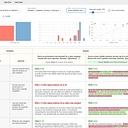
Data as of Sep 16, 2026 · Based on 363 AI responses from ChatGPT Search and Google AI Mode · See how Parse measures this



Brands AI recommends here
Named in 50% of answers
DeepEval — best when you lack labeled data: it synthesizes datasets, provides many built-in scoring metrics for unit/CI testing, and is developer-focused; caveat: requires engineering to integrate into pipelines.
Named in 37% of answers
Named in 36% of answers
Named in 33% of answers
Source | Citation share |
|---|---|
 LLM-as-a-judge: a complete guide to using LLMs for evaluationshttps://www.evidentlyai.com/llm-guide/llm-as-a-judge | 4.3% |
 Best LLM Evaluation Tools: Top 9 Frameworks for Testing AI Models - ZenML Bloghttps://www.zenml.io/blog/best-llm-evaluation-tools | 2.8% |
 LLM as a Judge - Primer and Pre-Built Evaluatorshttps://arize.com/llm-as-a-judge/ | 2.5% |
 LLM as a Judge, What platforms to use? : r/LLMDevshttps://www.reddit.com/r/LLMDevs/comments/1hxkey0/llm_as_a_judge_what_platforms_to_use/ | 2.4% |
 LLM evaluation platform | LLM-as-a-judge testing | Openlayerhttps://www.openlayer.com/products/llm-evaluation | 2.2% |
 LLM-as-a-Judge - Langfusehttps://langfuse.com/docs/evaluation/evaluation-methods/llm-as-a-judge | 1.7% |
 Top 5 Open-Source LLM Evaluation Platforms - KDnuggetshttps://www.kdnuggets.com/top-5-open-source-llm-evaluation-platforms | 1.6% |
Best LLM evaluation platforms 2025 - Articles - Braintrusthttps://www.braintrust.dev/articles/best-llm-evaluation-platforms-2025 | 1.6% |
Top LLM Evaluation Platforms: In Depth Comparison - Reddithttps://www.reddit.com/r/AI_Agents/comments/1pa02zc/top_llm_evaluation_platforms_in_depth_comparison/ | 1.4% |
 7 Best LLM Eval Platforms Compared - Galileo AIhttps://galileo.ai/blog/best-llm-eval-platforms-compared | 1.2% |
When you don't have a gold-standard ground truth dataset, **LLM-as-a-judge** is the standard way to bootstrap evaluations. Instead of matching exact strings, you use a more powerful model (like GPT-4o or Claude 3.5 Sonnet) paired with a clear rubric (e.g., scoring coherence, toxicity, hallucination, or task-specific…
When you don't have a gold-standard ground truth dataset, LLM-as-a-judge is the standard way to bootstrap evaluations. Instead of matching exact strings, you use a more powerful model (like GPT-4o or Claude 3.5 Sonnet) paired with a clear rubric (e.g., scoring coherence, toxicity, hallucination, or task-specific correctness on a scale of 1 to 5).
The "best" platform depends on whether you want a code-first open-source library you can run locally or a hosted collaborative workspace.
The top platforms for LLM-as-a-judge evaluation are organized by use case below:
No matter which platform you pick, keep these inherent judge biases in mind when writing your prompts:
To help narrow down the ideal choice, tell me:
If your main problem is **“I don’t have enough labeled evaluation data”**, I’d pick **[langchain.com](https://www.langchain.com/langsmith/evaluation?utm_source=chatgpt.com)**. The important distinction is that you don't actually need a big gold-standard dataset to get started. The better platforms help you **bootstrap…
If your main problem is “I don’t have enough labeled evaluation data”, I’d pick langchain.com.
The important distinction is that you don't actually need a big gold-standard dataset to get started. The better platforms help you bootstrap an eval set from real production traces, have an LLM judge those examples, then use a smaller amount of human feedback to calibrate the judge.
Don't wait until you have 1,000 labeled examples.
Start with something like:
Production traces → LLM judge → 50–100 human labels → calibrate judge → generate eval dataset → regression testing
For example, suppose you're building a customer-support agent. Your judge could score:
LangSmith explicitly supports reference-free LLM judges, so you can evaluate real production interactions without having a reference answer for every example.
Then, crucially, don't blindly trust the judge. Have humans label a relatively small sample and measure where the judge disagrees. LangSmith has tooling specifically for using those human corrections to improve the judge prompt.
So my short answer: start with LangSmith. It's unusually well suited to the “I have lots of outputs but almost no evaluation data” problem.
If you tell me what you're evaluating (RAG, chatbot, coding agent, voice agent, extraction, etc.), I can also tell you which platform I'd pick between LangSmith vs Braintrust vs Arize vs Humanloop, and what I'd use as the actual judge rubric.
Not having good evaluation data is the classic bootstrapping problem in LLMOps. When you lack a golden dataset, **LLM-as-a-judge** serves as a vital proxy, allowing you to score outputs, run unit tests on prompts, and synthetically bootstrap your evaluation…
Not having good evaluation data is the classic bootstrapping problem in LLMOps. When you lack a golden dataset, LLM-as-a-judge serves as a vital proxy, allowing you to score outputs, run unit tests on prompts, and synthetically bootstrap your evaluation pipeline.
The best platforms and open-source frameworks for implementing LLM-as-a-judge workflows depend on your team’s preferred architecture and setup:
To help narrow down which of these fits your setup, tell me:
If your main problem is **“I don’t have enough labeled evaluation data”**, I’d pick **Braintrust** as the first platform to try. The important distinction is that you don't necessarily need a big ground-truth dataset to get started. A good platform should let you: 1. Collect real production traces.
If your main problem is “I don’t have enough labeled evaluation data”, I’d pick Braintrust as the first platform to try.
The important distinction is that you don't necessarily need a big ground-truth dataset to get started. A good platform should let you:
That workflow is particularly important when you start with little or no labeled data.
| Platform | Best for | My take |
|---|---|---|
| Braintrust | Eval-first teams | My pick for your situation |
| LangSmith | LangChain/LangGraph + evals | Excellent, especially if you're already in that ecosystem |
| Arize Phoenix | Open-source / OpenTelemetry / self-hosting | Excellent if you want more control |
| Langfuse | Open-source + broad framework support | Great value and flexibility |
| DeepEval / Confident AI | Code/pytest-style eval development | Great if you want evals integrated into engineering workflows |
Why Braintrust: its workflow combines LLM judges, human review, datasets, tracing, and regression/CI evaluation rather than treating them as separate things. That makes it particularly suited to the chicken-and-egg problem of “I need evaluation data in order to build evaluation data.”
LangSmith is probably the strongest alternative. It explicitly supports starting from production traces, sampling interesting runs into datasets, bootstrapping labels with LLM judges, and then refining them with human annotation. LangChain Docs by LangChain Its LLM-as-judge system also supports custom rubrics, few-shot examples, and human corrections to improve judge alignment.
Don't wait until you have 1,000 labeled examples.
Start with something like:
Production traces → LLM judge → 50–100 human reviews → calibrated judge → growing eval set
For example, suppose you're building a customer-support agent. Your judge could score:
You then manually inspect, say, 50–100 examples, particularly the cases where the judge has low confidence or gives surprising scores. Those become your initial "gold-ish" dataset. You can subsequently measure how well the judge agrees with humans and iterate on the rubric.
One important caveat: LLM-as-a-judge isn't automatically ground truth. You should calibrate it against human judgments, and pair it with deterministic checks wherever possible. LangSmith, for example, explicitly supports human corrections/few-shot examples for this purpose.
If you tell me what you're evaluating (RAG, chatbot, coding agent, voice agent, extraction, etc.) and roughly how many production examples you have, I can tell you which of Braintrust vs. LangSmith vs. Phoenix vs. Langfuse I'd choose and how I'd set up the initial judge.
Don't wait until you have 1,000 labeled examples.
Start with something like:
Production traces → LLM judge → 50–100 human reviews → calibrated judge → growing eval set
For example, suppose you're building a customer-support agent. Your judge could score:
If your biggest problem is **“I don’t have good evaluation data”**, I’d choose **LangSmith** first, with **Braintrust** as the strongest alternative. The key distinction is that you don't just need an LLM-as-a-judge. You need a platform that helps you **turn messy production examples into an evaluation dataset, have…
If your biggest problem is “I don’t have good evaluation data”, I’d choose LangSmith first, with Braintrust as the strongest alternative.
The key distinction is that you don't just need an LLM-as-a-judge. You need a platform that helps you turn messy production examples into an evaluation dataset, have the LLM judge them, and then improve/calibrate that judge with human feedback.
| Platform | Best for | Why I'd consider it |
|---|---|---|
| LangSmith | Building eval data from scratch | Excellent production traces → datasets → LLM judge → human calibration loop |
| Braintrust | Eval-first teams | Excellent experiments, datasets, scorers, LLM judges, and regression/CI workflows |
| Arize / Phoenix | RAG + observability | Strong evaluation primitives and production tracing; Phoenix can be self-hosted |
| Langfuse | Open-source / self-hosted | Good if you want to own the stack and build your own evaluation workflow |
LangSmith specifically supports offline evaluation against datasets, online evaluation of production traffic, LLM-as-a-judge, and human calibration of judges.
If you don't have a good labeled dataset, I'd set up this loop:
Production traffic → sample real interactions → LLM judge → human review of disagreements → curated eval set → regression testing
That's more valuable than simply uploading a 100-example dataset and asking an LLM to score it.
LangSmith explicitly supports using production traces as the basis for evaluation and calibrating LLM judges against human feedback.
Braintrust is probably my #1 alternative if your primary goal is evaluation rather than observability. Its workflow is particularly strong around datasets, experiments, scorers, human review, and CI/CD quality gates.
Don't assume that “LLM-as-a-judge” solves the lack of ground truth.
If you have no evaluation data, your first goal should be to establish what “good” means. Otherwise the judge can confidently reinforce the wrong standard.
I'd start with perhaps 50–200 real examples, have humans label a subset, and use those to calibrate the judge. Then continuously add examples where:
That gives you an evaluation dataset that gets better over time rather than requiring you to manufacture one upfront.
If you tell me what you're evaluating (RAG chatbot, coding agent, customer-support agent, extraction, voice agent, etc.) and roughly how many production examples you have, I can recommend the specific platform and LLM-as-judge setup I'd use, including the evaluation criteria.
If you don't have a good labeled dataset, I'd set up this loop:
Production traffic → sample real interactions → LLM judge → human review of disagreements → curated eval set → regression testing
That's more valuable than simply uploading a 100-example dataset and asking an LLM to score it.
LangSmith explicitly supports using production traces as the basis for evaluation and calibrating LLM judges against human feedback.
Braintrust is probably my #1 alternative if your primary goal is evaluation rather than observability. Its workflow is particularly strong around datasets, experiments, scorers, human review, and CI/CD quality gates.
Don't assume that “LLM-as-a-judge” solves the lack of ground truth.
If you have no evaluation data, your first goal should be to establish what “good” means. Otherwise the judge can confidently reinforce the wrong standard.
I'd start with perhaps 50–200 real examples, have humans label a subset, and use those to calibrate the judge. Then continuously add examples where:
When you lack good evaluation data, the standard industry pattern is to **bootstrap your evaluation datasets** using a combination of production traffic (traces) and LLM-as-a-judge scorers.[](https://arize.com/guides/llm-as-a-judge/) [[1]](https://arize.com/guides/llm-as-a-judge/) The top platforms specializing in…
When you lack good evaluation data, the standard industry pattern is to bootstrap your evaluation datasets using a combination of production traffic (traces) and LLM-as-a-judge scorers.
The top platforms specializing in LLM-as-a-judge, synthetic data generation, and evaluation loops fall into a few clear categories depending on your workflow:
Top LLM-as-a-Judge Evaluation Platforms
How to solve the "No Data" problem with these platforms:
To help narrow down the ideal platform for you, let me know:
If your main problem is **“I don’t have good labeled evaluation data”**, I’d start with **[langchain.com](https://www.langchain.com/langsmith/evaluation?utm_source=chatgpt.com)** or **[braintrust.dev](https://www.braintrust.dev/?utm_source=chatgpt.com)**. ### My ranking for your specific problem 1. **LangSmith — best…
If your main problem is “I don’t have good labeled evaluation data”, I’d start with langchain.com or braintrust.dev.
An LLM-as-a-judge doesn't actually solve the lack of evaluation data by itself. What you want is a platform that helps you create a flywheel:
Production traffic → interesting examples → LLM judge → small amount of human review → calibrated eval set → regression tests → more production examples
That's why I'd favor LangSmith or Braintrust over a pure evaluation library in your situation. Current platform comparisons similarly distinguish these products by their ability to connect traces, datasets, experiments, human review, and production evaluation.
One caution: don't blindly trust the judge. LLM-as-judge scores need calibration against human judgments; pairwise comparisons can also be easier and more reliable than asking a judge for an absolute 1–10 score.
If you tell me what you're evaluating (e.g. RAG, customer-support chatbot, coding agent, extraction, voice agent, etc.) and roughly how much traffic you have, I can tell you which of LangSmith vs Braintrust vs Phoenix I'd pick and how I'd set up the evaluation loop.
When you lack a golden dataset, **LLM-as-a-judge** is the standard workaround. Instead of comparing outputs to a hardcoded ground truth, you use a more capable model (like GPT-4o, Claude 3.5 Sonnet, or specialized evaluators) to grade your system's outputs based on criteria like relevance, correctness, hallucination,…
When you lack a golden dataset, LLM-as-a-judge is the standard workaround. Instead of comparing outputs to a hardcoded ground truth, you use a more capable model (like GPT-4o, Claude 3.5 Sonnet, or specialized evaluators) to grade your system's outputs based on criteria like relevance, correctness, hallucination, or tone.
The "best" platform depends on whether you want an evaluation-first framework (great for building datasets and CI/CD testing from scratch) or an observability-first platform (great if you are logging production traffic and want to score it later).
The top platforms specializing in or heavily featuring robust LLM-as-a-judge capabilities include:
To help narrow down the ideal choice, tell me:
The best overall platform for implementing an LLM-as-a-judge when you lack good evaluation data is **[Langfuse](https://langfuse.com/docs/evaluation/evaluation-methods/llm-as-a-judge)** or **[Braintrust](https://www.braintrust.dev/articles/llm-as-a-judge-vs-human-in-the-loop-evals)** . These tools are highly regarded…
The best overall platform for implementing an LLM-as-a-judge when you lack good evaluation data is Langfuse or Braintrust . These tools are highly regarded because they excel at referenceless evaluation —meaning they can evaluate your production logs for semantic relevance, helpfulness, and safety without needing a pre-labeled "ground truth" dataset.
Here is a breakdown of the top platforms tailored specifically to solving your lack of data:
Top Platforms for Referenceless LLM Judges
Comparison of Top Evaluation Platforms
| Platform | Core Strength | Open Source? | Bias Mitigation Built-In? |
|---|---|---|---|
| Langfuse | End-to-end tracing + fully custom rubrics | Yes (Open-core) | Manual configuration required |
| Braintrust | Fast playground iteration & UI scoring | No | Yes |
| Arize Phoenix | Deeply optimized built-in semantic metrics | Yes | Yes |
| DeepEval | Running evaluations inside CI/CD pipelines | Yes | Yes (G-Eval / Arena) |
| Openlayer | Automated bias mitigation (position & length bias) | No | Yes (Automated) |
How to Bootstrap Evals When You Have No Data
To help narrow this down, what type of LLM application are you building (e.g., a RAG chatbot, text summarizer, autonomous agent)? Knowing your tech stack or if you prefer a UI-hosted platform vs. a purely programmatic Python library would also help select the absolute best fit.
If your **main problem is “I don’t have enough labeled evaluation data,”** I’d pick **LangSmith** as the best overall starting point. [smith.langchain.com](https://smith.langchain.com/?utm_source=chatgpt.com) has a particularly good workflow for your situation because it lets you start with **LLM-as-a-judge rather…
If your main problem is “I don’t have enough labeled evaluation data,” I’d pick LangSmith as the best overall starting point.
smith.langchain.com has a particularly good workflow for your situation because it lets you start with LLM-as-a-judge rather than requiring a large ground-truth dataset. You can define a rubric, have an LLM score outputs, inspect failures, and then use human corrections to improve the judge.
| Platform | Best for | Your situation |
|---|---|---|
| LangSmith | Building an eval dataset iteratively | ⭐ Best choice |
| Braintrust | Eval-first teams, experiments + CI/release gates | ⭐⭐⭐ Excellent |
| Arize Phoenix | Open-source/self-hosted + observability | ⭐⭐⭐ Good |
| Langfuse | Open-source, flexible tracing/evals | ⭐⭐⭐ Good |
| Humanloop | Human feedback + eval workflows | Good if humans are central |
The important distinction is that LLM-as-a-judge doesn't magically solve the lack of evaluation data. You still need some notion of what “good” means. But you can bootstrap that much more cheaply than creating thousands of labeled examples.
Start with maybe 50–100 representative real examples, not thousands.
For each example:
LangSmith explicitly supports this human-correction → few-shot-example workflow.
It also supports reference-free judging, which is particularly useful when you don't have ground-truth answers.
I'd not start by asking the judge:
“Is this answer good? Give it a score from 1–10.” That's surprisingly unreliable.
Instead, make the judge evaluate specific dimensions, e.g.:
Then periodically compare the judge against human ratings. The goal isn't merely to get an LLM-generated number; it's to establish that the number correlates with what you actually care about. LangSmith has tooling specifically for auditing and aligning judge scores with human feedback.
If you tell me what you're evaluating (RAG, chatbot, coding agent, customer-support agent, extraction, etc.), I can recommend the specific platform and show you exactly how I'd build the eval when you have almost no labeled data.
Then periodically compare the judge against human ratings. The goal isn't merely to get an LLM-generated number; it's to establish that the number correlates with what you actually care about. LangSmith has tooling specifically for auditing and aligning judge scores with human feedback.