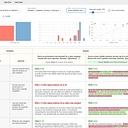
Data as of Sep 16, 2026 · Based on 350 AI responses from ChatGPT Search and Google AI Mode · See how Parse measures this
The best tool for building an LLM evaluation test set depends on your specific focus. 


Brands AI recommends here
Named in 63% of answers
DeepEval is best suited for engineering teams needing to build golden test datasets from documents for RAG accuracy, or for those integrating automated evaluation directly into unit testing and CI/CD pipelines.
Named in 44% of answers
Named in 40% of answers
Named in 39% of answers
Source | Citation share |
|---|---|
 Synthetic Dataset Generation for LLM Evaluation - Langfusehttps://langfuse.com/guides/cookbook/example_synthetic_datasets | 4.3% |
 How to create LLM test datasets with synthetic data - Evidently AIhttps://www.evidentlyai.com/llm-guide/llm-test-dataset-synthetic-data | 3.7% |
Evidently 0.7.11: open-source synthetic data generation for ...https://www.evidentlyai.com/blog/synthetic-data-generator-python | 3.0% |
 Generating Synthetic Datasets for LLM Evaluators & Agentshttps://arize.com/docs/phoenix/cookbook/tracing/generating-synthetic-datasets-for-llm-evaluators-and-agents | 2.7% |
 Generate synthetic data for evaluating RAG systems using Amazon Bedrockhttps://aws.amazon.com/blogs/machine-learning/generate-synthetic-data-for-evaluating-rag-systems-using-amazon-bedrock/ | 2.5% |
 Synthetic Data Generation for LLM Evaluationhttps://okareo.com/blog/posts/synthetic-data-generation | 2.4% |
 Best synthetic data generation tools for 2026https://www.k2view.com/blog/best-synthetic-data-generation-tools/ | 2.2% |
Datasets | DeepEval - The LLM Evaluation Frameworkhttps://deepeval.com/docs/evaluation-datasets | 2.1% |
 Master Synthetic Data Validation to Avoid AI Failure | Galileohttps://galileo.ai/blog/validating-synthetic-data-ai | 1.7% |
 Top 5 Synthetic Dataset Generators 2026: Rankedhttps://futureagi.com/blogs/top-5-synthetic-dataset-generators-2025 | 1.6% |
There is no single "best" tool overall, because the ideal synthetic data generator depends entirely on **what kind of LLM application** you are building. Instead of generic data generators (like Faker or Mockaroo), modern LLM engineering relies on evaluation frameworks with built-in synthetic data engines that…
There is no single "best" tool overall, because the ideal synthetic data generator depends entirely on what kind of LLM application you are building.
Instead of generic data generators (like Faker or Mockaroo), modern LLM engineering relies on evaluation frameworks with built-in synthetic data engines that understand context, reasoning, and prompt structures.
The top tools, categorized by their strengths, include:
Synthesizer that lets you generate synthetic "goldens" (evaluation test cases) straight from your raw documents or from scratch. Because DeepEval is tightly integrated with pytest, it makes turning synthetic data into automated regression tests smooth.For most engineering teams, the standard practice is a hybrid approach:
To narrow down the exact tool for your stack, tell me:
For **LLM evaluation datasets specifically**, I’d shortlist **Gretel Data Designer** first. It is designed to generate datasets from scratch, supports seeded examples, constraints, evaluations, and even LLM-as-a-judge columns; Gretel explicitly supports generating RAG question/ground-truth pairs.…
For LLM evaluation datasets specifically, I’d shortlist Gretel Data Designer first. It is designed to generate datasets from scratch, supports seeded examples, constraints, evaluations, and even LLM-as-a-judge columns; Gretel explicitly supports generating RAG question/ground-truth pairs.
Other strong options:
Important: synthetic data should supplement real/production examples rather than replace them; DeepEval itself recommends curated and production data first.
If you tell me whether you're evaluating RAG, agents, chat, coding, or a general-purpose LLM, I can recommend a concrete generation stack and test-set schema.
If your goal is specifically **generating synthetic test cases for evaluating an LLM**, my top pick today would be **DeepEval's Synthesizer**. [deepeval.com](https://deepeval.com/docs/synthetic-data-generation-introduction?utm_source=chatgpt.com) ### My recommendation
If your goal is specifically generating synthetic test cases for evaluating an LLM, my top pick today would be DeepEval's Synthesizer.
1. DeepEval — best overall for LLM evaluation datasets
DeepEval is particularly well suited because dataset generation and evaluation are part of the same workflow. Its Synthesizer can generate test cases from:
It also supports quality filtering and lets you customize the generation model, language, and output format.
The important advantage is that you're not just generating random synthetic prompts—you can generate evaluation goldens designed around the behavior you actually want to test. DeepEval also gives you 50+ evaluation metrics and CI/CD integration, so the dataset can become a regression suite afterward.
2. Ragas — best if you're primarily testing RAG
Ragas is a strong choice if your application is primarily a RAG system. It provides synthetic test generation alongside metrics such as faithfulness and context-related measures.
I'd choose Ragas over DeepEval if your evaluation problem is specifically:
"Given my documents/retrieval system, generate questions and contexts that stress-test retrieval and answer quality." 3. OpenAI Evals — best if you want a lightweight/custom evaluation framework
OpenAI Evals is excellent for actually running and maintaining evaluations, including private/custom evals, but I'd put DeepEval/Ragas ahead of it specifically for synthetic dataset generation.
I wouldn't generate your entire benchmark synthetically. A better approach is:
Production examples → human-curated seed set → synthetic augmentation → human review → frozen eval set
That's important because completely synthetic datasets can develop model-generated biases and blind spots. DeepEval itself recommends prioritizing curated/production data and using synthetic generation primarily to expand coverage and discover edge cases.
For example, I'd build a dataset with roughly:
| Category | Example |
|---|---|
| Normal cases | 40% |
| Edge cases | 20% |
| Adversarial cases | 15% |
| Ambiguous requests | 10% |
| Safety/policy cases | 5% |
| Long/complex inputs | 5% |
| Out-of-distribution cases | 5% |
Then have the synthesizer generate multiple variants of each seed scenario.
If you want one tool: choose DeepEval.
It gives you the strongest combination of synthetic test generation + dataset management + evaluation metrics + regression testing.
If you tell me what kind of LLM you're evaluating (chatbot, RAG, agent, extraction, coding model, customer support, etc.), I can recommend a specific synthetic-data architecture and show you how I'd generate a 1,000–10,000 case evaluation set without it becoming garbage synthetic data.
When bootstrapping an evaluation dataset for an LLM application, relying purely on manual data collection can be a slow, bottlenecked process. The industry standard has shifted toward specialized open-source evaluation frameworks that feature built-in **synthetic data…
When bootstrapping an evaluation dataset for an LLM application, relying purely on manual data collection can be a slow, bottlenecked process. The industry standard has shifted toward specialized open-source evaluation frameworks that feature built-in synthetic data synthesizers.
Rather than using generic synthetic data tools (like tabular data generators), the best tools for LLM evaluations are specifically built to ingest your raw domain documents (PDFs, text files, codebases) and output robust "golden" evaluation datasets (test queries, reference contexts, and expected answers).
Synthesizer module. You pass it a list of document paths (PDF, DOCX, TXT), and it automatically generates realistic "goldens" (test cases). It also supports generating adversarial test cases to intentionally try and break your application.Note: While synthetic data is a lifesaver for the cold-start problem, keep in mind that synthetic queries can miss strange user behaviors. Once your app goes live, the gold standard is to transition your eval set over to actual anonymized production traffic logs.
To help narrow down the best choice, tell me:
If your goal is **creating synthetic test sets specifically for evaluating an LLM**, the best tool depends on what you are evaluating (chatbot, RAG, agent, safety, prompt regressions, etc.). There is no single universal winner, but these are the strongest options today: Tool | Best for | Why choose it --- | --- | ---
If your goal is creating synthetic test sets specifically for evaluating an LLM, the best tool depends on what you are evaluating (chatbot, RAG, agent, safety, prompt regressions, etc.). There is no single universal winner, but these are the strongest options today:
| Tool | Best for | Why choose it |
|---|---|---|
| DeepEval | General LLM eval datasets, agents, chatbots, RAG | Best overall synthetic test generation workflow: generate from documents, contexts, existing examples, or scratch; integrates directly with eval metrics and CI testing. DeepEval DeepEval |
| Ragas | RAG evaluation datasets | Excellent for generating question-answer-context datasets and measuring retrieval quality (faithfulness, context precision/recall). GenAI QA |
| Promptfoo | Prompt regression, red teaming, model comparisons | Great when you already have test cases and want broad adversarial variation and automated model comparisons. GenAI QA |
| LangSmith | LangChain/LangGraph applications | Strong if your production traces already live in the LangChain ecosystem and you want to convert runs into datasets. Future AGI |
| Braintrust | Enterprise evaluation workflows | Good for teams that want datasets, experiments, human review, and production feedback loops together. Brainforge |
Start with DeepEval.
A strong workflow:
DeepEval is particularly strong because synthetic generation is tied into the evaluation workflow rather than being a standalone data generator.
Use Ragas + DeepEval.
Example dataset:
Context:
"Refunds are allowed within 30 days with proof of purchase."

Generated question:
"Can I return something I bought 3 weeks ago?"

Expected answer:
"Yes, if you have proof of purchase."

Failure categories:
- hallucination
- missing context
- wrong retrieval
- incomplete answer
Ragas is especially useful for creating retrieval-focused tests.
Use Promptfoo (often alongside another evaluator).
Generate:
Promptfoo is particularly strong for automated prompt/model testing and adversarial scenarios.
For most teams building an LLM product:
One important caveat: synthetic data should bootstrap coverage, not become your only source of truth. The highest-quality eval suites usually combine synthetic cases with real user failures and expert-reviewed examples.
If you tell me what you are evaluating (base model vs RAG app vs agent, domain, and whether you need open-source/self-hosted), I can recommend a more specific stack and dataset-generation pipeline.
The **[DeepEval Synthesizer](https://deepeval.com/guides/guides-using-synthesizer)** and **[Ragas Testset Generation](https://langfuse.com/guides/cookbook/example_synthetic_datasets)** are the best tools for generating synthetic evaluation datasets for…
The DeepEval Synthesizer and Ragas Testset Generation are the best tools for generating synthetic evaluation datasets for LLMs.
Choosing the right framework depends on your specific workflow and whether your primary focus is standard instruction-following or Retrieval-Augmented Generation (RAG).
| Feature / Tool | DeepEval (by Confident AI) | Ragas (Retrieval Augmented Generation Assessment) |
|---|---|---|
| Primary Use Case | General LLM apps, fine-tuning prep, and unit-testing workflows | Specialized RAG evaluation and context-grounded test sets |
| Data Source Inputs | Raw documents, custom seed topics, existing text chunks, or scratch | Text documents, PDF corpuses, and knowledge bases |
| Advanced Features | Edge-case "evolutions" (multistep, reasoning-heavy, hypothetical transforms) | Persona-based query generation and distribution tuning |
| Developer Workflow | Python, pytest integration, and local/cloud test management | Notebook-friendly python API and CI/CD integrations |
If you can share what your LLM application does (e.g., a customer support chatbot, a RAG document search tool, or a code generator) and what you want to test for (hallucinations, speed, formatting compliance, or safety), I can recommend the exact code setup or framework to start with.
The **best synthetic data generation tool depends entirely on your specific LLM architecture and application** . Because evaluating a RAG pipeline requires different test structures than evaluating a multi-turn conversational agent, the industry has split into specialized tooling…
The best synthetic data generation tool depends entirely on your specific LLM architecture and application . Because evaluating a RAG pipeline requires different test structures than evaluating a multi-turn conversational agent, the industry has split into specialized tooling lanes.
Core Recommendations by Use Case
If your LLM relies on a knowledge base, you need a tool that can ingest documents, extract contexts, and automatically evolve them into realistic user queries.
Synthesizer class. It chunks your documents, groups similar contexts, and applies "evolutions" to rewrite basic queries into multi-step, comparative, or hypothetical edge cases. It integrates seamlessly into pytest for CI/CD automation.If you are evaluating autonomous agents or complex customer support loops, basic question-answering pairs are insufficient.
fi.simulate , it generates persona-driven simulations—modeling adversarial, confused, or noisy human users—to stress-test how your agent platform reacts across multi-turn sessions.If you want an open-source, code-first infrastructure to generate both evaluation and fine-tuning datasets at massive scale, you need massive hardware optimization.
Comparison of Top Synthetic Data Generators
| Framework / Tool | Primary Strengths | Open Source? | Best Suited For |
|---|---|---|---|
| DeepEval | Local document-to-golden-dataset pipelines, evolution algorithms. | Yes | CI/CD testing & standard LLM verification. |
| Ragas | Deep focus on RAG metrics, context-based QA generation. | Yes | Knowledge bases and vector search apps. |
| Future AGI | Persona simulations, multi-turn tracking, user modeling. | No (Cloud Platform) | Complex AI Agents & conversational logic. |
| NeMo Data Designer | Code-first pipeline architecture, schema validation, scale. | Yes (Apache 2.0) | AI/ML engineers within GPU ecosystems. |
| Tonic Fabricate | Relational data mixing, unstructured text scrubbing. | Free tier available | Enterprise QA & safe production de-identification. |
3 Rules for Building an Effective Synthetic Test Set
To help narrow this down, what specific task or application (like RAG, text classification, or a chatbot) is your LLM performing? If you have existing raw data or documents you want to build from, let me know so I can suggest the exact code implementation.

There is no single “best” synthetic data generation tool for LLM evaluation datasets—the right choice depends on what you are evaluating (chatbot, RAG system, agent, safety, domain model, etc.). In practice, teams usually combine a **synthetic dataset generator** with an **evaluation framework** rather than relying on…
There is no single “best” synthetic data generation tool for LLM evaluation datasets—the right choice depends on what you are evaluating (chatbot, RAG system, agent, safety, domain model, etc.). In practice, teams usually combine a synthetic dataset generator with an evaluation framework rather than relying on one tool.
Here is the shortlist I would consider:
| Tool | Best for | Strengths | Weaknesses |
|---|---|---|---|
| Giskard | Broad QA + synthetic test generation | Generates tests for correctness, bias, security, hallucinations; good for enterprise workflows | More platform-oriented |
| RAGAS | RAG evaluation datasets | Excellent synthetic question generation from documents; creates multi-hop and adversarial RAG test cases | Mainly focused on retrieval systems |
| DeepEval | General LLM apps and agents | Synthetic dataset generation plus pytest-style evaluation; easy to integrate into CI | Less specialized for some RAG scenarios |
| Promptfoo | Prompt/model regression and red teaming | Generates adversarial variations and compares models/prompts | Less of a “golden dataset factory” |
| LangSmith | Production LLM applications | Strong tracing + dataset workflows | Best if you are already in the LangChain ecosystem |
GenAI QA DeepEval## My recommendation by use case
Use RAGAS first.
A strong workflow:
RAGAS is specifically designed around RAG metrics such as faithfulness, context relevance, and retrieval quality.
Use DeepEval.
It is closer to a software testing framework:
DeepEval also recommends using synthetic data as a supplement to curated production examples rather than as a replacement.
Use Promptfoo.
It is strong for generating:
GenAI QA## The stack I would choose for a serious LLM evaluation program
A practical setup:
Synthetic data is excellent for coverage, but purely synthetic benchmarks often miss the messy behavior seen in production.
If I had to pick one starting point:
When building an evaluation dataset for an LLM or RAG application, the "best" tool depends heavily on what you are starting with (e.g., raw documents, production logs, or a blank slate) and how you plan to run your evaluations. The top tools designed specifically for **generating LLM evaluation datasets** cluster into…
When building an evaluation dataset for an LLM or RAG application, the "best" tool depends heavily on what you are starting with (e.g., raw documents, production logs, or a blank slate) and how you plan to run your evaluations.
The top tools designed specifically for generating LLM evaluation datasets cluster into a few clear leaders:
A Quick Rule of Thumb for Choosing:
To help narrow down the exact tool you need, tell me:
If your goal is specifically **synthetically generating test cases for evaluating an LLM/agent**, rather than generating generic tabular synthetic data, I’d narrow the field considerably. ## My recommendation **Best overall: [gretel.ai](https://gretel.ai/navigator?utm_source=chatgpt.com)**
If your goal is specifically synthetically generating test cases for evaluating an LLM/agent, rather than generating generic tabular synthetic data, I’d narrow the field considerably.
Best overall: gretel.ai
Gretel is particularly well suited to your use case because it can generate RAG evaluation datasets, question/ground-truth pairs, domain-specific examples, and edge cases rather than merely creating statistically similar synthetic rows. Gretel explicitly positions Navigator for generating RAG evaluation datasets and testing/evaluating ML models.
I'd rank the options roughly like this:
| Tool | Best for | My take |
|---|---|---|
| Gretel Navigator | Synthetic LLM/RAG eval datasets | ⭐ Best overall for generation |
| langchain.com | Generating + running/managing LLM evals | ⭐ Best end-to-end eval platform |
| tonic.ai | Enterprise/domain-specific synthetic data | Excellent, particularly for regulated data |
| Argilla | Open-source data curation/annotation | Great if you want more control and self-hosting |
If you're building an evaluation system, I wouldn't optimize for "generate as much synthetic data as possible." Synthetic eval sets can easily become unrealistic or inadvertently encode the biases/capabilities of the model that generated them.
A better pipeline is:
10–50 carefully authored seed cases → synthetic expansion → adversarial/edge-case generation → human review → held-out evaluation set
That's actually consistent with LangSmith's guidance: synthetic generation works best when you start with several high-quality hand-crafted examples.
For example, if you're evaluating a customer-support LLM, I'd have the generator produce dimensions such as:
Then have a separate judge/human process validate the expected answer or scoring rubric.
If you're not just generating the dataset but want the whole evaluation loop, I'd actually choose LangSmith.
It lets you create datasets from hand-written cases, production traces, CSV/JSONL, and synthetic examples, then run experiments against those datasets with code-based evaluators, LLM-as-judge, human review, and pairwise comparisons.
So my practical recommendation is:
Gretel for generating sophisticated synthetic cases; LangSmith for storing, versioning, running, and analyzing the evaluation set. If you tell me what kind of LLM you're evaluating (RAG, chatbot, coding agent, customer support, extraction, classification, autonomous agent, etc.), I can give you a much more specific recommendation and propose the actual architecture for generating a high-quality 1K–100K-case eval set.
That's actually consistent with LangSmith's guidance: synthetic generation works best when you start with several high-quality hand-crafted examples.
For example, if you're evaluating a customer-support LLM, I'd have the generator produce dimensions such as: