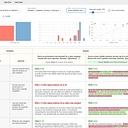
Data as of Sep 9, 2026 · Based on 351 AI responses from ChatGPT Search and Google AI Mode · See how Parse measures this
For RAG evaluation, 


Brands AI recommends here
Named in 79% of answers
Best for general-purpose RAG evaluation using research-backed, automated metrics. It is the industry standard for measuring component-level performance like faithfulness.
Named in 72% of answers
Best for software teams who want to incorporate LLM evaluation into CI/CD pipelines. It treats LLM outputs like standard code units and allows for Pytest-style testing.
Named in 56% of answers
Named in 42% of answers
Source | Citation share |
|---|---|
 Best RAG Evaluation Tools in 2026, Compared - Articles - Braintrusthttps://www.braintrust.dev/articles/best-rag-evaluation-tools | 5.6% |
RAG evaluation | Anyscale Docshttps://docs.anyscale.com/rag/evaluation | 3.2% |
 Evaluating RAG: A Comprehensive Guide to Measuring Qualityhttps://medium.com/@SkywardITSolutions/evaluating-rag-a-comprehensive-guide-to-measuring-quality-6ebc5bdf506e | 2.9% |
 Best Practices in RAG Evaluation: A Comprehensive Guidehttps://qdrant.tech/blog/rag-evaluation-guide/ | 2.5% |
Evaluate a RAG application - Docs by LangChainhttps://docs.langchain.com/langsmith/evaluate-rag-tutorial | 2.0% |
 7 RAG Evaluation Tools You Must Know - Iguaziohttps://www.iguazio.com/blog/best-rag-evaluation-tools/ | 1.9% |
 A complete guide to RAG evaluation: metrics, testing and best practiceshttps://www.evidentlyai.com/llm-guide/rag-evaluation | 1.8% |
 Best LLM Evaluation Tools: Top 9 Frameworks for Testing AI Models - ZenML Bloghttps://www.zenml.io/blog/best-llm-evaluation-tools | 1.8% |
RAG Evaluation Tools: How to Evaluate Retrieval Augmented ...https://medium.com/@alexchen3292/rag-evaluation-tools-how-to-evaluate-retrieval-augmented-generation-applications-45aba7b8ffe3 | 1.8% |
 RAG Evaluation Metrics: Best Practices for Evaluating RAG Systemshttps://www.patronus.ai/llm-testing/rag-evaluation-metrics | 1.8% |
There is **no single best framework** , as the right choice depends on your specific workflow, team focus, and production requirements. Industry consensus points to three leading open-source options, each optimized for a different stage or philosophy of RAG development:…
There is no single best framework , as the right choice depends on your specific workflow, team focus, and production requirements. Industry consensus points to three leading open-source options, each optimized for a different stage or philosophy of RAG development: RAGAS for rapid component-level pipeline metrics, DeepEval for CI/CD unit testing, and TruLens for agentic feedback loops and tracing.
To better understand how these top frameworks compare in practice, watch this breakdown of RAG evaluation tools:
32s
Top 3 RAG Evaluation Frameworks: RAGAS, DeepEval, and Opik 5 months ago
YouTube · Analytics Vidhya
| Framework | Best For | Core Metrics & Features |
|---|---|---|
| RAGAS | Rapid pipeline diagnostics and dataset scoring | Faithfulness, Answer Relevance, Context Precision, Context Recall |
| DeepEval | CI/CD integration and unit-test gating | G-Eval (custom criteria), Hallucination, CI/CD pipeline hooks |
| TruLens | Complex, agentic RAG and tracking | Feedback functions, Triad of RAG (relevance, groundedness, context) |
To help narrow down the best choice, tell me:
If your goal is specifically **evaluating a RAG system's answer quality**, my default recommendation today is **DeepEval**. It gives you both retrieval- and generation-level metrics and is designed around automated LLM evaluation/testing. [DeepEval](https://deepeval.com/docs/getting-started-rag?utm_source=chatgpt.com)…
If your goal is specifically evaluating a RAG system's answer quality, my default recommendation today is DeepEval. It gives you both retrieval- and generation-level metrics and is designed around automated LLM evaluation/testing.
| Framework | Best for | RAG evaluation | My take |
|---|---|---|---|
| DeepEval | Automated testing + CI/CD | ⭐⭐⭐⭐⭐ | Best default |
| Ragas | RAG-specific metrics/research | ⭐⭐⭐⭐⭐ | Best if you want a focused RAG toolkit |
| Phoenix | Tracing + debugging + evaluation | ⭐⭐⭐⭐⭐ | Best for production observability |
| TruLens | RAG instrumentation/evaluation | ⭐⭐⭐⭐ | Good alternative |
For RAG, you don't want a single "answer quality" score. You want to separate retrieval failures from generation failures.
DeepEval provides:
That gives you a very useful diagnostic matrix:
                    Generation
                 Good          Bad
              ┌───────────┬───────────┐
Retrieval Good│  GOOD RAG │ Hallucination│
              │           │ / bad prompt │
              ├───────────┼───────────┤
Retrieval Bad │ Lucky     │  BAD RAG   │
              │ answer    │            │
              └───────────┴───────────┘
In practice, I'd start with these four metrics:
1. Contextual Recall
2. Contextual Precision
3. Faithfulness
4. Answer Relevancy
Then add Answer Correctness against a human/reference answer if you have ground truth.
Ragas is an excellent choice if you want a framework specifically centered around RAG evaluation. Its classic evaluation approach covers answer relevancy, faithfulness, contextual precision, and contextual recall.
I'd choose Ragas over DeepEval if your primary goal is research/benchmarking RAG retrieval and you don't need a broader LLM testing framework.
If you're running RAG in production, I'd seriously consider Phoenix + DeepEval/Ragas rather than treating them as competitors.
Phoenix is particularly useful for seeing why an answer failed: traces, retrieved chunks, model calls, annotations, experiments, and evaluation results.
A strong production stack is therefore:
                 Your RAG application
                         │
                  OpenTelemetry
                         │
                    ┌────▼────┐
                    │ Phoenix │
                    │ tracing │
                    └────┬────┘
                         │
             ┌───────────┴───────────┐
             │                       │
       Retrieval evals         Answer evals
       ──────────────          ────────────
       Precision               Faithfulness
       Recall                  Relevancy
       Context relevance      Correctness
Don't blindly optimize an aggregate LLM-judge score. Build a small human-labeled evaluation set first—even 100–300 representative questions can be extremely valuable.
I'd structure each test case roughly as:
{
  "question": "...",
  "retrieved_context": ["...", "..."],
  "answer": "...",
  "reference_answer": "...",
  "metadata": {
    "category": "billing",
    "difficulty": "hard"
  }
}
Then evaluate retrieval and generation separately, and break results down by category/difficulty. This is much more actionable than saying "our RAG score is 0.87."
Bottom line:
If you tell me your stack (e.g. LangChain/LlamaIndex/custom + Pinecone/pgvector/Elasticsearch + OpenAI/Anthropic), I can give you a concrete evaluation architecture and the exact metrics/test dataset I'd use.
1. Contextual Recall
2. Contextual Precision
3. Faithfulness
4. Answer Relevancy
Then add Answer Correctness against a human/reference answer if you have ground truth.
Ragas is an excellent choice if you want a framework specifically centered around RAG evaluation. Its classic evaluation approach covers answer relevancy, faithfulness, contextual precision, and contextual recall.
I'd choose Ragas over DeepEval if your primary goal is research/benchmarking RAG retrieval and you don't need a broader LLM testing framework.
If you're running RAG in production, I'd seriously consider Phoenix + DeepEval/Ragas rather than treating them as competitors.
Phoenix is particularly useful for seeing why an answer failed: traces, retrieved chunks, model calls, annotations, experiments, and evaluation results.
A strong production stack is therefore:
                 Your RAG application
                         │
                  OpenTelemetry
                         │
                    ┌────▼────┐
                    │ Phoenix │
                    │ tracing │
                    └────┬────┘
                         │
             ┌───────────┴───────────┐
             │                       │
       Retrieval evals         Answer evals
       ──────────────          ────────────
       Precision               Faithfulness
       Recall                  Relevancy
       Context relevance      Correctness
Don't blindly optimize an aggregate LLM-judge score. Build a small human-labeled evaluation set first—even 100–300 representative questions can be extremely valuable.
I'd structure each test case roughly as:
{
  "question": "...",
  "retrieved_context": ["...", "..."],
  "answer": "...",
  "reference_answer": "...",
  "metadata": {
    "category": "billing",
    "difficulty": "hard"
  }
}
Then evaluate retrieval and generation separately, and break results down by category/difficulty. This is much more actionable than saying "our RAG score is 0.87."
Bottom line:
If your goal is **evaluating a production RAG system**, my default recommendation today would be **DeepEval**—with **Ragas** as the strongest alternative. ### My recommendation **1. [deepeval.com](https://deepeval.com/?utm_source=chatgpt.com) — best overall for engineering teams**
If your goal is evaluating a production RAG system, my default recommendation today would be DeepEval—with Ragas as the strongest alternative.
1. deepeval.com — best overall for engineering teams
It has a particularly good fit for RAG because it separates retrieval quality from generation quality:
It also fits naturally into CI/CD with pytest-style assertions, supports custom LLM-as-a-judge criteria, and can evaluate black-box RAG systems as well as individual components.
2. docs.ragas.io — best if you want a RAG-focused evaluation toolkit
Ragas has a strong RAG-specific metric set, including context precision, context recall, faithfulness, and other retrieval/generation metrics. It's a good choice if your primary concern is systematically tuning the retrieval pipeline.
3. phoenix.arize.com — particularly good for observability + evaluation
I'd consider Phoenix when you want evaluation tightly coupled with tracing, debugging, and production observability, rather than just an offline evaluation test suite.
Don't collapse RAG quality into one score. I'd start with these five:
| Metric | What it tells you |
|---|---|
| Faithfulness | Is the answer grounded in retrieved evidence? |
| Answer relevance | Did the answer actually answer the question? |
| Context relevance | Did retrieval bring back useful material? |
| Context precision | Were useful chunks ranked above junk? |
| Context recall | Did retrieval find all the necessary information? |
If you don't have ground-truth answers, start with the first three. DeepEval calls this the RAG Triad: answer relevancy + faithfulness + contextual relevancy. It is specifically designed to work without labeled expected answers.
If you do have ground-truth answers, add contextual precision and recall for much better retrieval diagnostics.
LLM-as-a-judge isn't automatically reliable. I would create a human-labeled evaluation set of ~100–300 representative questions, including:
Then validate that your evaluator's judgments correlate with human judgments. This is more important than picking between Ragas and DeepEval.
Bottom line: If you're building an engineering-grade RAG evaluation pipeline, I'd start with DeepEval + a human-labeled golden set, and use Ragas if you want a more RAG-specialized metric toolkit. For production systems, I'd pair either with Phoenix for tracing/observability.
If you tell me your stack (e.g. LangChain/LlamaIndex/custom Python + OpenAI/Claude/local LLM + vector DB), I can recommend a concrete evaluation architecture and metrics, including a sample test suite.
Don't collapse RAG quality into one score. I'd start with these five:
| Metric | What it tells you |
|---|---|
| Faithfulness | Is the answer grounded in retrieved evidence? |
| Answer relevance | Did the answer actually answer the question? |
| Context relevance | Did retrieval bring back useful material? |
| Context precision | Were useful chunks ranked above junk? |
| Context recall | Did retrieval find all the necessary information? |
If you don't have ground-truth answers, start with the first three. DeepEval calls this the RAG Triad: answer relevancy + faithfulness + contextual relevancy. It is specifically designed to work without labeled expected answers.
If you do have ground-truth answers, add contextual precision and recall for much better retrieval diagnostics.
LLM-as-a-judge isn't automatically reliable. I would create a human-labeled evaluation set of ~100–300 representative questions, including:
The **[Ragas (Retrieval Augmented Generation Assessment)](https://github.com/explodinggradients/ragas)** and **DeepEval by Confident AI** frameworks are the current industry standards for evaluating RAG systems, each leading in specific use…
The Ragas (Retrieval Augmented Generation Assessment) and DeepEval by Confident AI frameworks are the current industry standards for evaluating RAG systems, each leading in specific use cases.
Because RAG quality depends on both the retriever (did it find the right facts?) and the generator (did it write an honest answer?), the best framework depends on whether you need automated open-source component testing or comprehensive unit-testing pipelines.
Top RAG Evaluation Frameworks Compared
| Framework | Best For | Core Metrics Included | Setup / Integration |
|---|---|---|---|
| Ragas | CI/CD pipelines & synthetic data generation without heavy labeling | Faithfulness, Answer Relevance, Context Precision, Context Recall | Python library, integrates seamlessly with LangChain, LlamaIndex |
| DeepEval | Unit-testing LLM apps like a software engineer | G-Eval (custom), Hallucination, Contextual Relevancy, Bias, Toxicity | Pytest integration, CLI, optional dashboard via Confident AI |
| Arize Phoenix | Visual debugging & tracing steps visually | Latency, token usage, retrieval evaluation, embeddings visualization | Notebook-friendly, great UI for inspecting intermediate node steps |
The Core RAG Metrics You Must Track
Regardless of the framework you choose, a complete evaluation measures two distinct layers:
If you'd like to narrow this down, tell me:
I can give you a starter code snippet for the right framework.
If your main goal is **evaluating the quality of answers from a RAG system**, my default recommendation today is **DeepEval**. [DeepEval](https://deepeval.com/docs/introduction?utm_source=chatgpt.com) [DeepEval](https://deepeval.com/guides/guides-rag-evaluation?utm_source=chatgpt.com) That said, **Ragas** is an…
If your main goal is evaluating the quality of answers from a RAG system, my default recommendation today is DeepEval.
That said, Ragas is an excellent alternative, and Arize Phoenix is particularly attractive if you also want observability, tracing, datasets, and experiment tracking.
| Framework | Best for | RAG evaluation | CI/regression | Observability |
|---|---|---|---|---|
| DeepEval | Engineering teams / automated tests | ⭐⭐⭐⭐⭐ | ⭐⭐⭐⭐⭐ | ⭐⭐⭐⭐ |
| Ragas | RAG-specific experimentation | ⭐⭐⭐⭐⭐ | ⭐⭐⭐⭐ | ⭐⭐⭐ |
| Arize Phoenix | Debugging + production observability | ⭐⭐⭐⭐ | ⭐⭐⭐⭐ | ⭐⭐⭐⭐⭐ |
| Custom LLM judge | Highly specialized quality criteria | ⭐⭐⭐⭐⭐ | ⭐⭐⭐ | ⭐⭐ |
I'd start with DeepEval if you're building a serious evaluation suite rather than just running a one-off benchmark. It has RAG-specific metrics, pytest-style tests, custom metrics, synthetic test generation, and component-level evaluation.
Don't use a single "answer quality" score. Break RAG quality into at least these dimensions:
DeepEval explicitly separates the retrieval and generation sides this way.
Ragas has essentially the same core RAG evaluation surface, including context precision/recall, response relevancy, and faithfulness.
I'd build your evaluation pipeline roughly like this:
                 Your RAG pipeline
                       │
          ┌────────────┴────────────┐
          │                         │
     Retrieved chunks            Answer
          │                         │
          ▼                         ▼
 Context relevance            Answer relevance
 Context precision            Faithfulness
 Context recall               Correctness
          │                         │
          └────────────┬────────────┘
                       ▼
                 Overall eval
                       │
              Regression tests
For example, with DeepEval you can evaluate a test case containing:
LLMTestCase(
    input="What is our refund policy?",
    actual_output=rag_answer,
    retrieval_context=retrieved_chunks,
    expected_output=gold_answer,  # optional
)
Then run something like:
metrics = [
    ContextualRelevancyMetric(),
    ContextualPrecisionMetric(),
    ContextualRecallMetric(),
    AnswerRelevancyMetric(),
    FaithfulnessMetric(),
]
The first three diagnose retrieval, while the latter two diagnose generation.
If you don't have ground-truth answers, you can still get a very useful evaluation. The "RAG triad" of:
is specifically designed to work without an expected_output.
But if you can create even 100–500 high-quality golden questions + expected answers, I'd strongly recommend doing so. Reference-based evaluation lets you measure whether the system actually produced the right answer, rather than merely producing a plausible, well-grounded one.
I'd choose Phoenix instead of—or alongside—DeepEval if your biggest problem is "Why did this particular RAG answer fail?" Phoenix gives you traces showing retrieval, model calls, and application behavior, plus evaluation and experiment workflows.
So my practical stack would be:
DeepEval + Phoenix
If you tell me what your RAG stack is (e.g. LangChain/LlamaIndex/custom + vector DB + which LLM), I can recommend a concrete evaluation architecture and the 5–10 metrics I'd use, including how to build a representative eval dataset.
I'd choose Phoenix instead of—or alongside—DeepEval if your biggest problem is "Why did this particular RAG answer fail?" Phoenix gives you traces showing retrieval, model calls, and application behavior, plus evaluation and experiment workflows.
So my practical stack would be:
DeepEval + Phoenix
LLMTestCase(
    input="What is our refund policy?",
    actual_output=rag_answer,
    retrieval_context=retrieved_chunks,
    expected_output=gold_answer,  # optional
)
Then run something like:
metrics = [
    ContextualRelevancyMetric(),
    ContextualPrecisionMetric(),
    ContextualRecallMetric(),
    AnswerRelevancyMetric(),
    FaithfulnessMetric(),
]
The first three diagnose retrieval, while the latter two diagnose generation.
If you don't have ground-truth answers, you can still get a very useful evaluation. The "RAG triad" of:
is specifically designed to work without an expected_output.
There is no single "best" framework because the ideal choice depends on your specific workflow (CI/CD testing vs. production tracing) and whether your RAG pipeline stands alone or lives inside a larger agentic system.[](https://deepeval.com/blog/top-5-llm-evaluation-frameworks)…
There is no single "best" framework because the ideal choice depends on your specific workflow (CI/CD testing vs. production tracing) and whether your RAG pipeline stands alone or lives inside a larger agentic system.
The top-tier open-source frameworks specialize in different strengths:
How to Choose
To help narrow down the right choice, tell me:
If your goal is specifically **evaluating a RAG system's answers**, my default choice today would be **DeepEval**. [DeepEval](https://deepeval.com/docs/metrics-introduction?utm_source=chatgpt.com) [DeepEval](https://deepeval.com/guides/guides-rag-evaluation?utm_source=chatgpt.com) ### My recommendation Framework |…
If your goal is specifically evaluating a RAG system's answers, my default choice today would be DeepEval.
| Framework | Best for | My take |
|---|---|---|
| DeepEval | RAG + automated testing + CI/CD | ⭐ Best overall |
| Ragas | RAG-specific metrics and experimentation | ⭐ Excellent alternative |
| TruLens | Observability + evaluation/tracing | Good if monitoring matters |
| LangSmith | LangChain ecosystem + datasets/tracing | Great if you're already using LangChain |
For a RAG system, I wouldn't judge the final answer with just one "correctness" score. You want to separate retrieval quality from generation quality.
DeepEval gives you five particularly useful RAG metrics:
The first two primarily evaluate generation; the latter three diagnose retrieval.
This is where I'd start with the RAG triad:
Question → Retrieved Context → Answer
Measure:
These can be run without an expected_output, making them particularly useful when you have thousands of real user questions but don't have manually written reference answers.
Then create a smaller, high-quality golden dataset—say 100–500 representative questions with expected answers—and add contextual precision/recall and your own correctness criteria.
Ragas is absolutely worth considering. It has a strong RAG-specific metric set, including context precision/recall, response relevancy, faithfulness, noise sensitivity, and others.
But I'd lean DeepEval if you're building an evaluation system, rather than just calculating RAG metrics. It has:
That last part is particularly useful: a score of 0.62 isn't nearly as useful as "the answer made claim X, but no retrieved chunk supports X."
Don't blindly trust LLM-as-a-judge scores. For a serious production evaluation, I'd combine:
Automated evals → faithfulness, relevancy, retrieval precision/recall
+ Human evaluation → correctness, usefulness, domain-specific quality
+ Regression tests → a fixed golden dataset that runs whenever you change chunking, embeddings, reranking, prompts, or the generation model.
I'd also keep your evaluation dimensions to roughly 5 metrics or fewer initially rather than creating a giant dashboard of scores. DeepEval itself recommends limiting the number of metrics and adding custom criteria only where they matter to your application.
Bottom line: If you're starting from scratch, I'd use DeepEval + a 100–500 question golden set + the RAG triad, then add domain-specific G-Eval criteria for whatever "good answer" means in your application.
The best and most popular framework for evaluating Retrieval-Augmented Generation (RAG) systems is **[Ragas (Retrieval Augmented Generation Assessment)](https://docs.ragas.io/)** , closely followed by **[DeepEval](https://docs.confident-ai.com/)** and **[Arize…
The best and most popular framework for evaluating Retrieval-Augmented Generation (RAG) systems is Ragas (Retrieval Augmented Generation Assessment) , closely followed by DeepEval and Arize Phoenix.
The choice of framework depends on your specific workflow, but most modern setups use the "LLM-as-a-judge" approach rather than legacy word-overlap metrics like BLEU or ROUGE.
Top RAG Evaluation Frameworks
| Framework | Best For | Key Metrics Checked |
|---|---|---|
| Ragas | Automated pipeline evaluation & CI/CD integration | Faithfulness, Answer Relevance, Context Precision, Context Recall |
| DeepEval | Unit testing RAG components during development | Hallucination, Bias, Toxicity, Summarization, RAG Triad |
| Arize Phoenix | Visualizing traces, embeddings, and debugging retrieval | Latency, Token Usage, Retrieval Relevance, Step-by-Step Tracing |
Core Metrics You Need to Measure
Instead of testing the final output as a single block, effective RAG evaluation splits performance into the "RAG Triad":
If you share what data formats you are querying (e.g., PDFs, SQL databases, APIs) or your current tech stack , I can recommend a specific evaluation script or metric configuration.
Evaluating a RAG system requires looking at two distinct layers: **retrieval quality** (did you fetch the right chunks?) and **generation quality** (did the LLM synthesize a truthful, helpful answer without hallucinating?).[](https://www.youtube.com/watch?v=qe22zt5z3MI&t=97)…
Evaluating a RAG system requires looking at two distinct layers: retrieval quality (did you fetch the right chunks?) and generation quality (did the LLM synthesize a truthful, helpful answer without hallucinating?).
There is no single "best" framework universally, but rather a few top-tier open-source options tailored to different workflows.
Top RAG Evaluation Frameworks Compared
The Core Metrics You Must Measure
No matter which framework you pick, make sure you are evaluating the RAG Triad:
To help narrow down the ideal framework for your stack, tell me:
If your goal is specifically **evaluating the quality of a RAG system's answers**, my default recommendation today is **DeepEval**. It has first-class RAG metrics, pytest-style regression testing, component-level evaluation, and customizable LLM-as-a-judge metrics.…
If your goal is specifically evaluating the quality of a RAG system's answers, my default recommendation today is DeepEval. It has first-class RAG metrics, pytest-style regression testing, component-level evaluation, and customizable LLM-as-a-judge metrics.
| Framework | Best for | My take |
|---|---|---|
| DeepEval | RAG + CI/CD + systematic testing | Best overall |
| Ragas | RAG-specific experimentation/research | Excellent alternative |
| Arize Phoenix | RAG observability + evaluation | Best if you also need tracing/production debugging |
| LangSmith | LangChain-heavy applications | Great integrated platform |
Don't use a single "answer quality" score. RAG has two failure points: retrieval and generation.
I'd start with these five:
DeepEval explicitly provides these five RAG metrics, with the first two focused on generation and the latter three on retrieval.
If you don't have human-written ground-truth answers, start with the RAG triad:
Answer relevancy + faithfulness + contextual relevancy These can be evaluated without an
expected_output, which makes them practical for evaluating an existing production RAG corpus.
If you do have gold answers, add contextual precision/recall for much stronger retrieval evaluation.
I'd choose DeepEval if you're building a repeatable engineering test suite:
I'd choose Ragas if you're primarily doing RAG experimentation and benchmarking. It has a particularly broad collection of RAG metrics, including context precision/recall, entity recall, noise sensitivity, response relevancy, and faithfulness.
One important detail: faithfulness isn't the same thing as correctness. A response can be perfectly faithful to retrieved context that happens to be wrong or incomplete. Ragas, for example, defines faithfulness in terms of whether the response's claims are supported by the retrieved context.
For a serious RAG evaluation suite, I'd structure it roughly like:
                         RAG EVALUATION
                              │
              ┌───────────────┴───────────────┐
              │                               │
          RETRIEVAL                       GENERATION
              │                               │
     ┌────────┼────────┐               ┌──────┴──────┐
     │        │        │               │             │
 Precision   Recall  Relevancy     Faithfulness  Answer
                                                   Relevancy
Then add one domain-specific correctness metric. For example, if you're building a customer-support RAG, you might evaluate:
"Would this answer resolve the customer's issue correctly according to our policy?" That custom criterion is often more valuable than adding another generic metric. DeepEval supports custom G-Eval criteria for exactly this kind of evaluation.
Bottom line: Start with DeepEval + 5 RAG metrics + a small human-labeled golden set. Use the evaluation suite to distinguish "the retriever didn't find the answer" from "the LLM found it but answered incorrectly." That distinction is what makes RAG evaluation actually useful for improving the system.