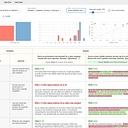
Data as of Sep 19, 2026 · Based on 354 AI responses from ChatGPT Search and Google AI Mode · See how Parse measures this
To scan your code for insecure LLM library usage, use developer-first SAST tools like 

Brands AI recommends here
Named in 70% of answers
Best for teams needing a customizable, lightweight scanner. Its ability to support custom rules allows you to detect specific, project-tailored insecure patterns in how your team calls AI libraries.
Named in 41% of answers
Ideal for developer-first workflows, this tool uses deep code analysis to spot dangerous data flow paths into LLM libraries, providing real-time feedback and remediation suggestions directly in your editor.
Named in 38% of answers
Named in 34% of answers
An open-source red-teaming tool rather than a standard code scanner. It is best used for proactively probing your LLM systems to simulate attacks and identify potential weaknesses in your security setup.
Source | Citation share |
|---|---|
 Top 12 LLM Security Tools: Paid & Free (Overview) | Lakera – Protecting AI teams that disrupt the world.https://www.lakera.ai/blog/llm-security-tools | 5.2% |
AISentryhttps://aisentry.co/ | 3.2% |
 The Top 7 Best Static Code Analysis Tools of 2026https://www.aikido.dev/blog/static-code-analysis-tools | 2.7% |
Navigating AI for Source Code Analysishttps://snyk.io/articles/navigating-ai-for-source-code-analysis/ | 2.3% |
 2025 Guide to the Best Code Security Scan Toolshttps://www.stackhawk.com/blog/code-security-scan-tools/ | 2.3% |
 10 LLM Security Tools to Know in 2025https://www.pynt.io/learning-hub/llm-security/10-llm-security-tools-to-know | 1.7% |
 10 best LLM security tools to use in 2026https://nexos.ai/blog/llm-security-tools/ | 1.6% |
 Top 10 SAST Tools in 2026 for Secure Engineering Workflowshttps://www.ox.security/blog/static-application-security-sast-tools/ | 1.6% |
 Code Scanning: Why, How, and the Role in AI Securityhttps://www.mend.io/blog/code-scanning-guide/ | 1.6% |
 Top 10 Code Analysis Tools in 2025 | Cycodehttps://cycode.com/blog/top-10-code-analysis-tools/ | 1.6% |
**Semgrep** combined with its community-driven and official [Semgrep Registry](https://semgrep.dev/registry) rulesets is currently the **best and most adaptable static analysis tool** for catching insecure usage of LLM libraries and OWASP Top 10 for LLM…
Semgrep combined with its community-driven and official Semgrep Registry rulesets is currently the best and most adaptable static analysis tool for catching insecure usage of LLM libraries and OWASP Top 10 for LLM risks.
While traditional enterprise SAST tools (like Snyk Code and GitHub CodeQL ) are catching up with generic data-flow and taint analysis, LLM-specific misconfigurations (such as unvalidated prompt construction, insecure LangChain chaining, missing guardrails, or excessive agency permissions) require customizable pattern matching that Semgrep provides out-of-the-box via flexible YAML rules.
| Tool | Core Strength for LLM Code | Best Use Case |
|---|---|---|
| Semgrep | Custom AST-based pattern matching; dedicated rules for LLM injections, insecure API keys, and framework misuses (LangChain, LlamaIndex). | CI/CD pipeline blocking and writing custom AI-security rules. |
| Snyk Code | DeepCode AI engine mapping standard data flows and third-party AI package vulnerabilities (SCA + SAST combo). | Real-time developer IDE feedback and tracking vulnerable PyPI/npm AI packages. |
| CodeQL | Advanced semantic code analysis treating code as data to trace prompt-to-sink data paths. | Deep enterprise source-code queries for complex taint analysis. |
| Bandit | Lightweight, focused Python security linting (catches insecure deserialization like pickle often used in ML/LLM persistence). | Quick, lightweight security checks in Python-heavy AI/ML backends. |
When configuring your static analysis rules, ensure your scanning pipeline targets these specific AI vulnerabilities:
pickle or joblib.If you share which programming languages and frameworks (e.g., Python with LangChain, TypeScript with Vercel AI SDK) your stack relies on, I can help you write or find specific Semgrep rules for your pipeline.
If you mean **static analysis of your application code that uses LLM libraries** (OpenAI SDKs, LangChain, LlamaIndex, Hugging Face, agent frameworks, MCP tooling, etc.), there is no single universally best tool yet. The strongest approach is usually a **hybrid: AI-aware SAST + custom rules + AI supply-chain…
If you mean static analysis of your application code that uses LLM libraries (OpenAI SDKs, LangChain, LlamaIndex, Hugging Face, agent frameworks, MCP tooling, etc.), there is no single universally best tool yet. The strongest approach is usually a hybrid: AI-aware SAST + custom rules + AI supply-chain scanning.
Good options by use case:
| Tool | Best fit | What it can catch |
|---|---|---|
| semgrep.dev | Fast developer-focused scanning with custom AI rules | Unsafe LLM API usage patterns, secrets in prompts, dangerous tool calls, insecure data flows, custom organization rules |
| github.com (CodeQL) | GitHub-native enterprise workflows | Deep data-flow analysis, vulnerable code paths, secrets, dependency issues; can be extended with queries for AI-specific patterns |
| snyk.io | Broad AppSec coverage | SAST, SCA, secrets, dependency risks around AI libraries and packages |
| checkmarx.com | Enterprise AI supply-chain visibility | AI component discovery, model/package scanning, AI-BOM generation, unsafe model artifact checks OWASP Gen AI Security Project Checkmarx |
| aghast.owasp.org | Experimental/open-source AI-assisted security analysis | Combines static discovery with AI-guided checks for codebase-specific security issues OWASP AGHAST |
For LLM-library misuse specifically, I would look for rules covering patterns like:
Sending sensitive data into prompts:
PII, secrets, credentials, source code, customer records
Unsafe agent/tool execution:
LLM output directly reaching exec(), shell commands, SQL, filesystem writes, browser automation, or privileged APIs
Prompt injection exposure:
Untrusted user content concatenated into system/developer prompts
Dangerous model loading:
pickle/unsafe deserialization
untrusted Hugging Face model code (trust_remote_code=True)
Weak API-key handling:
hardcoded provider keys
keys logged in traces
Over-permissive agent permissions:
tools with excessive filesystem/network/database access
Insecure RAG pipelines:
untrusted documents influencing authorization decisions
missing tenant isolation
A practical setup I would recommend:
If you tell me your stack (Python/JavaScript/Java, LangChain vs raw SDKs, GitHub/GitLab, cloud environment), I can suggest a more targeted toolchain and example rules.
A practical setup I would recommend:
If your goal is specifically **static analysis of code that uses LLMs/AI agents**, my first choice today is **Semgrep**—particularly **Semgrep Code + its AI Security/Guardian rules**. Why: - **Understands AI-specific risks**, not just generic SAST. Its AI-security rules cover things like **prompt injection,…
If your goal is specifically static analysis of code that uses LLMs/AI agents, my first choice today is Semgrep—particularly Semgrep Code + its AI Security/Guardian rules.
Why:
For a repository containing LLM integrations, I'd run:
There are also newer SAST+LLM hybrids such as Cisco's ai-deep-sast and Visa's VVAH, but the ecosystem is moving quickly and their maturity/maintenance varies. A recent comparison describes Semgrep/CodeQL-style deterministic analysis feeding LLM reasoning as one of the major approaches.
Bottom line: If you want one tool to start with, I'd pick Semgrep. If you tell me your stack (e.g. Python + LangChain, TypeScript + OpenAI SDK, Java + Spring AI, etc.), I can also give you a concrete set of AI-security rules/checks to run against the repo, including the insecure patterns I'd specifically hunt for.
When scanning application source code for insecure usage of LLM libraries, APIs, and data flows (mapping to the [OWASP Top 10 for LLM Applications](https://owasp.org/www-project-top-10-for-large-language-model-applications) ), you need a tool that bridges traditional AST (Abstract Syntax Tree) scanning with semantic…
When scanning application source code for insecure usage of LLM libraries, APIs, and data flows (mapping to the OWASP Top 10 for LLM Applications ), you need a tool that bridges traditional AST (Abstract Syntax Tree) scanning with semantic awareness of AI/LLM constructs.
The top tools specialized or heavily extended for this exact use case include:
To help narrow this down, tell me:
Scanning code for insecure usage of LLM libraries—such as unvalidated prompt concatenation, missing safety filters, excessive agency/tool permissions, or hardcoded provider API keys—requires tools that understand both traditional software bugs and the **OWASP Top 10 for Large Language Model…
Scanning code for insecure usage of LLM libraries—such as unvalidated prompt concatenation, missing safety filters, excessive agency/tool permissions, or hardcoded provider API keys—requires tools that understand both traditional software bugs and the OWASP Top 10 for Large Language Model Applications.
The landscape is split between deterministic SAST engines (with specialized AI rulesets) and AI-augmented SAST frameworks that use contextual reasoning to trace data flows into LLM calls.
p/ai-best-practices ) designed to inspect code interfacing with OpenAI, Anthropic, Gemini, Mistral, and Cohere. It flags anti-patterns like hardcoded API keys, unvalidated user inputs flowing directly into model prompts (Prompt Injection), missing safety settings, and insecure output parsing.openai.chat.completions wrapper without sanitization.semgrep -c p/ai-best-practices.If you stumble across Garak (Generative AI Red-teaming & Assessment Kit) , note that it is not a static code analyzer. Garak acts like an nmap for live AI endpoints—it fuzzes and bombards deployed running models with prompt injections and jailbreaks to see how the model behaves. You use Semgrep or Snyk to scan your source code repository, and Garak later when testing the deployed model endpoint.
To help narrow down the best setup for your stack, tell me:
If your goal is **static analysis specifically for insecure LLM/AI-library usage**, my top pick today is **[semgrep.dev](https://semgrep.dev/?utm_source=chatgpt.com)**. It now has dedicated **AI Security** and **Shadow AI** rulesets rather than treating LLM code as ordinary application code. Its AI-security rules…
If your goal is static analysis specifically for insecure LLM/AI-library usage, my top pick today is semgrep.dev.
It now has dedicated AI Security and Shadow AI rulesets rather than treating LLM code as ordinary application code. Its AI-security rules cover things such as prompt injection, unrestricted tool use, data exfiltration, insecure AI-framework integrations, and unsafe configurations across providers/frameworks including OpenAI, Anthropic, Gemini, LangChain, Bedrock, and others.
js/system-prompt-injection query that tracks untrusted input flowing into system prompts, with support for additional OpenAI, Anthropic, and Google GenAI SDK APIs. llm-seclint — interesting lightweight option for Python. It's specifically designed as an AST-based static linter for LLM applications, detecting things like prompt injection paths, LLM output flowing to eval/subprocess/SQL, API-key exposure, path traversal, and unsafe dependencies. It's newer and much narrower than Semgrep/CodeQL. My recommendation: use Semgrep as the primary scanner, and supplement it with CodeQL if you're already using GitHub Advanced Security. Don't rely on a generic SAST scanner alone—the interesting AI vulnerabilities are often data-flow relationships involving model inputs/outputs and tools, rather than simply "this library call is dangerous."
If you tell me your stack (e.g. Python + OpenAI/LangChain, TypeScript + Anthropic, etc.), I can recommend the exact rulesets and give you a CI configuration for scanning it.
Scanning code for insecure usage of LLM libraries (like missing input sanitization, exposed API keys, dangerous deserialization, or unvalidated prompt construction) requires tools that bridge **traditional static code analysis (SAST)** with **AI context…
Scanning code for insecure usage of LLM libraries (like missing input sanitization, exposed API keys, dangerous deserialization, or unvalidated prompt construction) requires tools that bridge traditional static code analysis (SAST) with AI context awareness.
Traditional SAST struggles because it catches general syntax/secrets leaks but misses how untrusted data propagates into LLM context windows or agentic tools. The industry has shifted toward hybrid approaches and specialized scanners.
The Top Recommendations
Comparison at a Glance
To help narrow down the ideal setup, could you share:
If your goal is specifically **finding insecure use of LLMs/AI libraries in source code**, my first choice today would be **Semgrep**, particularly its AI-security rulesets. ### Best fit: Semgrep [semgrep.dev](https://semgrep.dev/?utm_source=chatgpt.com) has added dedicated AI-security coverage rather than treating…
If your goal is specifically finding insecure use of LLMs/AI libraries in source code, my first choice today would be Semgrep, particularly its AI-security rulesets.
semgrep.dev has added dedicated AI-security coverage rather than treating LLM code like ordinary application code. Its current rules cover things such as:
It also has dataflow analysis, so you can detect a vulnerability based on how data moves through the program rather than simply matching a suspicious API call.
For example, Semgrep explicitly provides an AI-best-practices ruleset that can be run with:
semgrep -c p/ai-best-practices
Semgrep### Runner-up: CodeQL
If you're already heavily invested in GitHub, CodeQL is probably the strongest alternative. Its advantage is deep semantic/dataflow analysis, and it now has an explicit JavaScript/TypeScript query for system-prompt injection—detecting untrusted user input flowing into an AI model's system prompt.
So I'd choose:
| Situation | Pick |
|---|---|
| Dedicated LLM/AI security scanning | Semgrep |
| GitHub-native security program | CodeQL |
| Broad traditional SAST + AI security | Semgrep |
| Need highly customized security queries | CodeQL or Semgrep |
| Detecting risks while AI coding agents generate code | Semgrep Guardian |
One important distinction: static analysis won't catch every AI security problem. It is particularly good for insecure integration patterns—e.g. user_input → prompt → model, model_output → SQL, or model → unrestricted shell/tool. Runtime behavior such as jailbreak resistance and model-specific safety needs complementary dynamic testing.
If you tell me your language/framework (Python + LangChain, TypeScript + OpenAI SDK, Java, etc.), I can give you a concrete Semgrep/CodeQL ruleset and a checklist of the LLM-specific patterns I'd scan for.
If your goal is specifically **“find insecure ways our application uses LLM/agent libraries”**, my first choice today would be **[semgrep.dev](https://semgrep.dev/?utm_source=chatgpt.com)**, particularly Semgrep Code plus its AI-security rules/Guardian. ### Why Semgrep is a strong fit - **Actual static analysis:** It…
If your goal is specifically “find insecure ways our application uses LLM/agent libraries”, my first choice today would be semgrep.dev, particularly Semgrep Code plus its AI-security rules/Guardian.
openai, anthropic, LangChain, etc.I'd use it roughly like this:
                 Your codebase
                      │
          ┌───────────▼───────────┐
          │       Semgrep         │
          ├───────────────────────┤
          │ Traditional SAST      │
          │ AI/LLM security rules │
          │ Secrets               │
          │ Dependencies / SCA    │
          │ Data-flow analysis    │
          └───────────┬───────────┘
                      │
             AI-specific findings
                      │
          ┌───────────▼───────────┐
          │ Manual / AI-assisted  │
          │ security review       │
          └───────────────────────┘
No static analyzer will reliably detect all LLM security problems. Things such as jailbreak resistance, model behavior, multi-turn prompt injection, and whether an agent can be socially engineered into abusing a tool require dynamic testing/red teaming as well.
For the taxonomy of what you should actually be looking for, I'd pair the scanner with the current genai.owasp.org. The 2026 edition was released in August and maps risks to frameworks including NIST, MITRE ATLAS, and CWE.
Bottom line: Semgrep = my pick for code/static analysis. OWASP GenAI Top 10 = the checklist I'd use to define what “AI security” needs to cover. For an agent-heavy application, I'd then add a dedicated dynamic AI-security/red-team tool rather than expecting SAST to catch everything. OWASP maintains a current landscape of those tools as well.
If you tell me whether you're using OpenAI/Anthropic SDKs, LangChain, LlamaIndex, MCP, or custom agents, I can give you a concrete scanner/ruleset and CI setup for that stack.
Scanning codebases for insecure usage of AI/LLM libraries (such as unvalidated prompt assembly, dangerous deserialization, missing output sanitization, or excessive agent permissions) requires tools that map source code patterns to the [OWASP Top 10 for LLM…
Scanning codebases for insecure usage of AI/LLM libraries (such as unvalidated prompt assembly, dangerous deserialization, missing output sanitization, or excessive agent permissions) requires tools that map source code patterns to the OWASP Top 10 for LLM Applications.
The best approach relies on modern Static Application Security Testing (SAST) engines that support deep data-flow (taint) analysis combined with AI-aware rule sets.
Top Tools for Scanning Code for Insecure LLM Usage
openai.ChatCompletion.create or LangChain's PromptTemplate concatenates raw request.form or sys.argv inputs without sanitization).What about runtime/behavioral scanners like Garak?
You might encounter Garak (Generative AI Red-teaming & Assessment Kit) . While it is the gold standard for scanning and vulnerability-probing of LLMs, it is a dynamic/runtime scanner (like a port scanner or fuzzer for AI endpoints) rather than a static code analysis tool. Use Garak to test your deployed models or live APIs for jailbreaks and data leakage, but use Semgrep or llm-sast-scanner to find the insecure library usage directly in your source repository.
To help narrow down the implementation, let me know: