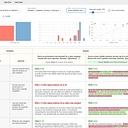
Data as of Sep 17, 2026 · Based on 297 AI responses from ChatGPT Search and Google AI Mode · See how Parse measures this
For enterprise teams that need always-on, low-latency defenses against prompt injection and jailbreaks, choose 


Brands AI recommends here
Named in 34% of answers
Best if you need comprehensive, application-layer scanning of every prompt and response to block injections and sensitive data exposure in generative AI apps; caveat: may be paired with WAAP or edge controls for full coverage.
Named in 30% of answers
Named in 30% of answers
Named in 25% of answers
Best for RAG operators who need context-aware sanitization: Securiti’s LLM firewall filters prompts and monitors retrieved data to prevent poisoning and sensitive-data leakage; often paired with WAAP partners.
Source | Citation share |
|---|---|
 Radware Pagehttps://www.radware.com/cyberpedia/ai-firewall/ | 4.3% |
 Protection and Security for AI and LLM Applications - Akamaihttps://www.akamai.com/products/firewall-for-ai | 3.7% |
 As AI Agents Scale, So Does the Security Risk | Domohttps://www.domo.com/blog/as-ai-agents-scale-so-does-the-security-risk | 2.0% |
 Securing AI's Front Lineshttps://www.paloaltonetworks.com/resources/whitepapers/securing-ai-s-front-lines | 1.9% |
AI Security in 2026: Threats, Core Principles & Defenses - Radwarehttps://www.radware.com/cyberpedia/ai-security/ | 1.9% |
 Safeguard your generative AI workloads from prompt injectionshttps://aws.amazon.com/blogs/security/safeguard-your-generative-ai-workloads-from-prompt-injections/ | 1.7% |
 PromptGuard, The production firewall for AI applicationshttps://www.promptguard.co/ | 1.6% |
Context-aware LLM Firewalls - Securiti.aihttps://securiti.ai/gencore/llm-firewalls/ | 1.5% |
PromptGuard — The production firewall for AI applicationshttps://promptguard.co/ | 1.5% |
 AI LLM Firewall as a service | CQRhttps://cqr.company/service/ai-llm-firewall-as-a-service/ | 1.3% |
Yes. The market usually calls these **AI firewalls, LLM firewalls, AI guardrails, or runtime AI security** products. Several vendors specifically address prompt injection and system-prompt/data leakage. - **[lakera.ai](https://www.lakera.ai/?utm_source=chatgpt.com) — Lakera Guard.** Detects direct and indirect prompt…
Yes. The market usually calls these AI firewalls, LLM firewalls, AI guardrails, or runtime AI security products. Several vendors specifically address prompt injection and system-prompt/data leakage.
I wouldn't treat an AI firewall as a guarantee that your system prompt can't leak. Input sanitization alone is insufficient, particularly for agents and RAG systems: an attacker can put an injection inside a webpage, PDF, retrieved document, tool response, or MCP metadata.
A robust architecture generally looks like:
untrusted input → injection detector/firewall → authorization/data-access controls → LLM → output/DLP filter
And the system prompt itself should not contain secrets. The firewall should be an additional layer, not the mechanism on which confidentiality depends. Check Point/Lakera's documentation explicitly recommends combining prompt defenses with secure system prompts and separate data-leakage controls.
If you're evaluating these for production, I can also give you a vendor comparison matrix (Lakera vs. Check Point vs. Protect AI vs. HiddenLayer, including API integration, self-hosting, latency, RAG/agent coverage, and pricing model).
To protect your system prompts and prevent prompt injection, the market has largely coalesced around **AI firewalls**, **LLM gateways** , and **guardrail libraries** . These tools intercept user inputs, sanitize or flag malicious instructions (like "ignore previous instructions"), and block data exfiltration before…
To protect your system prompts and prevent prompt injection, the market has largely coalesced around AI firewalls, LLM gateways , and guardrail libraries . These tools intercept user inputs, sanitize or flag malicious instructions (like "ignore previous instructions"), and block data exfiltration before the payload ever reaches your primary model.
The ecosystem of vendors and tools offering input sanitization and firewall capabilities falls into distinct categories:
If you are already hosted within a major cloud ecosystem, native security firewalls can be turned on directly inside your infrastructure:
If your data sovereignty requirements mean prompts cannot leave your network or cluster, you can embed these open-source firewalls/validators directly into your application pipeline:
To help narrow down which path makes sense for you, could you share:
Protecting your system prompts from extraction via direct and indirect prompt injection requires a "sandwich architecture"—where a proxy or firewall intercepts user inputs and cleans them before they touch your core LLM, and then scans the output on the way…
Protecting your system prompts from extraction via direct and indirect prompt injection requires a "sandwich architecture"—where a proxy or firewall intercepts user inputs and cleans them before they touch your core LLM, and then scans the output on the way back.
A wide ecosystem of commercial SaaS providers, cloud giants, and open-source toolkits offer specialized "AI firewalls" and runtime guardrails for input sanitization:
If you are already hosted within a specific cloud ecosystem, native enterprise guardrails can sanitize inputs natively without adding external third-party API dependencies:
If your data sovereignty requirements mean prompts cannot leave your own cluster or private VPC, you can self-host open-source guardrail layers:
Are you looking for a fully managed SaaS API (quickest setup, data leaves your environment) or a self-hosted open-source tool (keeps data fully in-house)? Let me know your infrastructure setup and I can help you narrow down the best integration path.

Yes. The main vendors offering “AI firewall” / prompt-defense layers include: - **Lakera Guard** — detects/blocks direct and indirect prompt injection and can prevent system-prompt leakage. [Lakera](https://www.lakera.ai/risk/prompt-injection-attacks?utm_source=chatgpt.com)…
Yes. The main vendors offering “AI firewall” / prompt-defense layers include:
For specifically preventing system-prompt extraction, I’d shortlist Lakera, Cloudflare, and Prisma AIRS and evaluate them on indirect-injection detection, latency, false positives, and whether they inspect RAG/tool/MCP content—not just the user’s raw prompt.
Yes. The market has matured quite a bit, although vendors use overlapping terms such as **AI firewall, LLM firewall, AI gateway, guardrails, and AI runtime security**. For your specific concern—**blocking prompt injection before it reaches the model, including attempts to extract system prompts**—I'd shortlist these:…
Yes. The market has matured quite a bit, although vendors use overlapping terms such as AI firewall, LLM firewall, AI gateway, guardrails, and AI runtime security.
For your specific concern—blocking prompt injection before it reaches the model, including attempts to extract system prompts—I'd shortlist these:
I wouldn't think of this as simply "sanitize the user's input and we're safe." Prompt injection isn't reliably solved by stripping suspicious phrases. In an agentic application, malicious instructions can arrive through retrieved documents, webpages, tool results, MCP servers, or other supposedly trusted context.
For protecting system-prompt confidentiality, I'd use a layered architecture:
User/input → AI firewall/guardrail → retrieval/tool-content scanning → LLM → output/DLP guardrail → application
And independently enforce least-privilege tool access, because even a very good injection detector can miss a novel attack.
If you're evaluating vendors, Lakera, Cloudflare, and Prisma AIRS are probably the three I'd put into an initial bake-off. The key test isn't just "does it detect obvious jailbreaks?" but whether it catches direct + indirect + obfuscated prompt injection, while keeping false positives low on your actual workload.
Several `enterprise security vendors and specialized platforms` offer "AI firewalls," runtime guardrails, and input sanitization layers specifically designed to block prompt injections and prevent system prompt leakage.[](https://www.akamai.com/products/firewall-for-ai)…
Several enterprise security vendors and specialized platforms offer "AI firewalls," runtime guardrails, and input sanitization layers specifically designed to block prompt injections and prevent system prompt leakage.
The prominent providers fall into a few clear categories:
Would you like to explore open-source developer toolkits that you can self-host, or are you looking for a fully managed enterprise SaaS firewall?
Protecting system prompts from extraction and overriding via prompt injection requires intercepting inputs and outputs through a "sandwich" proxy architecture (an AI firewall or gateway). These tools inspect user prompts, Retrieval-Augmented Generation (RAG) data, and tool responses before they hit your core LLM, and…
Protecting system prompts from extraction and overriding via prompt injection requires intercepting inputs and outputs through a "sandwich" proxy architecture (an AI firewall or gateway). These tools inspect user prompts, Retrieval-Augmented Generation (RAG) data, and tool responses before they hit your core LLM, and scrub the outputs before they return to the user.
Enterprise-grade AI firewalls, security gateways, and guardrail providers span major cloud ecosystems, specialized cybersecurity vendors, and open-source frameworks:
If you share details about where your LLM is hosted (e.g., AWS, Azure, self-hosted on Kubernetes) and whether you are using AI agents with external tools , I can recommend the most seamless architectural integration for your stack.
Yes. The market is increasingly using terms like **AI firewall**, **LLM firewall**, **AI guardrails**, and **runtime AI security** for products that sit between your application and the model. A few vendors worth evaluating: - **Lakera — Lakera Guard.** Probably one of the closest matches to what you're describing. It…
Yes. The market is increasingly using terms like AI firewall, LLM firewall, AI guardrails, and runtime AI security for products that sit between your application and the model.
A few vendors worth evaluating:
I wouldn't rely on an "AI firewall" as the only defense against system-prompt extraction. A good architecture should assume that prompt injection will sometimes get through.
For protecting your system prompt specifically, I'd combine:
This matters especially for RAG and agents: an attacker doesn't necessarily have to type "reveal your system prompt." They can put malicious instructions into a webpage, PDF, email, RAG document, or tool response that your agent subsequently ingests.
If your primary requirement is specifically "prevent users from extracting our system prompt," I'd shortlist Lakera/Check Point, HiddenLayer, and an architecture-level solution rather than buying based on the "AI firewall" label alone. The key question for vendors is whether their detector can catch system-prompt extraction as a data-leakage policy, rather than merely detecting obvious jailbreak phrases.
Several dedicated cybersecurity vendors, cloud providers, and open-source projects offer **AI firewalls and runtime guardrails** specifically designed to sanitize user inputs, block jailbreaks, and prevent prompt injections from leaking system prompts.[](https://appsecsanta.com/ai-security-tools)…
Several dedicated cybersecurity vendors, cloud providers, and open-source projects offer AI firewalls and runtime guardrails specifically designed to sanitize user inputs, block jailbreaks, and prevent prompt injections from leaking system prompts.
Specialized AI Security & Guardrail Providers
Enterprise Cloud & Infrastructure Firewalls
If you can share where your models are hosted (e.g., self-hosted open-source vs. OpenAI/Anthropic APIs) and your deployment stack , I can suggest the best integration pattern (gateway proxy vs. native SDK guardrails) for your architecture.

F5
f5.com
Yes. The market often calls these **AI firewalls**, **LLM firewalls**, or **AI guardrails**. For your specific concern—**prompt injection plus system-prompt/data leakage**—these are worth evaluating: - **[lakera.ai](https://www.lakera.ai/?utm_source=chatgpt.com)** — probably the closest match to what you describe. It…
Yes. The market often calls these AI firewalls, LLM firewalls, or AI guardrails. For your specific concern—prompt injection plus system-prompt/data leakage—these are worth evaluating:
For an enterprise application where protecting the system prompt is a primary requirement, I'd shortlist Lakera, Cisco AI Defense, and a self-hosted NeMo/LLM Guard architecture.
One important caveat: don't treat input sanitization as sufficient protection for the system prompt. OWASP recommends screening not just user messages but also RAG documents, web content, tool results, and other untrusted context—and combining model-based detection with deterministic controls.
In other words, a good architecture is:
untrusted input → AI firewall/guardrail → LLM → output/data-leakage guardrail → user/tool
rather than simply:
user input → sanitizer → LLM
If you tell me whether you're running OpenAI/Anthropic APIs, Azure/AWS, or self-hosted models, I can narrow this to the 3–5 products that best fit your stack, including deployment model, latency, pricing model, and how well each handles indirect prompt injection and system-prompt extraction.
F5
f5.com