Real-time, individual plant identification and precision treatment rely on Agricultural AI, computer vision, and advanced robotics . While real-time weed identification and micro-spot spraying are widely commercialized, pest and disease identification at the individual plant level is an evolving frontier—often handled via early-stage computer vision mapping, drone scouting, or specialized sensor booms.
The leading systems capable of real-time identification and targeted treatment include:
1. Optical Spot-Spraying & AI Weed Systems (Commercialized)
These systems use high-speed cameras mounted on large agricultural spray booms or autonomous rovers to process computer vision data in milliseconds, triggering individual nozzles precisely over weeds.
: John Deere See & Spray (Ultimate & Select ): Uses advanced machine vision and processors to differentiate crops (corn, soy, cotton) from weeds in real time. It targets weeds dynamically while rolling through fields at high speeds, reducing herbicide use by up to 9 0%.
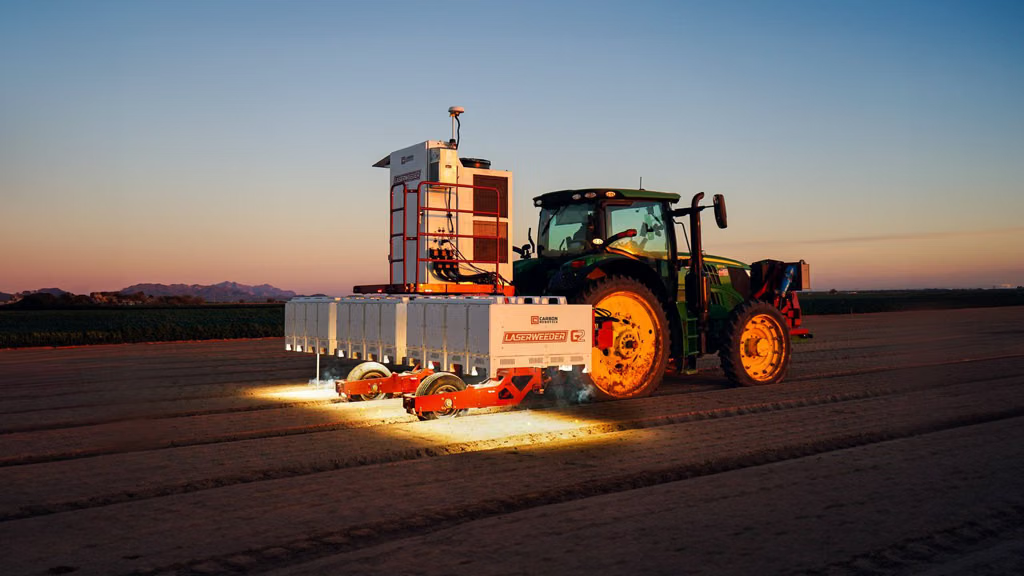
Carbon Robotics LaserWeeder: Replaces chemicals entirely with physical AI. It utilizes high-resolution cameras, deep learning models, and high-powered CO 2 CO sub 2 C O 2 lasers to zap up to 2 0 0,0 0 0 weeds per hour down to a pen-tip size without touching the cash crop.
Question: Which systems can identify weeds, pests, and disease in real time and treat individual plants precisely?
Yes. Several commercial precision-ag systems use cameras + AI/computer vision to identify individual plants in real time and then apply a targeted treatment. The important distinction is that most mature systems specialize in , while plant-by-plant identification of is less widely commercialized.
Question: Which systems can identify weeds, pests, and disease in real time and treat individual plants precisely?
: Bilberry Intelligent Spot Spraying (by Ecorobotix ): Integrates AI camera technology onto tractor booms or autonomous solar-powered weeders to pinpoint specific weed species among green crops, achieving up to a 9 5% reduction in chemical volume.
2. Pest and Disease Mapping & Micro-Application (Advanced/Emerging)
Detecting microscopic pests or early-stage foliar diseases in real time at micro-dose precision requires closer imaging than a fast-moving tractor boom can typically manage. Current implementations split this into two phases:
Drone and Sensor Scouting (e.g., DJI Agriculture / MicaSense) : Multispectral drones fly over fields mapping stress signatures, nutrient deficiencies, and localized fungal outbreaks down to individual plant zones. This creates a prescription map loaded into variable-rate smart sprayers for precise chemical application on the next pass.
In-Row Autonomous Scouting Robots (e.g., Small Robot Company or Naïo Technologies) : These smaller field robots hover closely over individual plants, using micro-cameras and localized AI models to flag insect damage or early blight symptoms, dispensing micro-droplets of targeted treatment or mechanically removing the infected leaf/weed.
If you are looking into this for a specific crop type (e.g., specialty vegetables, broad-acre grains, or orchard crops) or a particular budget scale (commercial farming equipment vs. research/smallholder tech), let me know so I can narrow down the best matching system.
Yes. Several commercial precision-agriculture systems can see plants in real time and selectively treat them, but the maturity differs between weeds, insects, and diseases.
This is probably the closest match to your wording. Its cameras and onboard computing scan plants in real time, identify targets, and trigger individual spray nozzles milliseconds later. Ecorobotix says it can recognize more than 50 weed species/classes and spray a target area as small as 6 × 6 cm.
Importantly, ARA isn't limited to herbicides. Its current software supports targeted applications of fungicides, insecticides, fertilizers and biostimulants, including treating the crop rather than simply spraying the whole field.
Carbon Robotics takes a different approach: computer vision identifies individual weeds and high-power lasers destroy them rather than applying herbicide. Its newer Carbon AI system is trained on 150 million labeled plants across 15 countries and 100+ crops, and can adapt plant-recognition profiles to particular fields.
“Identifies disease” is considerably harder than “identifies weeds.” Today's commercial systems are much more mature at distinguishing crop vs. weed and selectively spraying weeds than at reliably diagnosing arbitrary diseases on an individual plant and then choosing a treatment automatically.
For disease/pest management, there are also systems that detect and map symptoms or insects in real time, but the complete loop—
see individual plant → diagnose weed/pest/disease → select treatment → treat only that plant
—is still a relatively emerging capability.
If you're looking for this technology for a specific crop or farm size, tell me the crop (e.g. grapes, tomatoes, corn, lettuce, cannabis, orchard trees) and acreage, and I can narrow it down to the systems actually capable of doing it today.
Real-time identification and precision treatment systems rely on a combination of high-speed machine vision, deep learning AI models, and precision-actuated hardware (such as targeted micro-sprayers or high-powered lasers).
While weeds are currently managed in real time with extreme commercial precision, pests and diseases are at an intermediate stage—mostly handled via localized detection-and-mapping or early-stage robotic spot-spraying.
The primary commercial and advanced developmental systems capable of these tasks include:
1. Commercial Weed-Identification & Precision Treatment Systems
Carbon Robotics LaserWeeder: Uses high-resolution cameras feeding data to an onboard supercomputer running AI models in real time. It distinguishes crops from weeds in milliseconds and fires high-powered carbon dioxide lasers to instantly eliminate weeds at the meristem (growing point) with millimeter accuracy, completely chemical-free. It can target tens of thousands of weeds per hour without disturbing the soil.
John Deere See & Spray (Select, Premium, and Ultimate): An advanced machine-vision spraying system mounted directly onto large agricultural sprayers. As the machine rolls through the field at operational speeds, cameras capture imagery processed instantly by onboard computer vision to spot-spray weeds among green crops (or fallow ground) with herbicide, while leaving the cash crop untouched. This reduces herbicide usage by a massive margin compared to blanket-spraying.[1]
Bosch and BASF Smart Spraying Solutions: Marketed via ONE Smart Spray , this joint venture combines Bosch's camera sensor technology and electronic control units with BASF's agronomic logic. It features real-time day/night weed identification and variable-rate, ultra-precise injection nozzles that apply exact doses of crop protection products only where needed.
2. Pest & Disease Identification (Emerging and Micro-Targeted Systems)
Autonomous Agricultural Drones (e.g., DJI Agras series / Rantizo): Equipped with multispectral cameras, these drones map fields to pinpoint early outbreaks of fungal disease, nutrient deficiencies, or insect infestations. While broad real-time "zap-on-the-fly" micro-treatment for individual insects is still evolving, these platforms enable precision variable-rate spot-spraying based on real-time aerial data analysis.
Greenhouse & Robotic Manipulator Research: In controlled environments like greenhouses, experimental robotic systems (such as YOLOv-based AI models coupled with dual-nozzle robotic arms) are being actively deployed. These systems identify individual leaf diseases (like powdery mildew or tomato blight) and use micro-manipulators to apply targeted treatments directly to the infected leaf area without harming adjacent healthy foliage.
Would you like to explore how these systems compare in cost-effectiveness for large-scale vs. specialty crops , or are you looking into a specific crop type (e.g., corn, vineyards, leafy greens)?
Fungicides/insecticides can be applied to selected crops, but detection is not primarily marketed as disease diagnosis
Blue River Technology See & Spray
Computer vision + deep learning
Yes
Yes
Primarily weed/crop discrimination rather than disease diagnosis
Other emerging robotic/vision systems
Cameras, AI, sometimes hyperspectral/3D sensing
Varies
Increasingly yes
Disease/pest detection is an active research/commercial-development area
The most direct examples
Ecorobotix ARA is probably the closest match to your description. Its Plant-by-Plant AI scans crops and weeds in real time, identifies targets, and triggers individual nozzles. Ecorobotix says the system can recognize more than 50 weed species and execute the scan/decision/spray process in under 250 ms. Its spray pattern is approximately 6 × 6 cm, allowing treatment of individual plants or very small areas.
ARA isn't limited to herbicides: its current system can selectively apply fungicides, insecticides, fertilizers and biostimulants to crops. However, that's different from saying it autonomously diagnoses a particular fungal disease or insect species and then chooses the corresponding pesticide.
Blue River Technology See & Spray uses deep learning and computer vision to classify individual crops and weeds while the machine is moving. Blue River reports 36 cameras scanning more than 2,500 square feet per second, with plant-level decisions and spray actuation occurring in milliseconds.
If you specifically mean "detect a diseased/pest-infested plant → identify what's wrong → treat only that plant"
That's a harder and somewhat different technology category. The pipeline would be:
Commercial systems are already strong at the first, second and last parts for weed control. Fully autonomous disease/pest diagnosis plus plant-specific treatment is less mature and often relies on specialized imaging, such as multispectral/hyperspectral or close-range cameras, rather than ordinary RGB cameras alone.
So, if you're looking for technology for a specific crop or farm application, tell me the crop (e.g. tomatoes, strawberries, corn, lettuce, citrus) and whether you want spraying, mechanical removal, or robotic treatment, and I can identify the systems that actually support that use case.
Real-time identification and precise, individual plant treatment rely on AI-powered computer vision, machine learning, and advanced robotics . While weed detection and targeted micro-spraying or mechanical/thermal destruction are heavily commercialized, pest and disease identification in real time at the individual plant level is rapidly merging into these platforms (often via multispectral imaging and predictive AI mapping).
The leading systems capable of real-time identification and precise, localized intervention include:
John Deere See & Spray (Select, Ultimate, and Premium)
How it works: Uses machine learning and high-speed boom-mounted cameras to scan fields and differentiate crops from weeds in milliseconds, firing individual targeted nozzles only where weeds are present.
Capabilities: Primarily targets weeds (green-on-green and green-on-brown), but advanced iterations and dual-tank configurations allow simultaneous broadcast fungicide/pesticide application alongside precise targeted herbicide passes.
Greeneye Technology
How it works: A retrofittable precision spraying system equipped with high-resolution cameras and powerful GPUs.
Capabilities: Utilizes AI to detect and spray individual weeds in real time (even in mature, dense cash crops like corn and soy), slashing herbicide use drastically while collecting plant-level data maps.
Bosch & BASF "One Smart Spray"
How it works: A joint venture combining Bosch’s camera-sensor technology and AI with BASF’s agronomic logic.
Capabilities: Offers real-time weed identification day and night, combined with smart map generation, variable rate application, and micro-dosing exact targets.
Ecorobotix ARA Field Sprayer
How it works: An ultra-high precision sprayer utilizing an AI-equipped camera system under a wide hood.
Capabilities: Targets individual weeds, crop-health anomalies, or specific patches with micro-doses of treatments (herbicides, fungicides, or micro-fertilizers) with centimeter-level precision, drastically reducing chemical runoff.
Carbon Robotics LaserWeeder
How it works: Uses high-resolution computer vision and deep learning models trained on millions of images to pinpoint weeds.
Capabilities: Instead of chemicals, it destroys individual weeds in real time using high-powered thermal lasers , executing precise weed control down to the millimeter with zero soil or crop disturbance.
WEED-IT (Quadro)
How it works: Utilizes advanced optical sensors and pulse-width modulation nozzle control to detect chlorophyll/green matter.
Capabilities: Highly responsive real-time spot spraying that can be retrofitted onto large agricultural sprayers or specialized robotic platforms.
How it works: Autonomous solar- or electric-powered field robots that crawl crop rows continuously.
Capabilities: Rather than just spraying, they map pest and disease outbreaks via hyper-spectral scanning and execute localized micro-applications or alert operators to treat micro-zones before infestations spread.
If you're looking into one of these systems, tell me:
What specific crop or acreage scale are you managing?
Are you primarily trying to solve a weed, pest, or disease challenge?
I can help narrow down which specific machine or tech stack fits your operation best.
Systems that can identify weeds, pests, and plant diseases in real time and treat plants precisely are generally called AI precision agriculture systems, smart sprayers, plant-level treatment robots, or autonomous crop protection platforms. They combine cameras/sensors, machine learning, robotics, and targeted application hardware.
Some leading examples:
System
What it detects
How it treats
John Deere See & Spray
Weeds among crops using computer vision and AI
Turns individual spray nozzles on/off to spot-spray weeds rather than blanket spraying
Ecorobotix ARA
Individual weeds in row crops
Ultra-precise micro-spraying directly onto weeds
Verdant Robotics SharpShooter
Individual plants, weeds, and crop targets
Robotic “aim-and-apply” micro-doses delivered only to selected plants
Carbon Bee Smart Striker
Weeds using AI vision
Targeted spraying
Bosch / BASF ONE SMART SPRAY
Crop vs. weed recognition
Selective herbicide application through smart nozzles
Greeneye Technology
Weed species in crops
Plant-level spraying with AI-controlled nozzles
Naïo Technologies robots (such as Dino)
Weeds and crop rows
Mechanical weeding guided by cameras and GPS
Solinftec Solix
Weeds, pests, diseases, crop stress indicators
Autonomous scouting plus targeted crop-management actions
How these systems work
Detection - RGB cameras, multispectral cameras, hyperspectral sensors, thermal sensors, and sometimes LiDAR scan plants.
Onboard computers run machine-learning models in milliseconds.
The system decides whether a plant should be ignored, sprayed, mechanically removed, or flagged for inspection.
Precision treatment
Individual solenoid nozzles, robotic arms, lasers, mechanical weeders, or micro-injection systems treat only the target plant.
This can reduce chemical use compared with broadcast spraying.
Systems closest to “identify and treat every individual plant”
The most advanced category is plant-by-plant robotics, including:
AI vision + robotic spot sprayers (best commercial maturity)
Autonomous weeding robots (mechanical removal)
Laser weeding robots (emerging)
Drone-based AI scouting + targeted treatment (more common for detection than individual treatment)
Current commercial systems are strongest for weed identification and precision herbicide application. Real-time individual treatment of pests and diseases is advancing, but is generally less mature because symptoms can be subtle and require more complex diagnosis.
Yes. The technology is already commercially deployed, although no single mainstream system reliably identifies and treats weeds, insects, and diseases at individual-plant level in every crop. The strongest systems today are specialized.
System
Detects
Treatment
Precision
John Deere / Blue River See & Spray
Crops vs. weeds
Targeted herbicide
Individual weed/nozzle
Carbon Robotics LaserWeeder
Crops vs. weeds
Laser destruction
Individual weed, sub-mm
AI crop-scouting systems
Disease symptoms, insects, weeds, crop stress
Usually alerts/maps rather than autonomous treatment
Plant/leaf level, depending on system
1. John Deere See & Spray — best example for precision spraying
deere.com uses cameras, edge computing and machine learning to distinguish crops from weeds as the sprayer moves through the field. Individual nozzles are activated only when a weed is detected.
The newer See & Spray Gen 2, released in 2026, performs plant-level decisions in real time and also supports real-time biomass-based variable-rate application.
carbonrobotics.com uses dozens of cameras and AI vision to identify weeds and then fires lasers at individual weeds. The company reports sub-millimeter accuracy and up to 5,000 weeds treated per minute on its systems.
Its Carbon AI platform is particularly interesting: the company says its Large Plant Model has been trained on 150 million labeled plants across 15 countries and 100+ crops, with field-specific "Plant Profiles" that can adapt detection to particular crop and weed conditions.
What's still emerging
Disease and pest treatment is the harder part. Cameras and AI can identify disease symptoms, insects, nutrient deficiencies and stress, but fully autonomous detect → diagnose → treat that specific plant systems are less mature than weed-control systems.
The overall architecture you're describing is often called precision crop protection or plant-level agricultural robotics:
So, if you're asking "What existing technology comes closest to a robot that walks through a field, recognizes weeds/pests/disease in real time, and treats each affected plant individually?", I'd rank Carbon Robotics LaserWeeder and John Deere/Blue River See & Spray as the two clearest commercial examples today. Neither, however, is yet a universal weed + pest + disease treatment robot.
If you tell me what crop you're interested in (e.g., cotton, corn, vegetables, fruit, vineyard), I can identify the systems that currently get closest to this capability for that crop.
carbonrobotics.com uses dozens of cameras and AI vision to identify weeds and then fires lasers at individual weeds. The company reports sub-millimeter accuracy and up to 5,000 weeds treated per minute on its systems.
Its Carbon AI platform is particularly interesting: the company says its Large Plant Model has been trained on 150 million labeled plants across 15 countries and 100+ crops, with field-specific "Plant Profiles" that can adapt detection to particular crop and weed conditions.
What's still emerging
Disease and pest treatment is the harder part. Cameras and AI can identify disease symptoms, insects, nutrient deficiencies and stress, but fully autonomous detect → diagnose → treat that specific plant systems are less mature than weed-control systems.
Real-time identification and precise treatment of agricultural threats rely on advanced computer vision, edge-computing supercomputers, and high-speed robotic actuation.
While weeds can now be identified and treated in real time with high commercial maturity, real-time detection and spot-treatment for specific pests and diseases are mostly handled via scouting platforms, predictive mapping, or early-stage research prototypes, rather than instant macro-spraying (though fungicides and broad treatments can be co-applied).
Major commercial systems and technologies capable of real-time identification and precision treatment include:
1. Computer Vision & Smart Sprayers (Weeds)
These systems mount onto large agricultural booms, scanning fields via dozens of high-resolution cameras and processing the data instantly through onboard AI units to trigger individual nozzle pulses.
John Deere See & Spray™ Ultimate: Uses carbon-fiber booms with 36 integrated cameras and onboard processors to distinguish between crops and weeds in milliseconds, applying targeted herbicide strictly to the weed while optionally broadcast-spraying nutrients or residual controls simultaneously.
ONE SMART SPRAY (Bosch & BASF Joint Venture): Combines high-resolution camera hardware, automated day-and-night LED illumination, and digital agronomic intelligence from xarvio to perform selective green-on-green and green-on-brown weed targeting.
DAT Eco Patch: A modular, plug-and-play AI weed detection system built to retrofit various farm implements for targeted micro-spraying.
Instead of spraying liquids, these autonomous or tractor-drawn robotic platforms identify individual weeds and destroy them physically via thermal energy.
Carbon Robotics LaserWeeder: Utilizes high-resolution cameras and deep-learning AI models to scan crops in real time. It fires high-powered carbon dioxide diode lasers to thermally kill the meristem of individual weeds (up to 8,000+ weeds per minute) with sub-millimeter precision, entirely eliminating chemical usage and soil disturbance.
3. Pest & Disease Identification (The Current Frontier)
Real-time in-field treatment of individual pests and diseases lags behind mechanical weed control because microscopic fungal spores or hidden insects are harder to capture via high-speed tractor cameras. However, the ecosystem uses hybrid approaches:
AI Scouting & Decision Apps (e.g., Pest ID): Mobile and edge-AI applications trained on millions of images allow farmers to photograph localized insect damage or leaf blights for instant identification, severity metrics, and localized treatment instructions.
Robotic Micro-Manipulators (Research/Greenhouse): Advanced academic prototypes (utilizing lightweight neural networks like YOLO variants paired with fuzzy logic controllers and dual-nozzle robotic arms) are being tested in controlled environments to target localized leaf disease spots precisely without blanket spraying the whole crop.
Are you looking into these technologies for large-scale commercial row-cropping, specialty horticulture/vegetables , or academic/research purposes ? I can dive deeper into the specific hardware or economic payback for your context.
Yes. Several commercial precision-ag systems can identify plants in real time and act on individual plants, but there’s an important distinction: weed detection and treatment are commercially mature; real-time identification of specific pests and diseases followed by plant-by-plant treatment is less mature and more fragmented.
Leading systems
John Deere / Blue River Technology — See & Spray™
Uses cameras, edge computing, and deep-learning computer vision to distinguish crops from weeds while moving through the field.
Individual nozzles fire only when the system detects a target weed, making it genuinely plant-level rather than blanket spraying.
The current See & Spray Gen 2 supports crops including corn, soybeans, cotton, wheat, sorghum, barley, canola, sugar beets, peanuts and edible beans.
John Deere says the system processes plant-level decisions in milliseconds and can operate with boom lighting for targeted applications at night.
Uses computer vision and AI to identify weeds among crops and then physically kills individual weeds with lasers, rather than spraying herbicide.
Its new Large Plant Model is trained on more than 150 million labeled plants and can be adapted to particular crop/weed conditions through its Plant Profiles system.
This is particularly interesting for high-value specialty crops such as vegetables.
That's where the technology landscape changes. Systems can use RGB cameras, multispectral/hyperspectral imaging, thermal cameras, and AI models to detect disease symptoms or insect damage, but a single commercially deployed machine that reliably does “identify disease/pest → diagnose it → treat only that plant” across many crops is not yet as established as See & Spray's weed-targeting capability.
So, if you're looking for the closest existing system to a real-time “robot doctor for every plant,” I'd rank them:
See & Spray — strongest commercial example of real-time plant identification + individual treatment.
Carbon Robotics LaserWeeder — strongest example of real-time individual-plant identification + non-chemical treatment.
AI crop-scouting/disease-detection platforms — increasingly capable of identifying pests/disease, but generally still provide detection/maps/recommendations rather than autonomous plant-by-plant treatment.
Research prototypes — combine disease/pest vision with robotic arms, spot spraying, UV, lasers, or other treatments, but aren't yet as broadly commercialized.
The key enabling architecture is essentially camera/sensor → edge AI → plant-level classification → real-time decision → precision actuator. Blue River explicitly describes its systems as performing classification, decisioning, and actuation in milliseconds.
If you mean systems specifically for orchards/vineyards/vegetable farms that can detect weeds + insects + fungal/bacterial disease and then treat each individual plant, I can give you a more comprehensive list of the companies and robots currently doing that.
Real-time, plant-specific identification and micro-targeted treatment rely on advanced computer vision, edge-AI computing, and high-precision actuation (such as targeted micro-spraying or thermal lasers).
While handling weeds with pixel-level precision is widely commercialized today, handling individual pests and diseases in real time at the single-plant level is an evolving frontier—often managed via specialized spot-sprayers, autonomous rovers, and targeted UV or biological applications.
Carbon Robotics (LaserWeeder): Uses high-resolution cameras and deep learning models to distinguish crops from weeds in milliseconds, then eliminates individual weeds using high-powered thermal lasers without disturbing the soil or applying chemicals.
John Deere (See & Spray Ultimate / Select): Utilizes machine vision and artificial intelligence on tractor booms to scan the field in real time. It differentiates crop plants from weeds ("green-on-green" or "green-on-brown") and triggers individual nozzles to target only the weed.
Ecorobotix (ARA): An AI-powered ultra-high-precision spot sprayer that captures rapid field images, analyzes them via onboard edge-computing, and activates precise micro-valves to spray individual weed targets with up to 95% less chemical usage.
Pest & Disease Identification and Treatment (Emerging & Specialized)
Saga Robotics (Thorvald): Frequently deployed in high-value crops (like vineyards and strawberries), this autonomous robot uses UV-C light treatments applied precisely at night to suppress fungal diseases like powdery mildew without chemicals.
AI-Enabled Agricultural Drones & Swarms (e.g., Ailand Systems' Bee or UAV Swarms): Advanced autonomous drones carry multispectral/RGB sensors and edge-microcomputers to spot-diagnose canopy health stress, localized insect infestations, or early disease pockets, deploying localized micro-dosages of organic or targeted treatments.[2]
The Limitation on Pest/Disease Real-Time Zapping: While weeds have distinct structural and color profiles easily targeted by lasers or micro-jets, microscopic pathogens (diseases) and small mobile insects are harder to detect and treat on a single-plant level on the fly. Most broad field systems still rely on targeted preventative scouting maps or zonal spot-spraying rather than instant single-insect zapping.
If you are looking for a system for a specific crop type (e.g., broad-acre corn/soy versus specialty crops/vegetables or orchards), let me know and I can narrow down which machinery or software fits your scale and budget.