Aerospace Engineering Firms Special… AI recommendations | Parse
Which aerospace engineering firms specialize in hypersonic flight dynamics?
Data as of Sep 24, 2026 · Based on 293 AI responses from ChatGPT Search and Google AI Mode · See how Parse measures this
Multiple firms specialize in hypersonic flight dynamics, offering expertise ranging from full-scale weapons systems to specialized R&D. Leading defense prime contractors, such as Lockheed Martin and RTX, focus on integrated propulsion and guidance for missile systems. Meanwhile, agile startups like Hermeus, , and Reaction Engines lead in high-speed aircraft development, scramjet propulsion, and reusable flight testing, while others like provide critical simulation and analysis.
Best for integrated defense applications, Lockheed Martin offers decades of experience in propulsion and guidance systems for hypersonic glide vehicles and missiles operating at speeds of Mach 5 and faster.
Best for rapid development and testing, Hermeus focuses on high-Mach, hypersonic aircraft for both commercial and defense roles, aiming to accelerate the industry transition toward practical high-speed flight.
Top 50 Companies in Hypersonic Weapons Market Statistics , Growth Report 2035https://www.sphericalinsights.com/blogs/top-50-companies-in-hypersonic-weapons-market-statistics-report-till-2035
6%
Hypersonic Flight Companies - Top Companies List of Hypersonic Flight Industryhttps://www.marketsandmarkets.com/ResearchInsight/hypersonic-flight-market.asp
Top 100 Hypersonic Flight Companies in 2026 - ensunhttps://ensun.io/search/hypersonic-flight
2%
Using Ramjet Technology for Hypersonic Flight | GE Aerospace Newshttps://www.geaerospace.com/news/articles/need-speed-ge-aerospace-using-ramjet-technology-ante-hypersonic-flight
1%
Question: Which aerospace engineering firms specialize in hypersonic flight dynamics?
Several major defense primes, specialized propulsion companies, and venture-backed startups focus heavily on hypersonic flight dynamics , high-Mach aerodynamics, and thermal management.
Major Defense Primes
Lockheed Martin Corporation: A dominant leader in hypersonic systems, Lockheed Martin (via its Skunk Works division) designs and develops multiple classified and unclassified hypersonic boost-glide and scramjet-powered vehicles for the U.S. military.
Raytheon Technologies (RTX): Through its Raytheon and Pratt & Whitney segments, the company specializes in hypersonic weapon systems, guidance systems, and advanced scramjet propulsion integration.
Northrop Grumman Corporation: A pioneer in scramjet (supersonic combustion ramjet) technology, Northrop Grumman designs high-speed propulsion and airframe integration critical for sustained hypersonic flight dynamics.
The Boeing Company: Boeing has decades of high-speed research experience, ranging from the X-51A Waverider program to ongoing concepts for autonomous hypersonic flight vehicles and surveillance platforms.
Propulsion and Subsystem Specialists
GE Aerospace: Following acquisitions like Innoveering, GE Aerospace develops advanced high-speed propulsion systems—including rotating detonation combustion and turbine-based combined cycle (TBCC) engines—engineered to survive Mach 5+ thermal and dynamic environments.
Aerojet Rocketdyne (an L3Harris Technologies company): Specializes in rocket and air-breathing scramjet engines built to withstand the extreme pressures and thermal loads of hypersonic acceleration.
Commercial and Startup Innovators
Hermeus Corporation: A venture-backed aerospace startup designing reusable high-Mach and hypersonic aircraft. They utilize a turbine-based combined cycle engine approach, scaling from supersonic testbeds toward uncrewed defense systems (Darkhorse ) and commercial hypersonic flight.
Stratolaunch: Focuses on reusable hypersonic flight-test services. Using their giant carrier aircraft (Roc ), they air-launch the autonomous Talon-A testbed vehicle to gather real-world flight dynamics data at speeds exceeding Mach 5.
Would you like to explore the technological differences between boost-glide systems vs. scramjets , or dive deeper into the thermal protection materials used in these designs?
Several firms have substantial hypersonics and flight-dynamics expertise:
Lockheed Martin — extensive hypersonic vehicle development, including maneuvering reentry vehicles, aero/thermal flight sciences, and guidance/manueverability.
RTX / Raytheon — hypersonic systems emphasizing maneuvering, modeling/simulation, propulsion, sensing, and integrated flight technologies.
Southwest Research Institute (SwRI) — particularly strong in hypersonic modeling, aerothermodynamics, flight testing, and experimental validation.
For flight-dynamics/GNC specifically, NASA's documented capabilities include flight dynamics, controls, guidance, trajectory optimization, and hypersonics, making NASA-linked research partnerships relevant as well.
If by “hypersonic flight dynamics” you mean firms doing the modeling, simulation, guidance/navigation/control (GN&C), trajectory optimization, aerodynamics, and 3/6-DOF dynamics of vehicles operating above roughly Mach 5, several U.S. aerospace/defense organizations stand out. NASA defines hypersonic flight as generally beginning above Mach 5.
Firms with particularly relevant expertise
Boeing — Its Experimental Systems Group is currently recruiting GN&C engineers specifically for space and hypersonic capabilities. The work includes 6-DOF dynamics simulations, trajectory optimization, atmospheric flight mechanics, reentry guidance, and flight-control algorithms.
Lockheed Martin — A major hypersonics prime with extensive vehicle-development activity. Its public hypersonics material emphasizes maneuverability, communications, and development/integration of hypersonic systems.
Kratos Defense & Security Solutions — Particularly relevant if you're interested in flight testing, modeling/simulation, and high-speed test vehicles. Kratos describes capabilities spanning hypersonic modeling and simulation, ground and flight testing, and hypersonic vehicles, including testing to Mach 20.
Draper — One of the more directly relevant organizations for GN&C and flight dynamics software. Draper explicitly lists hypersonic/reentry applications among its GN&C work and has developed GN&C software for Stratolaunch's hypersonic flight-test vehicle.
Northrop Grumman — Active across hypersonic vehicle and propulsion programs and associated guidance/control technologies. NASA/AIAA materials also identify Northrop Grumman involvement in hypersonic technology.
RTX / Raytheon — Relevant particularly for hypersonic weapons, interceptors, guidance and control, rather than purely academic flight-dynamics consulting. A NASA market study identifies Raytheon among representative hypersonic missile/interceptor companies.
L3Harris Technologies — Relevant to guidance/targeting and avionics. The NASA market study identifies L3Harris among companies working in hypersonic guidance and targeting software.
Moog — Particularly interesting for guidance, flight-control actuation, and targeting/control systems; it is identified in the NASA market study's hypersonic guidance/targeting-software segment.
If you're specifically looking for flight-dynamics engineering
I'd distinguish the firms somewhat by the type of work:
The distinction matters because “hypersonics” is a very broad field: propulsion, aerothermodynamics, structures/thermal protection, vehicle design, flight testing, and GN&C are all separate specialties. AIAA's technical description of hypersonic GN&C specifically includes nonlinear 3-DOF/6-DOF equations of motion, linearized flight-dynamics models, guidance algorithms, and simulation.
If you're asking because you're looking for employers/contractors for a flight-dynamics career, I can also give you a more targeted list of 20–30 companies, ranked only by relevance of their publicly documented hypersonic flight-dynamics/GN&C work (without a “best” ranking), including smaller specialized firms and likely job locations.
Several major aerospace prime contractors, specialized propulsion companies, and venture-backed startups focus heavily on hypersonic flight dynamics (Mach 5+), thermodynamics, high-temperature material stresses, and airbreathing propulsion (ramjets/scramjets).
The key industry leaders specializing in this domain are categorized below:
1. Major Defense Primes (Systems Integration & Glide Vehicles)
Lockheed Martin Corporation: A dominant force in hypersonic weapon systems development . Through its Skunk Works division and Missiles and Fire Control business, Lockheed develops major U.S. government programs like the AGM-183 ARRW (Air-Launched Rapid Response Weapon) and various scramjet-powered cruise missile concepts. They specialize heavily in high-Mach aerodynamics, integrated guidance, and thermal protection structures.
Northrop Grumman Corporation: A premier provider of high-speed propulsion, Northrop Grumman designs and manufactures rocket motors and scramjet engines optimized for hypersonic weapon systems. They are key partners in major defense agency contracts focusing on airbreathing hypersonics and resilient flight control configurations.
RTX (Raytheon): Collaborating closely with DARPA and the U.S. Air Force, Raytheon specializes in tactical hypersonic boost-glide and scramjet-powered systems, emphasizing advanced guidance, seeker technology that survives high-temperature plasma sheaths, and aerodynamic control at extreme velocities.
The Boeing Company: Long a pioneer in high-speed flight (dating back to the X-43A and X-51 WaveRider programs), Boeing maintains advanced research and development infrastructure dedicated to high-Mach aerodynamic testing, vehicle configuration, and thermal management.
2. Specialized Propulsion & Subsystems
GE Aerospace: Through its Edison Works and acquired entities like Innoveering , GE Aerospace focuses intensely on hypersonic propulsion—specifically Turbine-Based Combined Cycle (TBCC) engines and rotating detonation combustion . They also pioneer high-temperature Ceramic Matrix Composites (CMCs) essential for withstanding the severe thermal environments of sustained hypersonic flight.
L3Harris / Aerojet Rocketdyne: Aerojet Rocketdyne (now part of L3Harris) has decades of heritage in ramjet, scramjet, and high-pressure rocket propulsion, which provide the core boost and sustained thrust phases for hypersonic flight dynamics testing.
Kratos Defense & Security Solutions: Known for low-cost tactical jet targets and uncrewed systems, Kratos plays a vital role in manufacturing affordable hypersonic testbeds and subscale vehicles used to gather empirical flight dynamics data.
3. Hypersonic Flight Testing Infrastructure
Stratolaunch: Operates as a premier provider of reusable hypersonic flight test platforms . Using their massive carrier aircraft (Roc ) and Talon test vehicles, they provide critical commercial and government flight-test environments to validate hypersonic flight dynamics in actual atmospheric conditions.
4. Next-Wave Commercial Startups
Hermeus: An Atlanta-based aerospace startup designing reusable hypersonic aircraft and combined-cycle engines (the Chimera engine). Their development roadmap focuses on transitioning from prototype uncrewed high-speed jets (like Quarterhorse ) toward an envisioned passenger-carrying hypersonic transport (Darkhorse).
Destinus: A European deep-tech and aerospace firm developing supersonic and hypersonic autonomous drones and vehicles utilizing hydrogen-based propulsion systems.
Castelion: A venture-backed defense startup focused on accelerating the development, flight-testing, and scalable manufacturing of rapid-strike hypersonic weapon systems.
Would you like to explore hypersonic propulsion types (like scramjets vs. boost-glide) or focus on the aerodynamic and thermal challenges these firms face?
If by “hypersonic flight dynamics” you mean vehicle dynamics, trajectory optimization, guidance/navigation/control (GNC), aerodynamic modeling, and flight-test analysis at Mach 5+, a handful of U.S. firms stand out.
Strongest candidates
Draper — Probably the clearest match for hypersonic flight dynamics/GNC specifically. Draper develops GNC systems for hypersonic and reentry vehicles, including flight software for Stratolaunch’s Talon-A, and led the GNC work on the AFRL Mayhem program.
Leidos — A major systems-engineering player in hypersonics. Its Mayhem work encompasses vehicle design, digital engineering, propulsion, avionics and subsystems, with Draper leading GNC on the team.
Specter Aerospace — Particularly interesting if you're looking for a smaller, specialized engineering company. It is currently recruiting principal GNC engineers specifically for high-speed/hypersonic flight and describes its work around rapid design of hypersonic flight vehicles.
Mclaurin Aerospace — Strong GNC/flight-dynamics pedigree across launch vehicles, missiles and entry vehicles. Its staff have worked on systems including SLS, Space Shuttle, GBI and EKV, with specific experience in hypersonic systems and adaptive control.
Stratolaunch — Less of a consulting engineering firm and more of a hypersonic vehicle developer/test organization, but exceptionally relevant for actual flight dynamics and flight-test work. It designs, manufactures and operates reusable hypersonic vehicles and collects flight data in the Mach 5+ regime.
Also worth considering
Johns Hopkins University Applied Physics Laboratory — Not technically a commercial aerospace firm, but one of the strongest organizations for hypersonic dynamics, GNC, modeling and control research. APL explicitly identifies guidance, navigation and control as a major part of its hypersonics work.
Calspan — Particularly relevant for aerodynamic characterization, modeling and hypersonic testing; it has participated in the Leidos/Draper/Kratos Mayhem team.
Kratos Defense & Security Solutions — Relevant for hypersonic vehicle/weapon systems and flight testing, including participation in the Mayhem team.
If you're specifically looking for employers for a flight-dynamics/GNC engineer, I'd narrow the list to Draper, Specter Aerospace, Mclaurin Aerospace, Leidos, APL, and Stratolaunch. Draper is probably the best direct match for hypersonic GNC/flight dynamics as a specialty, while Stratolaunch is especially attractive if you want hands-on hypersonic flight-test experience.
If you tell me whether you're interested in commercial/civilian work, DoD work, or job opportunities, I can rank these firms by how much of their work is actually flight dynamics/GNC versus broader hypersonics.
The field of hypersonic flight dynamics (Mach 5+) spans complex aerodynamics, extreme thermal management, guidance, navigation, and propulsion (such as scramjets and boost-glide systems). Major prime defense contractors, specialized propulsion innovators, and flight-test providers lead this sector.
Major Defense Primes & Aerospace Giants
Lockheed Martin Corporation : Through its legendary Skunk Works® | Lockheed Martin advanced development division, Lockheed Martin is a primary developer of high-speed and hypersonic flight systems. They handle major offensive and defensive hypersonic programs, focusing heavily on aerodynamic design, thermal protection, and system integration.
Northrop Grumman Corporation : A leader in air-breathing hypersonic propulsion, Northrop Grumman specializes in scramjet technology. With facilities like their dedicated Hypersonic Capability Center, they focus on integrating flight dynamics with high-speed propulsion configurations that operate efficiently at Mach 5+.
RTX (Raytheon / Pratt & Whitney) : RTX collaborates extensively on hypersonic weapons development, maneuverable glide bodies, and high-temperature material applications, pairing closely with military research labs to address the severe aero-thermodynamic challenges of sustained hypersonic flight.
GE Aerospace : Through its Edison Works and Innoveering divisions, GE Aerospace focuses intensely on hypersonic propulsion systems, including rotating detonation combustion and turbine-based combined cycle (TBCC) engines, managing the delicate boundary layer and thermal control dynamics required at high Mach numbers.
Specialized Innovators & Test Providers
Kratos Defense & Security Solutions : Kratos specializes in low-cost, high-performance tactical UAVs, target drones, and hypersonic test-bed vehicles. They play an invaluable role in providing actual flight-test data for hypersonic flight dynamics validation.
GoHypersonic : A boutique, vertically integrated innovator focusing explicitly on hypersonic technology research, end-to-end design, flight testing, and airframe-propulsion integration.
Hypersonix Launch Systems : An Australian aerospace engineering company specializing in green hydrogen-fueled scramjet engines and reusable hypersonic flyer configurations.
Would you like to explore the aerodynamic challenges (like plasma sheath communications blackout or thermal barrier management) or focus more on the propulsion mechanics (scramjets vs. boost-glide) of these systems?
If by “hypersonic flight dynamics” you mean companies doing the actual aerodynamic modeling, 3-/6-DOF dynamics, guidance/navigation/control (GN&C), trajectory optimization, and flight-test work—not simply companies that manufacture hypersonic components—the field is fairly specialized.
Strong candidates
Stratolaunch — Probably the clearest fit. Its Talon-A reusable vehicles are designed specifically for hypersonic flight testing, producing real flight-dynamics and aerodynamic data. Stratolaunch describes itself as a pure-play hypersonics company and operates reusable autonomous vehicles at Mach 5+.
Draper — Particularly strong for GN&C, navigation, flight software, and dynamic modeling. Draper has developed GN&C software for Stratolaunch's hypersonic vehicle, explicitly addressing the unusual dynamics of sustained hypersonic maneuvering flight.
Hermeus — A strong option if you're interested in vehicle-level flight dynamics and control for high-Mach aircraft. Its development program explicitly includes testing stability and control, with a reusable hypersonic unmanned aircraft (Darkhorse) on its roadmap.
Northrop Grumman — One of the major established defense primes with extensive hypersonics work spanning vehicle aerodynamics, propulsion integration, guidance/control and flight testing. It is also specifically associated with hypersonic GN&C expertise in AIAA's technical material.
Lockheed Martin — Major U.S. hypersonics developer, particularly relevant for flight vehicles, aerodynamics, guidance and control, and systems integration. It is one of the primes repeatedly identified in the hypersonic vehicle and missile ecosystem.
Leidos / Dynetics — Relevant for hypersonic vehicle development, modeling, flight testing and systems engineering. Dynetics is particularly interesting if your focus is vehicle dynamics and integrated aerospace systems rather than purely commercial aircraft.
Southwest Research Institute (SwRI) — More of an R&D/engineering organization than a conventional aircraft OEM, but particularly relevant to hypersonic modeling, simulation, aerodynamics and flight dynamics. A NASA commercial-hypersonics study identifies SwRI among organizations working in hypersonic modeling.
If you're looking specifically for flight-dynamics jobs
I'd divide the market this way:
Focus
Firms I'd prioritize
6-DOF modeling / simulation
Draper, SwRI, Northrop Grumman, Lockheed Martin
GN&C / flight controls
Draper, Northrop Grumman, Lockheed Martin
Hypersonic aerodynamics
Northrop Grumman, Lockheed Martin, SwRI
One important distinction: flight dynamics and GN&C are unusually intertwined at hypersonic speeds. NASA notes that hypersonic vehicles can have strongly coupled aerodynamics, propulsion, structural flexibility and control, making conventional aircraft flight-dynamics approaches insufficient in some regimes.
If you're asking because you're looking for employers, I can also give you a more useful shortlist of ~15 companies that specifically hire flight-dynamics/GN&C engineers for hypersonics, including which ones are strongest for CFD, MATLAB/Simulink, 6-DOF simulation, controls, trajectory optimization, or flight-test engineering.
Lockheed Martin, Northrop Grumman, and Hermeus are among the leading aerospace engineering firms actively specializing in hypersonic flight dynamics, high-speed aerodynamics, and propulsion.
Developing vehicles that travel at Mach 5 or higher requires complex integration of extreme aerodynamics, high-temperature materials, and specialized flight control architectures. Key players in this sector range from major defense contractors to venture-backed startups and flight-test providers.
Major Defense Contractors and Systems Providers
Lockheed Martin : A dominant force in hypersonic development, managing major U.S. national programs such as the Conventional Prompt Strike (CPS) missile system and advanced air-breathing boost-glide concepts.
Northrop Grumman : Specializes in both offensive hypersonic systems and defensive solutions, including prominent work on the Glide Phase Interceptor (GPI) designed to track and neutralize maneuvering hypersonic threats.
Boeing Co : Utilizes its extensive high-speed wind-tunnel testing heritage and aerospace design capabilities to research hypersonic cruise missiles and reusable vehicle concepts.
Specialized Startups and Commercial Innovators
Hermeus : Focuses on commercial and defense hypersonic flight, developing reusable aircraft architectures powered by proprietary turbine-based combined cycle (TBCC) engines.
Hypersonix Launch Systems : An international aerospace engineering and build company specializing in green hydrogen-fueled scramjet engines and high-mach flight demonstrators.
Stratolaunch : Operates as a premier private hypersonic flight test provider, offering reusable testbeds (such as Talon-A) to gather real-world flight dynamics data at Mach 5+.
Ursa Major Technologies : Focuses heavily on advanced propulsion, providing high-performance, flexible rocket engines built to address the critical thrust requirements of hypersonic flight testing and defense applications.
If you're looking for specific details, let me know if you are interested in:
The field of hypersonic flight dynamics (Mach 5+ flight, high-temperature aerodynamics, real-gas effects, and integrated scramjet/boost-glide control) involves a mix of legacy defense primes and venture-backed startups specializing in flight testbeds and propulsion.
Here are the key aerospace engineering firms leading the charge in hypersonic flight dynamics:
Focus: As a premier prime contractor, Lockheed's Advanced Development Programs (Skunk Works) handles some of the U.S. military's most sensitive hypersonic weapon systems and vehicle designs (such as the AGM-183 ARRW and follow-on scramjet concepts). They specialize in high-Mach aerodynamics, thermal protection systems, and tactical flight control integration.
Hermeus
Focus: A fast-moving commercial startup taking an iterative flight-test approach to high-Mach and hypersonic flight. Hermeus develops reusable aircraft designed to scale from high-supersonic into hypersonic regimes (utilizing their Quarterhorse and Darkhorse vehicle roadmap), focusing heavily on adaptive, high-speed propulsion integration and dynamic flight control across changing regimes.
Focus: Specializes in providing reusable hypersonic flight testbeds. Their Talon-A vehicle series is air-launched from the world's largest aircraft, providing researchers and the military with actual flight data on aerodynamic stability, separation dynamics, and guidance/control systems at hypersonic speeds.
Northrop Grumman
Focus: Deeply specialized in propulsion and vehicle design—specifically air-breathing scramjet engines (inheriting significant expertise through legacy Aerojet Rocketdyne and internal development). They focus heavily on the complex thermo-fluid dynamics required to keep an engine stable while ingesting air moving at Mach 5+.
Raytheon Technologies (RTX)
Focus: Focuses heavily on boost-glide systems and scramjet-powered weapons, working closely with DARPA and the USAF on aerodynamic steering, high-temperature material stress, and onboard guidance navigating plasma sheaths.
Focus: An Australian aerospace engineering firm specializing in green, hydrogen-fueled, reusable scramjet engines and 3D-printed high-temperature alloy structures capable of sustained hypersonic flight.
Would you like to explore the physics challenges of hypersonic flight dynamics (like the plasma sheath or thermal barriers), or are you more interested in the commercial vs. defense applications of these firms?
Firms specializing in hypersonic flight dynamics—the study and design of vehicle aerodynamics, trajectory control, guidance, stability, propulsion integration, and thermal effects at Mach 5+—are concentrated in defense aerospace, advanced research, and emerging commercial space sectors. Some of the most notable include:
Firm
Hypersonic specialization
Lockheed Martin
Hypersonic glide vehicles, boost-glide trajectories, flight dynamics modeling, guidance/control, thermal protection, and integrated hypersonic weapon systems. Its hypersonics work includes advanced vehicle design and maneuvering at extreme speeds.
RTX (Raytheon)
Hypersonic propulsion integration, aerodynamic design, modeling and simulation, maneuverable missile systems, and counter-hypersonic technologies.
Northrop Grumman
Hypersonic propulsion, scramjet-related technologies, high-temperature materials, and advanced flight systems. It participates in major U.S. hypersonics programs.
Boeing
Hypersonic vehicle concepts, computational fluid dynamics (CFD), high-speed aerodynamics, and flight-test support. Boeing has participated in U.S. hypersonic research programs.
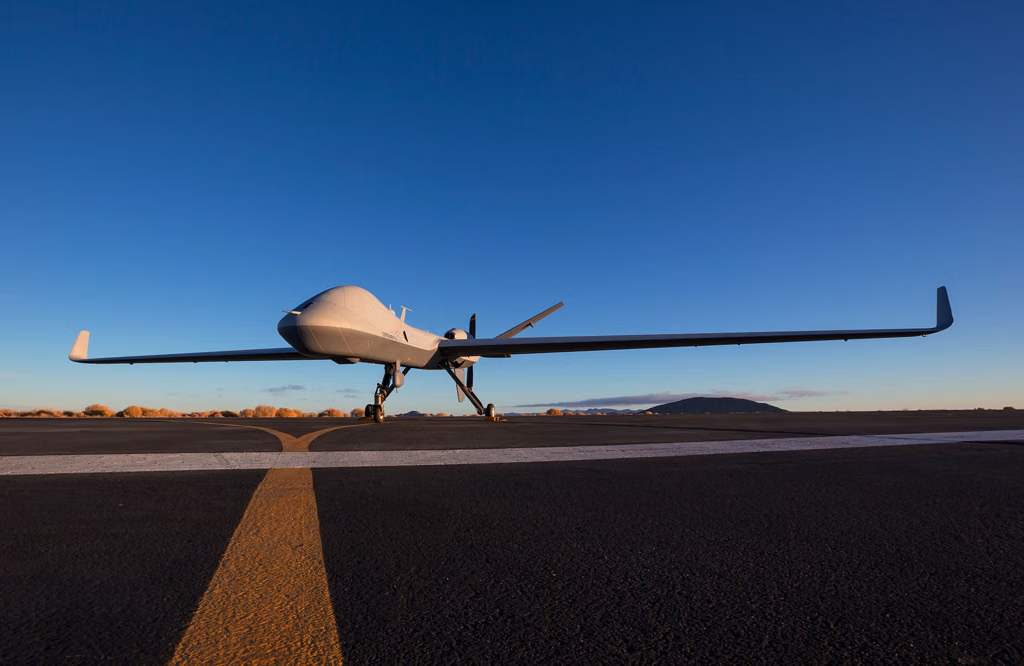
General Atomics Aeronautical Systems
High-speed vehicle concepts, aerospace systems engineering, and hypersonic research programs involving advanced flight vehicles.
Hypersonix Launch Systems
Commercial hypersonic aircraft and reusable scramjet systems, with emphasis on sustained hypersonic flight, hydrogen propulsion, and high-speed access-to-space concepts.
Reaction Engines
High-speed propulsion and thermal management, especially technologies related to combined-cycle engines and extreme-speed atmospheric flight.
Aerojet Rocketdyne
Hypersonic propulsion, rocket systems, and propulsion integration for advanced flight vehicles.
BAE Systems
Guidance, avionics, flight-control systems, and high-speed defense aerospace technologies.
Hermeus
Commercial hypersonic aircraft development, focusing on autonomous flight systems, high-speed aerodynamics, and propulsion integration.
Firms especially strong in flight dynamics and simulation
If your focus is specifically on 6-degree-of-freedom (6-DOF) flight dynamics, trajectory optimization, CFD, stability/control, and hypersonic vehicle simulation, look closely at:
Lockheed Martin — vehicle-level hypersonic dynamics and guidance/control.
Northrop Grumman — propulsion–airframe integration and advanced flight systems.
Boeing — aerodynamic modeling and high-speed vehicle analysis.
Southwest Research Institute — computational modeling, aerodynamics, and hypersonic testing support.
SpaceWorks Enterprises — advanced aerospace modeling and hypersonic concept studies.
Academic/government-adjacent organizations with major hypersonic dynamics expertise
Although not aerospace firms, these organizations heavily influence the field:
NASA Langley Research Center — hypersonic aerothermodynamics, CFD, wind tunnels, and vehicle analysis.
Sandia National Laboratories — hypersonic experiments, modeling, and defense applications.
Johns Hopkins University Applied Physics Laboratory — hypersonic systems engineering and guidance technologies.
For commercial aircraft-style hypersonics, the strongest candidates are emerging companies like Hypersonix and Hermeus. For military maneuvering hypersonic vehicles, the largest expertise base remains with Lockheed Martin, RTX, Northrop Grumman, and Boeing.












Lockheed Martin Corporation: A dominant leader in hypersonic systems, Lockheed Martin (via its Skunk Works division) designs and develops multiple classified and unclassified hypersonic boost-glide and scramjet-powered vehicles for the U.S. military.
Raytheon Technologies (
Pratt & Whitney segments, the company specializes in hypersonic weapon systems, guidance systems, and advanced scramjet propulsion integration.