Data as of Sep 14, 2026 · Based on 298 AI responses from ChatGPT, Google AI Overviews, ChatGPT Search and Google AI Mode · See how Parse measures this
Brands AI recommends here
Named in 29% of answers
Named in 12% of answers
Named in 10% of answers
Named in 10% of answers
Source | Citation share |
|---|---|
 Tests and surveys used during bridge and structural investigationshttps://constructiontesting.co.uk/news-and-insights/bridge-and-structural-investigations/ | 3.6% |
 6 methods for Bridge Damage and Deterioration Inspectionhttps://www.giatecscientific.com/education/bridge-inspection-technologies/ | 3.5% |
 Bridge Inspection: What We Learn From Bridge Failures And Repairshttps://underbridgeplatforms.com/bridge-inspection-what-we-learn-from-bridge-failures-and-repairs/ | 3.2% |
 Ultimate Guide to Bridge Inspections & Drone Benefitshttps://www.flyability.com/blog/bridge-inspections | 2.9% |
 Bridge Inspection Methods: Pros, Cons & Tools Explainedhttps://bridgemastersinc.com/bridge-inspection-methods/ | 2.8% |
 Bridge inspection is paramount to infrastructure resilience | ASCEhttps://www.asce.org/publications-and-news/civil-engineering-source/civil-engineering-magazine/issues/magazine-issue/article/2025/03/bridge-inspection-is-paramount-to-infrastructure-resilience | 2.5% |
 Best Practices for Utilizing Non-Destructive Testing for In-Service Bridge Inspection | For Construction Proshttps://www.forconstructionpros.com/business/construction-safety/article/22379891/aeis-best-practices-for-utilizing-nondestructive-testing-for-inservice-bridge-inspection | 2.2% |
 Inside the Bridge Inspection Toolboxhttps://www.structuremag.org/article/inside-the-bridge-inspection-toolbox/ | 2.0% |
 Bridge Inspection and Condition Assessment | Bridge Engineering Class Noteshttps://fiveable.me/bridge-engineering/unit-14 | 1.9% |
 Bridge Inspection - LinkedInhttps://www.linkedin.com/pulse/bridge-inspection-marcel-poser-didze | 1.9% |
The best way to inspect and assess the structural integrity of an existing bridge is through a **phased, multi-tiered approach** . No single test provides a complete picture. Engineers combine historical research, direct visual evaluation, advanced non-destructive testing (NDT), and structural…
The best way to inspect and assess the structural integrity of an existing bridge is through a phased, multi-tiered approach . No single test provides a complete picture. Engineers combine historical research, direct visual evaluation, advanced non-destructive testing (NDT), and structural modeling.
Evaluating an existing bridge involves specific methodologies, specialized tools, and key testing phases.
Before stepping onto the bridge, engineers must understand its background to target high-risk areas.
Visual assessment remains the baseline foundation of any bridge inspection. It helps catalog overt defects and determines which components require specialized engineering instruments.
When visual cracks or rust are spotted, or internal flaws are suspected, NDT methods allow engineers to evaluate materials without damaging the bridge.
| Testing Category[1][2][3][4][5][6][7][8] | Specific Methods | Primary Purpose |
|---|---|---|
| Acoustic & Wave | Ultrasonic Pulse Velocity (UPV), Impact-Echo | Identifies subsurface air voids, internal concrete cracks, and timber decay. |
| Electromagnetic | Ground Penetrating Radar (GPR) | Locates internal steel rebar networks and identifies concrete layer separation (delamination). |
| Surface Hardness | Schmidt Rebound Hammer | Measures surface bounce-back to calculate the compressive strength of the concrete. |
| Electrochemical | Half-Cell Potential, Electrical Resistivity | Measures electric current inside concrete to calculate active corrosion rates of steel reinforcements. |
| Chemical Dye | Dye Penetrant and Developer spray | Pinpoints exact surface boundaries and depths of fatigue cracks hidden under paint on steel beams. |
When non-destructive estimates leave room for uncertainty, direct physical testing validates structural parameters.
For older bridges, or structures under repair, real-time sensing hardware is left on-site.
If you are planning an inspection, tell me the primary material of the bridge (concrete, steel, or timber) and its approximate age . I can recommend the exact NDT tools best suited for your project.
The best practice is not a single inspection method, but a **tiered structural assessment program** that progresses from document review to detailed testing and engineering analysis. Professional bridge owners and agencies generally follow a process similar to the standards established by the U.S. Federal Highway…
The best practice is not a single inspection method, but a tiered structural assessment program that progresses from document review to detailed testing and engineering analysis. Professional bridge owners and agencies generally follow a process similar to the standards established by the U.S. Federal Highway Administration (FHWA).
Before going into the field, gather:
This establishes a baseline and helps identify critical elements that deserve closer attention.
A close visual inspection remains the foundation of bridge assessment.
Inspectors look for:
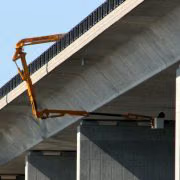
For many bridges, specialized access equipment, rope access, boats, or under-bridge inspection vehicles are required to get close enough to critical components.
If visual inspection suggests deterioration—or if the bridge contains critical structural components—a hands-on inspection is performed.
This may involve:
FHWA guidance describes these as "in-depth inspections" intended to identify deficiencies not visible during routine inspections.
Visual inspection alone can miss hidden defects.
Common NDT methods include:
| Method | Detects |
|---|---|
| Ultrasonic Testing (UT) | Internal flaws, thickness loss, weld defects |
| Ground Penetrating Radar (GPR) | Deck deterioration, rebar condition, voids |
| Impact Echo | Delamination and voids in concrete |
| Magnetic Particle Testing | Surface cracks in steel |
| Dye Penetrant Testing | Fine surface cracks |
| Acoustic Emission Monitoring | Active crack growth |
| Electrical Resistivity Testing | Corrosion potential in concrete decks |
For example, FHWA specifically recommends ultrasonic thickness measurements where corrosion of steel gusset plates may not be adequately assessed visually.
Many bridge failures originate below the waterline.
Assessment should include:
For water crossings, underwater inspections may range from a simple diver survey to detailed ultrasonic and coring investigations.
Use modern surveying techniques to detect movement:
These can reveal:
before they become obvious visually.
Field observations should be translated into engineering capacity assessments.
Engineers typically:
The goal is determining whether the bridge still possesses adequate strength, serviceability, and redundancy.
For major or aging bridges, continuous monitoring may be worthwhile:
These systems can identify changes between scheduled inspections.
For an existing bridge whose condition is uncertain, a robust assessment would typically be:
This combination provides a far more reliable picture of structural integrity than visual inspection alone and is generally considered the industry standard for evaluating existing bridges.
Assessing the structural integrity of an existing bridge is usually done in layers: start broad and noninvasive, then escalate to detailed testing and analysis if the bridge shows distress, deterioration, or unusual behavior. A solid bridge assessment program typically combines: 1. **Document review**
Assessing the structural integrity of an existing bridge is usually done in layers: start broad and noninvasive, then escalate to detailed testing and analysis if the bridge shows distress, deterioration, or unusual behavior.
A solid bridge assessment program typically combines:
Before going into the field, engineers gather:
This establishes:
Visual inspection is still the foundation of bridge assessment.
Inspectors look for:
Typical tools include:
Modern inspections increasingly use UAV photogrammetry and AI-assisted crack detection to improve coverage and documentation.
| Symptom | Possible concern |
|---|---|
| Longitudinal cracking | Reinforcement corrosion |
| Rust staining | Hidden steel corrosion |
| Differential settlement | Foundation/scour issue |
| Fatigue cracks near welds | Cyclic overstress |
| Excessive vibration | Stiffness reduction |
| Concrete delamination | Rebar corrosion |
| Bearing lock-up | Thermal restraint forces |
| Girder distortion | Load redistribution or impact damage |
If visual inspection suggests hidden deterioration, engineers move to NDT methods.
Common methods include:
| Method | Used for |
|---|---|
| Ultrasonic Testing (UT) | Internal steel cracks/thickness |
| Ground Penetrating Radar (GPR) | Deck delamination/rebar mapping |
| Magnetic Particle Testing | Surface steel cracks |
| Dye Penetrant Testing | Fine crack detection |
| Acoustic Emission | Active crack growth |
| Infrared Thermography | Delamination/moisture |
| Half-cell potential | Corrosion probability |
| Impact echo | Concrete voids/delamination |
| LiDAR/laser scanning | Geometry/deformation |
| Strain gauges | Real-time stress response |
FHWA guidance specifically recommends combining visual inspection with ultrasonic testing for critical gusset plate connections.
For reinforced concrete bridges, engineers often combine:
Many bridge failures originate below the waterline.
For bridges over water:
are used to assess:
Underwater inspections are often classified:
Once field data are collected, engineers create or update a structural model.
Typical analyses include:
The bridge is then load-rated using current code requirements.
Simplified example of load demand:
Where:
If measured deterioration reduces section properties, stresses rise significantly.
Engineers may also compare measured strains/deflections against analytical predictions.
When analysis is uncertain, controlled load testing may be used.
This can involve:
Engineers measure:
This helps validate:
Load testing is especially useful for:
Critical or aging bridges increasingly use continuous monitoring systems.
Sensors may track:
Modern SHM systems can detect changes before visible damage appears.
Common technologies:
The final goal is not just “is the bridge safe today?” but:
Engineers typically classify bridges into:
A practical assessment sequence is usually:
For most existing bridges today, the best combination is:
No single method is sufficient alone.
Visual inspection finds obvious distress quickly and cheaply, while NDT and SHM reveal hidden deterioration and structural behavior that the eye cannot detect.
Inspecting and assessing the structural integrity of an existing bridge requires a combination of visual, non-destructive, and sometimes destructive testing methods to gather comprehensive data, generally following mandated schedules to monitor for issues like corrosion or…
Inspecting and assessing the structural integrity of an existing bridge requires a combination of visual, non-destructive, and sometimes destructive testing methods to gather comprehensive data, generally following mandated schedules to monitor for issues like corrosion or cracking.
Primary Inspection and Assessment Methods
Best Practices for Inspection
If you're interested, I can also look into:
Inspecting and assessing the structural integrity of an existing bridge is a **layered engineering process** that combines visual inspection, data review, and advanced testing. In practice, engineers follow standardized procedures (like the U.S. National Bridge Inspection Standards) and escalate from simple…
Inspecting and assessing the structural integrity of an existing bridge is a layered engineering process that combines visual inspection, data review, and advanced testing. In practice, engineers follow standardized procedures (like the U.S. National Bridge Inspection Standards) and escalate from simple observations to sophisticated diagnostics depending on what they find.
Here’s what the process typically looks like in a well-structured way:
Before going on site, engineers gather background data:
Original design drawings and specifications
Construction history and materials used
Previous inspection reports and repair records
Known issues (fatigue cracks, scour, corrosion, etc.)
This helps target high-risk areas during inspection rather than treating the bridge as “unknown.”
This is the most common and foundational step.
Engineers physically examine all accessible parts:
Deck, girders, trusses, bearings, piers, abutments
Look for cracks, rust, spalling concrete, deformation, settlement
Check drainage, joints, and expansion systems
Tools often used:
Measuring devices (crack gauges, levels)
Binoculars, cameras, drones
Hammer sounding (to detect delamination in concrete)
Visual inspection is essential but limited—it can miss hidden internal damage.
If issues are suspected, engineers perform hands-on or access-assisted checks:
Under-bridge lifts or rope access systems
Diving inspections for submerged components
Removal of coatings or surface cleaning for better evaluation
This step focuses on critical or deteriorated elements.
This is where deeper structural integrity is evaluated without damaging the bridge.
Common methods include:
Ultrasonic testing → detects internal cracks or flaws in steel/concrete
Ground-penetrating radar (GPR) → maps reinforcement and voids
Magnetic particle testing → finds surface and near-surface cracks in steel
Radiography (X-ray methods) → internal defect detection
Infrared thermography → identifies moisture or delamination zones
These methods are widely used for assessing internal condition and material integrity.
For critical structures or uncertain capacity:
Controlled vehicle loads are placed on the bridge
Deflection, strain, and vibration are measured
Results compared to design expectations
This helps validate actual performance vs. theoretical capacity.
Engineers combine inspection data with engineering models:
Calculate remaining strength of beams, deck, foundations
Evaluate fatigue life and safety factors
Determine load rating (how much traffic the bridge can safely carry)
This step translates field observations into engineering safety decisions.
Depending on the bridge, additional checks may include:
Scour analysis (erosion around foundations in water)
Fatigue/fracture assessment (steel bridges)
Seismic vulnerability evaluation
Corrosion rate monitoring
Finally, everything is compiled into:
Condition ratings (good / fair / poor or numeric scales)
Maintenance or repair recommendations
Closure or restriction decisions if necessary
These reports often feed into national bridge management systems.
A proper bridge integrity assessment is not a single test—it’s a progressive investigation :
Visual inspection → targeted close inspection → NDT → structural analysis → load rating → decision
Each step adds confidence and reduces uncertainty.
If you want, I can also break down how engineers decide whether a bridge is safe for heavy loads or how drones and AI are starting to change inspection methods.
The best approach to inspect and assess bridge structural integrity combines **visual inspection** with **non-destructive testing (NDT)** (e.g., GPR, ultrasonic testing) and **load testing** to detect surface damage, internal corrosion, and structural capacity flaws without damaging the bridge. Modern methods include…
The best approach to inspect and assess bridge structural integrity combines visual inspection with non-destructive testing (NDT) (e.g., GPR, ultrasonic testing) and load testing to detect surface damage, internal corrosion, and structural capacity flaws without damaging the bridge. Modern methods include using drones and AI for rapid damage detection.
Key Inspection and Assessment Methods:
These methods ensure safety by monitoring fatigue and deterioration, allowing for proactive maintenance and repair.
The best way to inspect and assess an existing bridge involves a combination of **visual inspection, non-destructive testing (NDT), and load testing** , guided by historical records review. A comprehensive assessment typically starts with a detailed visual examination—using technologies like drones—followed by…
The best way to inspect and assess an existing bridge involves a combination of visual inspection, non-destructive testing (NDT), and load testing , guided by historical records review. A comprehensive assessment typically starts with a detailed visual examination—using technologies like drones—followed by specialized tests like ground-penetrating radar (GPR) and ultrasonic testing to identify internal defects, corrosion, or material degradation.
Top Inspection & Assessment Methods
Structural Assessment Procedure
Common Technologies Used
Regular inspections, often mandated every 24 months, are essential to ensure long-term safety and identify necessary repairs.
Assessing the structural integrity of an existing bridge isn’t a single test—it’s a layered process that combines **visual inspection, engineering judgment, and advanced testing technologies**. The “best” approach is really a structured workflow that escalates from simple to sophisticated methods depending on what you…
Assessing the structural integrity of an existing bridge isn’t a single test—it’s a layered process that combines visual inspection, engineering judgment, and advanced testing technologies. The “best” approach is really a structured workflow that escalates from simple to sophisticated methods depending on what you find.
Here’s how professionals typically do it:
This is always the first step and still the most widely used method.
Inspect all accessible components: deck, girders, piers, bearings, cables
Look for:
Cracks, spalling, deformation
Corrosion or section loss in steel
Water damage, drainage issues
Use tools like lighting, magnifiers, probes, and cleaning to expose defects
Visual inspection is fast and cost-effective, but it mainly detects surface-level problems and can miss internal damage Framework for assessing bridge quality index based on the correlation of non-destructive test results - PMC.
👉 In practice, most bridge programs rely on routine visual inspections every 1–2 years, with more detailed inspections every few years Bridge Inspection and Bridge Structure Testing Methods.
For high-risk components (like tension members or fracture-critical parts):
Inspect within arm’s length
Clean surfaces to expose cracks
Use magnification and strong lighting
This “hands-on” approach is essential for detecting fatigue cracks before they propagate Fracture Critical Bridge Inspection.
When visual inspection isn’t enough, engineers use NDT methods to “see inside” the structure without damaging it.
For concrete:
Ground-penetrating radar (GPR) → rebar location, voids
Impact echo → delamination detection
Infrared thermography → subsurface defects
For steel:
Ultrasonic testing → internal cracks, thickness loss
Magnetic particle or dye penetrant → surface cracks
Eddy current → corrosion and coating condition
These methods provide quantitative data on hidden defects and material condition Highway Bridge Inspections | US Department of Transportation.
For important or aging bridges, continuous monitoring is used:
Strain gauges → measure stress and load response
Accelerometers → detect vibration changes
Displacement sensors → track movement over time
Changes in vibration or strain patterns can indicate damage progression or stiffness loss.
Emerging methods even use:
Vehicle-based sensing
Drone imaging
AI crack detection
If there’s uncertainty about capacity:
Static load testing : apply controlled loads and measure deflection
Dynamic testing : observe vibration behavior under traffic
These results are compared with analytical models to evaluate safety margins.
If deterioration is suspected:
Core samples of concrete
Steel samples for lab testing
This is more invasive but provides definitive material properties.
All collected data feeds into:
Structural analysis models
Condition ratings (e.g., “good,” “fair,” “poor”)
Remaining life prediction
This step determines whether the bridge:
Is safe
Needs repair/rehabilitation
Requires load restrictions or closure
The best assessments share a few traits:
Multi-method approach (never rely on just visual or just NDT)
Focus on critical components first (not all parts carry equal risk)
Trend monitoring over time , not just one inspection snapshot
Integration with engineering models , not just raw data
The most effective way to assess a bridge is a tiered strategy :
Visual inspection → targeted hands-on inspection → NDT → monitoring → analysis
No single method is sufficient. The real strength comes from combining them to detect both visible damage and hidden structural weaknesses —and tracking how they evolve over time.
If you want, I can walk through a real example (like how engineers would inspect a corroded steel girder bridge step by step).
Inspecting and assessing the structural integrity of an existing bridge is a multi-layered engineering process that combines **routine visual inspection, detailed condition assessment, and targeted advanced testing**. The “best” approach depends on the bridge type, age, materials, environment, and whether you’re doing…
Inspecting and assessing the structural integrity of an existing bridge is a multi-layered engineering process that combines routine visual inspection, detailed condition assessment, and targeted advanced testing. The “best” approach depends on the bridge type, age, materials, environment, and whether you’re doing routine monitoring or a deeper forensic evaluation.
Here’s how it’s typically done in professional practice.
This is the most common and important first method. Engineers physically examine the bridge to identify obvious defects.
They look for:
Cracks in concrete or welds
Corrosion (especially in steel members)
Spalling or delamination in concrete
Deformation, sagging, or misalignment
Bearing/joint deterioration
Drainage issues (water is a major long-term cause of damage)
Tools often include:
Flashlights, mirrors, magnifiers
Hammers for “sounding” concrete (detecting delamination)
Measuring devices and crack gauges
Visual inspection is fast and cost-effective, but it only detects surface-level or near-surface problems , not internal defects.
Because of that limitation, it is always followed by more advanced methods when needed.
When visual inspection raises concerns—or for critical bridges—engineers use NDT methods that reveal internal conditions without damaging the structure.
Common techniques include:
Ultrasonic testing (UT): detects internal cracks or thickness loss
Magnetic particle testing: reveals surface and near-surface cracks
Dye penetrant testing: highlights fine surface cracks
Eddy current testing: detects flaws and corrosion in metals
Ground-penetrating radar (GPR): locates rebar, voids, and delamination
Impact echo / ultrasonic pulse velocity: evaluates internal cracking
Infrared thermography: identifies subsurface voids via heat patterns
These methods are essential because they detect issues like:
Hidden corrosion in rebar
Internal voids in concrete
Fatigue cracks not visible on the surface
For important or aging bridges, engineers may install sensors that continuously monitor behavior over time:
Strain gauges (measure stress)
Accelerometers (detect vibration changes)
Displacement sensors (track movement or sagging)
Temperature and environmental sensors
This helps detect gradual deterioration trends , not just isolated defects.
Modern systems may even include:
Wireless sensor networks
Real-time dashboards
AI-based anomaly detection
In some cases, engineers physically test how the bridge behaves under controlled loads:
Trucks placed at specific positions
Measurement of deflection and stress response
Comparison with design predictions
This is especially useful when:
Structural capacity is uncertain
The bridge has been damaged
Upgrading load limits is being considered
All collected data feeds into computational models:
Finite element analysis (FEA)
Load rating calculations
Fatigue life estimation
Safety factor evaluation
This step translates field observations into:
Load capacity ratings
Remaining service life estimates
Repair or strengthening recommendations
Not all defects are equal. Engineers classify findings based on:
Severity (minor cracking vs structural fracture)
Location (primary load-bearing vs secondary member)
Progression rate (stable vs rapidly worsening)
This determines whether the bridge needs:
Routine maintenance
Targeted repair
Load restriction
Full closure or replacement
No single method is sufficient. The standard best-practice workflow is:
Visual inspection (baseline condition)
Targeted NDT (investigate suspicious areas)
Structural health monitoring (if critical)
Load testing (if needed for verification)
Analytical modeling (final engineering assessment)
The most reliable bridge integrity assessments come from combining:
human inspection + advanced sensing + structural modeling + engineering judgment
If you want, I can walk through how this differs for steel bridges vs concrete bridges or how drones and AI are changing inspections today.
The best way to inspect and assess bridge structural integrity is a combined approach using detailed visual inspections, hands-on techniques (like concrete sounding), and non-destructive testing (NDT) such as ground-penetrating radar, ultrasonic testing, and drone technology. This hybrid approach identifies surface…
The best way to inspect and assess bridge structural integrity is a combined approach using detailed visual inspections, hands-on techniques (like concrete sounding), and non-destructive testing (NDT) such as ground-penetrating radar, ultrasonic testing, and drone technology. This hybrid approach identifies surface flaws and hidden internal defects, ensuring comprehensive safety evaluation.
Core Inspection Methods
Advanced NDT Techniques
Modern Technology
Typical Assessment Process