Data as of Sep 18, 2026 · Based on 50 AI responses from ChatGPT Search and Google AI Mode · See how Parse measures this
Your brand can be here too.
Source | Citation share |
|---|---|
 8 Best AI Agent Evaluation Platforms in 2026 | Galileohttps://galileo.ai/blog/best-ai-agent-evaluation-platforms | 4.9% |
 5 best AI evaluation tools for AI systems in production (2026) - Articleshttps://www.braintrust.dev/articles/best-ai-evaluation-tools-2026 | 2.9% |
 Top 5 AI Agent Evaluation Platforms in 2026 - Maxim AIhttps://www.getmaxim.ai/articles/top-5-ai-agent-evaluation-platforms-in-2026/ | 2.4% |
 Agent Evaluators for Generative AI - Microsoft Foundryhttps://learn.microsoft.com/en-us/azure/foundry/concepts/evaluation-evaluators/agent-evaluators | 2.0% |
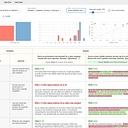
 Top 5 Agent Evaluation Tools in 2026 - MLflowhttps://mlflow.org/top-5-agent-evaluation-frameworks/ | 2.0% |
 Best AI Agent Evaluation Tools for Production Teams (2026)https://www.augmentcode.com/tools/best-ai-agent-evaluation-tools | 2.0% |
 AI agent evaluation: frameworks, metrics & testing strategies - Algoliahttps://www.algolia.com/blog/ai/ai-agent-evaluation-frameworks-metrics-testing-strategies | 1.8% |
 For people out there making AI agents, how are you evaluating ... - Reddithttps://www.reddit.com/r/AI_Agents/comments/1k1mmb1/for_people_out_there_making_ai_agents_how_are_you/ | 1.6% |
AI agent evaluation: A practical framework for testing multi ...https://www.braintrust.dev/articles/ai-agent-evaluation-framework | 1.4% |
5 best AI agent observability tools for agent reliability in 2026 - Articles - Braintrusthttps://www.braintrust.dev/articles/best-ai-agent-observability-tools-2026 | 1.4% |
For evaluating **whether an AI agent actually completed a multi-tool task correctly**, the strongest platforms to shortlist are: - **Braintrust** — strong for task/trajectory evals, datasets, custom scorers, and CI/release workflows. [Arize…
For evaluating whether an AI agent actually completed a multi-tool task correctly, the strongest platforms to shortlist are:
For your specific use case, I’d focus less on final-answer scoring and more on trajectory evaluation: did it choose the right tools, pass correct arguments, make the required state changes, recover appropriately, and ultimately satisfy the task?
Evaluating whether an AI agent correctly completes multi-step tasks across multiple tools requires looking at **execution trajectories** (the sequence of reasoning steps, API choices, argument formatting, and intermediate tool responses) rather than just final…
Evaluating whether an AI agent correctly completes multi-step tasks across multiple tools requires looking at execution trajectories (the sequence of reasoning steps, API choices, argument formatting, and intermediate tool responses) rather than just final outputs.
The leading platforms built to handle cross-tool agent evaluation, tracing, and scoring span different architectural and workflow needs:
- Braintrust — **Best for enterprise-grade experiment tracking and data logging speed.** Braintrust excels at managing complex evaluation datasets, running parallelized evaluations across different models/prompts, and bridging offline unit-test evals with real-time production monitoring. It handles multi-step tool accuracy scoring gracefully via custom code and LLM judges.[[1]](https://www.braintrust.dev/docs/best-practices/agents)[[2]](https://www.braintrust.dev/articles/ai-agent-evaluation-framework)
- Maxim AI — **Best for end-to-end agent simulation.** Maxim specializes in workflow graph workloads, allowing teams to endlessly simulate multi-step agent trajectories and user interactions in sandbox environments prior to deployment, alongside robust live observability.[[1]](https://www.cio.com/article/4207550/tools-for-evaluating-and-benchmarking-agentic-ai-systems.html)
- Galileo — **Best for connecting offline evaluations directly to production guardrails.** Galileo provides robust chain-of-thought and tool-use metrics, helping isolate whether a failure originated in bad reasoning or a malformed tool call, translating offline findings straight into runtime guardrails.[[1]](https://galileo.ai/blog/best-ai-agent-evaluation-platforms)
- Langfuse — **Best open-source/self-hosted option.** If data sovereignty or strict compliance prevents sending multi-tool traces to third-party clouds, Langfuse offers a flexible, MIT-licensed observability and evaluation suite that you can run entirely in your own infrastructure.[[1]](https://galileo.ai/blog/best-ai-agent-evaluation-platforms)
When evaluating cross-tool completion, platforms typically rely on two scoring methods:
To help narrow down the ideal platform, tell me:
For **cross-tool agent correctness**, I’d shortlist: - **Braintrust** — best general-purpose choice for datasets, trajectory scoring, human review, and CI/release gates. [Omid Saffari](https://omidsaffari.com/blog/best-ai-benchmark-audit-tools-for-agent-evaluations-2026?utm_source=chatgpt.com) [Arize…
For cross-tool agent correctness, I’d shortlist:
My pick: Braintrust for a heterogeneous multi-tool agent; LangSmith if you're already deeply invested in LangGraph.
Evaluating whether an AI agent correctly completes multi-step tasks across various external tools requires looking at three distinct layers: **final-response accuracy**, **trajectory evaluation** (the sequence of tool calls and decisions), and **single-step parameter…
Evaluating whether an AI agent correctly completes multi-step tasks across various external tools requires looking at three distinct layers: final-response accuracy, trajectory evaluation (the sequence of tool calls and decisions), and single-step parameter correctness.
PlanQualityMetric, PlanAdherenceMetric , and ToolCorrectnessMetric to test tool selection and parameter accuracy natively inside CI/CD pipelines via GitHub Actions.When choosing between rigid unit-testing patterns and open-source observability stacks, developer communities often emphasize composability and tracking the exact tool trajectory over simple output checking:
I found that breaking down evaluations into step-by-step tool trajectories rather than just looking at the final output saved hours of debugging phantom agent errors.
Using open-source metrics inside integrated experiment workflows gives you the flexibility to customize how strict your tool-parameter validations are without locking into a single vendor's ecosystem.
If you'd like to narrow this down, tell me:
I can help you pick the best fit for your stack.
If by **“completed a task correctly across tools”** you mean evaluating an agent’s *entire trajectory*—tool selection, arguments, intermediate state changes, final outcome, and whether it actually accomplished the user’s goal—then the strongest options today are: Platform | Best for | Tool/trajectory evals |…
If by “completed a task correctly across tools” you mean evaluating an agent’s entire trajectory—tool selection, arguments, intermediate state changes, final outcome, and whether it actually accomplished the user’s goal—then the strongest options today are:
| Platform | Best for | Tool/trajectory evals | Production evals | Self-host |
|---|---|---|---|---|
| Braintrust | Eval-first teams, regression/CI | ★★★★★ | ★★★★☆ | Limited |
| LangSmith | LangGraph/LangChain + full lifecycle | ★★★★★ | ★★★★★ | Limited |
| Arize Phoenix | Open-source + deep tracing | ★★★★★ | ★★★★☆ | Yes |
| Langfuse | Open-source, flexible eval infrastructure | ★★★★☆ | ★★★★☆ | Yes |
| Inspect AI | Safety, capability, adversarial evaluations | ★★★★☆ | ★★☆☆☆ | Yes |
| DeepEval | Developer-centric automated tests | ★★★★☆ | ★★★☆☆ | Yes |
1. braintrust.dev — best if evaluation itself is the product
Braintrust is particularly good at treating an agent run as an experiment: individual tool calls/reasoning steps become spans, you can score both individual steps and the overall task, compare agent versions, and turn production failures into regression datasets.
For example, you can evaluate:
2. langchain.com — best integrated agent-development platform
LangSmith captures the full trajectory—including tool calls—and supports offline datasets, online evaluation, human review, and LLM-as-judge evaluators. It's especially compelling if you're using LangGraph, although it is not limited to that ecosystem.
3. arize.com — best open-source choice
Phoenix is excellent when you want to own the evaluation infrastructure. It traces prompts, retrieval, tool calls and outputs, lets you annotate traces, build datasets from failures, and run experiments/evaluations.
It is particularly attractive if your agents span multiple frameworks and you want OpenTelemetry/OpenInference rather than committing to one vendor's SDK.
4. langfuse.com — strong open-source alternative
I'd consider Langfuse when self-hosting and controlling your data are important. It sits somewhere between observability, prompt management, datasets and evaluation rather than being purely an agent benchmark.
5. Inspect AI — best for capability/safety evaluation
If the question is less “did my customer-support agent correctly process this refund?” and more “what can this agent do under adversarial conditions?”, Inspect AI is worth serious consideration. It is oriented toward systematic capability and safety evaluations rather than primarily being a production observability platform.
For your use case, don't evaluate only the final answer.
Suppose the task is:
“Find the cheapest flight meeting these constraints, book it, and put the confirmation in my calendar.” A useful evaluator should have access to something like:
Task
 ├─ Tool call: search_flights(...)
 ├─ Tool call: filter_results(...)
 ├─ Tool call: book_flight(...)
 ├─ Tool call: get_confirmation(...)
 ├─ Tool call: calendar_create(...)
 └─ Final response
Then score multiple dimensions:
Task success          1/0
Tool selection        0.0–1.0
Tool arguments        0.0–1.0
Policy compliance     0.0–1.0
Intermediate state    0.0–1.0
Final state            0.0–1.0
Efficiency             0.0–1.0
Final response         0.0–1.0
This matters because an agent can produce a convincing final response while having failed the actual task. Agent evaluation specifically needs to account for multi-step actions, tool calls and changes to external systems; conventional single-turn LLM evaluation doesn't capture that reliably.
I'd shortlist Braintrust vs. LangSmith vs. Phoenix first.
One particularly important feature to demand in a proof-of-concept is state-based evaluation: the evaluator should be able to inspect the state of the systems the agent interacted with, rather than judging only its trace or final prose. That is the difference between “the agent looked like it succeeded” and “the agent actually accomplished the task.”
Phoenix is excellent when you want to own the evaluation infrastructure. It traces prompts, retrieval, tool calls and outputs, lets you annotate traces, build datasets from failures, and run experiments/evaluations.
It is particularly attractive if your agents span multiple frameworks and you want OpenTelemetry/OpenInference rather than committing to one vendor's SDK.
4. langfuse.com — strong open-source alternative
I'd consider Langfuse when self-hosting and controlling your data are important. It sits somewhere between observability, prompt management, datasets and evaluation rather than being purely an agent benchmark.
5. Inspect AI — best for capability/safety evaluation
If the question is less “did my customer-support agent correctly process this refund?” and more “what can this agent do under adversarial conditions?”, Inspect AI is worth serious consideration. It is oriented toward systematic capability and safety evaluations rather than primarily being a production observability platform.
For your use case, don't evaluate only the final answer.
Suppose the task is:
“Find the cheapest flight meeting these constraints, book it, and put the confirmation in my calendar.” A useful evaluator should have access to something like:
Task
 ├─ Tool call: search_flights(...)
 ├─ Tool call: filter_results(...)
 ├─ Tool call: book_flight(...)
 ├─ Tool call: get_confirmation(...)
 ├─ Tool call: calendar_create(...)
 └─ Final response
Then score multiple dimensions:
Task success          1/0
Tool selection        0.0–1.0
Tool arguments        0.0–1.0
Policy compliance     0.0–1.0
Intermediate state    0.0–1.0
Final state            0.0–1.0
Efficiency             0.0–1.0
Final response         0.0–1.0
This matters because an agent can produce a convincing final response while having failed the actual task. Agent evaluation specifically needs to account for multi-step actions, tool calls and changes to external systems; conventional single-turn LLM evaluation doesn't capture that reliably.
Evaluating whether an AI agent correctly executes multi-step tasks across multiple tools requires tracking **trajectory validation** (sequence of tool calls), **parameter correctness** (arguments passed), and **final goal achievement**.[](https://www.youtube.com/watch?v=eeLSnvDLMQQ&vl=en-US&t=61)…
Evaluating whether an AI agent correctly executes multi-step tasks across multiple tools requires tracking trajectory validation (sequence of tool calls), parameter correctness (arguments passed), and final goal achievement.
The leading platforms and frameworks specialized in scoring and tracing complex, multi-tool agent behavior include:
pytest and includes specific metrics like ToolCorrectnessMetric (evaluating tool selection and parameter accuracy) alongside plan quality and adherence metrics. Ideal for CI/CD pipelines via GitHub Actions.When configuring any of these platforms, ensure your evaluation suite tests three distinct layers:
If you'd like to narrow this down, tell me:
Evaluating multi-step AI agents that interact with external tools requires specialized platforms. Traditional LLM testing only scores the final text answer. Agent evaluation platforms instead isolate **the agent's trajectory** , checking whether it selected the correct tool, passed the right parameters, and correctly…
Evaluating multi-step AI agents that interact with external tools requires specialized platforms. Traditional LLM testing only scores the final text answer. Agent evaluation platforms instead isolate the agent's trajectory , checking whether it selected the correct tool, passed the right parameters, and correctly handled tool errors.
The best platforms for evaluating cross-tool task execution are grouped below by their primary strengths:
These tools act like unit-testing frameworks for AI, making them ideal for catch-and-block regression testing during development.
pytest workflow. It features dedicated agentic metrics like ToolCorrectnessMetric (checking if the agent invoked the right tool with accurate parameters), PlanQualityMetric , and PlanAdherenceMetric.When a task fails across a complex environment, these platforms provide visual, nested execution "traces" (graphs) showing exactly which tool failed, suffered high latency, or caused a planning loop.
These platforms focus heavily on enterprise governance, handling massive traffic, and using advanced small models to reduce evaluation costs.
Key Metrics to Configure When Testing Tool Usage
When setting up any of these platforms, focus on three layers of metrics rather than just the final output:
| Metric Type | What It Measures | Example Failure Caught |
|---|---|---|
| Tool Selection | Did the agent pick the correct tool for the intent? | Calling DeleteDatabase instead of QueryDatabase. |
| Argument Accuracy | Were parameter values formatted and passed correctly? | Passing an unformatted string into a strict ISO-date API field. |
| Error Recovery | How did the agent respond when a tool returned a 404 or timeout? | Crashing immediately vs. retrying or trying an alternate tool. |
To give you the most tailored recommendation, what tech stack is your agent built on (e.g., LangGraph, CrewAI, custom Python), and how many tools does it typically orchestrate during a single run?
If by **“completed a task correctly across tools”** you mean evaluating an agent’s *entire execution*—tool selection, arguments, intermediate state, side effects, and final outcome—rather than just grading its final answer, the strongest options today are: Platform | Best for | Trajectory/tool-call eval | Production…
If by “completed a task correctly across tools” you mean evaluating an agent’s entire execution—tool selection, arguments, intermediate state, side effects, and final outcome—rather than just grading its final answer, the strongest options today are:
| Platform | Best for | Trajectory/tool-call eval | Production eval | Self-host |
|---|---|---|---|---|
| Braintrust | Best overall eval-first platform | Excellent | Excellent | No |
| LangSmith | LangChain/LangGraph & end-to-end agent lifecycle | Excellent | Excellent | No |
| Arize Phoenix | Open-source / self-hosted | Excellent | Good | Yes |
| Langfuse | Open-source tracing + evals | Very good | Excellent | Yes |
| **Confident AI / DeepEval | Code-first testing & CI | Excellent | Moderate | Yes |
| Inspect AI | Research / rigorous custom benchmarks | Excellent | Less focused | Yes |
| **OpenAI Evals | Custom eval harnesses | Good | Less focused | Code-first |
1. Braintrust — best if evaluation itself is the core problem. It records individual tool calls and other agent steps as spans, supports trace-level scoring such as task completion and tool-use accuracy, and lets you turn production failures into evaluation datasets. That makes it particularly well suited to answering “Did the agent actually accomplish the task, and where did it go wrong?”
2. LangSmith — best for complex agent workflows. Its trajectory evaluations can compare exact tool sequences, expected tool sets, or use an LLM judge to assess the complete trajectory. It also combines offline regression testing with online production evaluation.
3. Arize Phoenix — best open-source choice. Phoenix traces prompts, retrieval, tool calls, and outputs, then lets you annotate traces with human or LLM judgments and turn traces into datasets/experiments. It's especially attractive if you need to keep evaluation infrastructure under your control.
4. Langfuse — strong open-source production option. I'd consider it when you want observability, datasets, experiments, and evaluation without committing to a proprietary hosted platform.
For agents, I wouldn't evaluate just:
Input → final answer → score Instead, I'd evaluate:
Goal → trajectory → tool calls + arguments → resulting state/side effects → final outcome For example, suppose an agent is told:
“Find the cheapest flight, book it, and email me the confirmation.” A good evaluator should separately check:
This matters because trajectory-level evaluation can expose failures that a final-answer grader misses. LangSmith's documentation, for example, explicitly distinguishes evaluating the selected tools from evaluating the full trajectory, including tool inputs and model decisions.
My recommendation would be:
The key architectural feature I'd prioritize is state/outcome verification, not merely LLM-as-a-judge. A judge can say an agent appears to have completed a task; a strong harness can query the actual database, CRM, filesystem, browser state, API response, etc. and establish whether the intended side effect really occurred.
If you're specifically evaluating computer-use/browser agents or MCP/tool-using agents, the shortlist changes somewhat—I can give you a comparison specifically for that use case.
3. Arize Phoenix — best open-source choice. Phoenix traces prompts, retrieval, tool calls, and outputs, then lets you annotate traces with human or LLM judgments and turn traces into datasets/experiments. It's especially attractive if you need to keep evaluation infrastructure under your control.
4. Langfuse — strong open-source production option. I'd consider it when you want observability, datasets, experiments, and evaluation without committing to a proprietary hosted platform.
For evaluating whether an **AI agent actually completed a task correctly across multiple tools** (browser, APIs, databases, code execution, SaaS apps, etc.), the strongest platforms are the ones that evaluate the **whole trajectory**: tool choices, arguments, intermediate states, failures/retries, and final…
For evaluating whether an AI agent actually completed a task correctly across multiple tools (browser, APIs, databases, code execution, SaaS apps, etc.), the strongest platforms are the ones that evaluate the whole trajectory: tool choices, arguments, intermediate states, failures/retries, and final outcome—not just the final text response.
| Platform | Best for | Strengths | Trade-offs |
|---|---|---|---|
| Braintrust | Production-grade agent eval pipelines | Golden datasets, experiments, scoring, human review, CI gates | Less focused on deep framework-specific traces |
| LangSmith | LangChain/LangGraph agents | Excellent trace visualization, trajectory inspection, datasets, evaluators | Best fit if you use the LangChain ecosystem |
| Arize AI / Arize Phoenix | Open-source and framework-agnostic evaluation | OpenTelemetry-based tracing, evaluations, self-hosting | Requires more assembly for some workflows |
| Langfuse | Teams wanting self-hosted tracing | Open source, traces, prompts, evaluations | More DIY than managed platforms |
| Confident AI | Code-first automated testing | Strong metric library, CI-friendly workflows | Less focused on full production observability |
| Weights & Biases | Teams already using ML experiment tracking | Integrates evals with broader ML workflows | Agent-specific features are not its only focus |
Arize AI Cipher Projects## How I would choose
Pick Braintrust or Arize AX/Phoenix.
You typically want:
Omid Saffari Arize AI### For LangGraph/LangChain agents
Pick LangSmith.
It is especially good when you need to answer:
Cipher Projects### For open-source / self-hosted environments
Pick Arize Phoenix, Langfuse, or DeepEval.
Useful when:
Arize AI GitHub## What to evaluate (the important part)
A good agent evaluator should score:
Trajectory-level evaluation is increasingly important because a final answer can look correct while the agent used the wrong tools or produced an invalid side effect.
A mature setup often looks like:
Arize AI morphllm.comIf your agents are tool-using autonomous agents (e.g., coding agents, research agents, customer support agents), I would prioritize platforms that support trajectory evaluation and environment-state verification, not just LLM output grading.
Evaluating multi-step AI agents that interact with external tools requires specialized platforms. Traditional LLM testing only scores the final text answer. Agent evaluation platforms instead isolate **the agent's trajectory** , checking whether it selected the correct tool, passed the right parameters, and correctly…
Evaluating multi-step AI agents that interact with external tools requires specialized platforms. Traditional LLM testing only scores the final text answer. Agent evaluation platforms instead isolate the agent's trajectory , checking whether it selected the correct tool, passed the right parameters, and correctly handled tool errors.
The best platforms for evaluating cross-tool task execution are grouped below by their primary strengths:
These tools act like unit-testing frameworks for AI, making them ideal for catch-and-block regression testing during development.
pytest workflow. It features dedicated agentic metrics like ToolCorrectnessMetric (checking if the agent invoked the right tool with accurate parameters), PlanQualityMetric , and PlanAdherenceMetric.When a task fails across a complex environment, these platforms provide visual, nested execution "traces" (graphs) showing exactly which tool failed, suffered high latency, or caused a planning loop.
These platforms focus heavily on enterprise governance, handling massive traffic, and using advanced small models to reduce evaluation costs.
Key Metrics to Configure When Testing Tool Usage
When setting up any of these platforms, focus on three layers of metrics rather than just the final output:
| Metric Type | What It Measures | Example Failure Caught |
|---|---|---|
| Tool Selection | Did the agent pick the correct tool for the intent? | Calling DeleteDatabase instead of QueryDatabase. |
| Argument Accuracy | Were parameter values formatted and passed correctly? | Passing an unformatted string into a strict ISO-date API field. |
| Error Recovery | How did the agent respond when a tool returned a 404 or timeout? | Crashing immediately vs. retrying or trying an alternate tool. |
To give you the most tailored recommendation, what tech stack is your agent built on (e.g., LangGraph, CrewAI, custom Python), and how many tools does it typically orchestrate during a single run?