Data as of Sep 18, 2026 · Based on 50 AI responses from ChatGPT Search and Google AI Mode · See how Parse measures this
Your brand can be here too.
Source | Citation share |
|---|---|
Drona VR — Immersive industrial training, built by EHS practitioners | 100+ plants trainedhttps://dronavr.com/ | 2.7% |
Humulo | Enterprise VR Safety Training for Businesshttps://humulo.com/ | 2.7% |
 Revolutionizing Industrial Safety with VR trainingshttps://www.youtube.com/watch | 2.3% |
HapzXR — VR Training, AR Solutions & Digital Twins for Enterprisehttps://hapzxr.com/ | 1.9% |
Humulo Virtual Realityhttps://humulo.com/ | 1.9% |
 Transfr | VR Career Exploration & Vocational Traininghttps://transfrinc.com/ | 1.9% |
 Virtual Reality Construction Training Solutions - PIXO VRhttps://pixovr.com/vr-training-categories/construction/ | 1.6% |
 SynergyXR - Constructionhttps://synergyxr.com/solutions/industries/construction/ | 1.6% |
SynergyXR - Manufacturinghttps://synergyxr.com/solutions/industries/manufacturing/ | 1.6% |
 Industrial Safety Training Simulation - ForgeFX Simulationshttps://forgefx.com/simulation-projects/construction/jobsite-safety-training-simulation/ | 1.5% |
Several innovative platforms and scale-ups specialize in immersive, VR/AR, and scenario-based simulation training for manufacturing, construction, and safety-critical industrial operations . They replace passive manuals and high-risk on-the-floor learning with hands-on virtual…
Several innovative platforms and scale-ups specialize in immersive, VR/AR, and scenario-based simulation training for manufacturing, construction, and safety-critical industrial operations . They replace passive manuals and high-risk on-the-floor learning with hands-on virtual environments.
The leading companies solving this space include:
If you want to narrow this down, tell me:
Yes. The market is fairly active, but it splits into **off-the-shelf safety training**, **custom industrial simulations**, and **hands-on equipment/technical-skills simulators**. Here are startups/scale-ups I’d put on a serious evaluation list: Company | Manufacturing | Construction | Safety-critical | What they…
Yes. The market is fairly active, but it splits into off-the-shelf safety training, custom industrial simulations, and hands-on equipment/technical-skills simulators.
Here are startups/scale-ups I’d put on a serious evaluation list:
| Company | Manufacturing | Construction | Safety-critical | What they simulate |
|---|---|---|---|---|
| Humulo | Strong | Strong | Strong | LOTO, forklift, confined space, PPE, fire, fall protection; OSHA-aligned VR |
| PIXO VR | Strong | Strong | Strong | Industrial safety, equipment, hazardous scenarios; large VR content library |
| Transfr | Strong | Some | Strong | CNC, welding, industrial maintenance, forklift and workforce skills |
| TrainBeyond | Strong | Strong | Strong | Plant/rig replicas, LOTO, machine guarding, emergencies, construction hazards |
| Drona VR | Strong | Strong | Strong | SOP-specific operator training for steel, pharma, refining, mining, chemicals, automotive |
| Pixaera | Some | Strong | Strong | Construction/industrial safety, hazard recognition and behavioral training |
| Interplay Learning | Some | Some | Moderate | Skilled-trades training—HVAC, electrical, plumbing, solar, etc. |
| The Prime VR | Strong | Strong | Strong | Bespoke simulations built around a company's actual equipment, procedures and scenarios |
| HapzXR | Strong | Strong | Strong | Custom industrial safety simulations, SOP mapping and workforce assessment |
| ARK by Genesis Creations | Some | Strong | Strong | Construction safety capability assessment and realistic site scenarios |
| iUNI | Strong | Some | Strong | PLC/SCADA simulation, factory safety, maintenance and industrial training |
If you're looking for a startup to benchmark against or potentially partner with, I'd divide them like this:
A particularly relevant trend is moving from VR content → measurable competency: the newer products are recording what the trainee did wrong, in what sequence, how long they took, and whether they can repeat the procedure, rather than simply giving a course-completion certificate. Humulo, for example, describes per-session AI feedback and mistake tracking, while Drona emphasizes reproducing an organization's actual SOP sequence.
For manufacturing specifically, the scenarios worth looking at include lockout/tagout, machine guarding, forklift operation, confined spaces, electrical hazards, startup/changeover procedures, maintenance and emergency response. TrainBeyond explicitly lists manufacturing LOTO, machine guarding and line startup/changeover among its simulations.
For construction, the analogous category is falls, struck-by hazards, excavation, confined spaces, cranes/heavy equipment and site-specific hazard recognition.
If your underlying question is "which of these startups is closest to an AI-powered flight simulator for industrial workers?", that's a narrower and more interesting competitive set: I can map ~20 companies by simulation fidelity, AI assessment, custom-scenario capability, hardware, customers, funding, and business model.
For manufacturing specifically, the scenarios worth looking at include lockout/tagout, machine guarding, forklift operation, confined spaces, electrical hazards, startup/changeover procedures, maintenance and emergency response. TrainBeyond explicitly lists manufacturing LOTO, machine guarding and line startup/changeover among its simulations.
iUNI
iuni.ai
Yes. The strongest startups/vendors I’d shortlist are: - **[pixovr.com](https://pixovr.com/?utm_source=chatgpt.com)** — broad manufacturing/construction/safety library plus custom simulations; strong enterprise fit. [PIXO VR](https://pixovr.com/?utm_source=chatgpt.com) [PIXO…
Yes. The strongest startups/vendors I’d shortlist are:
Most interesting startup angle: Drona VR and Humulo look particularly differentiated if you mean high-consequence operational procedures, rather than generic corporate VR training.
Several standout platforms and venture-backed scale-ups specialize in immersive, VR/AR, and simulation-based training for manufacturing, construction, and high-risk, safety-critical environments. ### Key Players in Industrial XR Training - **Transfr**
Several standout platforms and venture-backed scale-ups specialize in immersive, VR/AR, and simulation-based training for manufacturing, construction, and high-risk, safety-critical environments.
To help narrow down which platform fits your environment, could you share:
Yes. There’s a fairly mature startup ecosystem here, but it splits into **three different products**: off-the-shelf safety training, technical/skills simulation, and custom simulations built around a company’s actual equipment/SOPs. ### Strongest startups/platforms to look at Company | Best fit | What they simulate
Yes. There’s a fairly mature startup ecosystem here, but it splits into three different products: off-the-shelf safety training, technical/skills simulation, and custom simulations built around a company’s actual equipment/SOPs.
| Company | Best fit | What they simulate |
|---|---|---|
| Transfr | Manufacturing + construction workforce training | Welding, electrical, manufacturing, maintenance, construction, equipment and safety |
| Pixo VR | Enterprise safety training | Industrial safety, forklift, confined space, electrical, hazardous materials |
| Ludus Global | HSE / safety-critical environments | Working at heights, electrical, confined spaces, fire, PPE, LOTO, plant hazards |
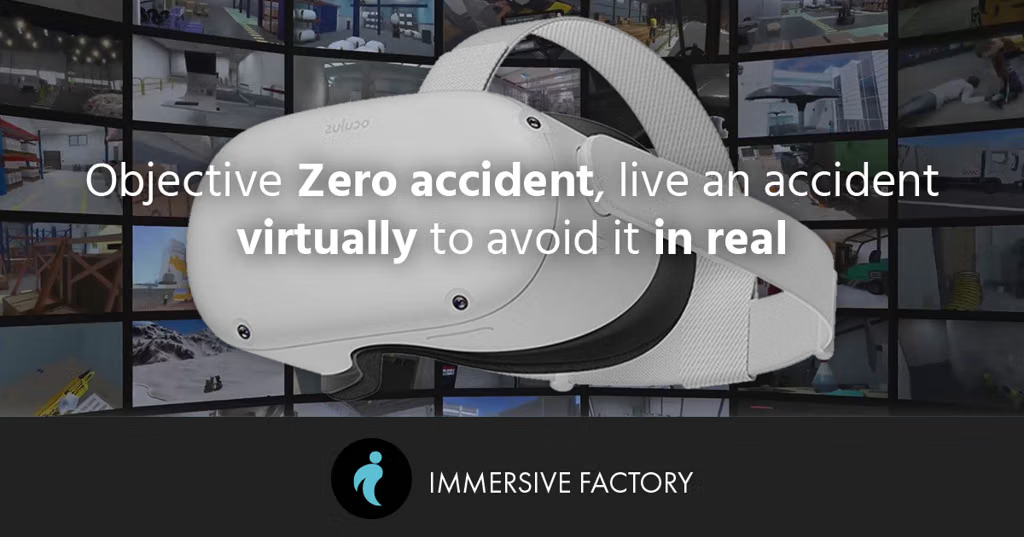
| Immersive Factory | Industrial/manufacturing safety | Factory operations, machinery, industrial hazards and safety procedures |
| Serious Labs | Heavy equipment / construction | Crane, aerial work platforms and heavy-equipment operation |
| Strivr | Large enterprises needing custom simulations | Safety, emergency response, operational procedures and behavioral training |
| SynergyXR | Companies wanting to build their own simulations | Converts manufacturing procedures/workflows into 3D/VR training without-code |
| Adaptive Immersion | Manufacturing onboarding | Factory-floor onboarding, hazard recognition and first-90-day safety |
| HapzXR | Custom manufacturing workflows | Startup/shutdown, changeovers, LOTO, troubleshooting, quality checks |
| Treeview | Highly customized industrial training | Bespoke VR simulations around specific equipment, facilities and procedures |
There is independent evidence of this segmentation: current market comparisons put Transfr, Pixo VR, Strivr, Interplay Learning and specialized HSE vendors among the leading platforms, while custom-build firms focus on simulations tied to a company's particular facility and procedures.
Transfr is probably the closest match if you're thinking "train someone for an actual manufacturing/construction job without putting them on the equipment yet." It has 90+ manufacturing VR simulations, including safety, materials handling, electrical, mechatronics, welding and robot troubleshooting, and also has dedicated construction training.
Ludus Global is more interesting if the problem is specifically HSE/safety-critical behavior rather than general job skills. Its simulations cover things such as working at height, electrical hazards, confined spaces, fire safety, PPE and LOTO.
Pixo VR is another strong enterprise option if the buyer wants a large existing content library rather than commissioning every scenario. Current comparisons specifically highlight its industrial safety coverage and enterprise deployment.
SynergyXR is an interesting alternative model: rather than selling only a library of canned courses, it gives manufacturing organizations a no-code 3D platform for turning their own procedures and workflows into immersive training.
And HapzXR / Adaptive Immersion are examples of the newer startups going directly after the manufacturing-specific use case—training operators on actual workflows and getting them competent before they touch live production equipment.
The interesting whitespace isn't really "VR safety training" anymore. There are plenty of vendors there.
The more compelling opportunity is:
AI-generated, equipment-specific training simulations from existing SOPs, manuals, CAD/BIM models and videos. For example, a factory uploads its machine manual + SOP + CAD model, and the system automatically produces a simulation for:
Then the system scores whether the worker actually performed the procedure correctly, rather than merely recording that they completed a safety video.
That distinction is important: current vendors already demonstrate the demand for immersive practice, while the newer platforms are moving toward company-specific workflows and measurable competency.
If you're evaluating this as a startup/investment landscape, I can also map out 20–30 companies by funding, customers, technology (VR/AR/AI/digital twins), target industry, and defensibility, and identify the biggest gaps in the market.
Ludus Global is more interesting if the problem is specifically HSE/safety-critical behavior rather than general job skills. Its simulations cover things such as working at height, electrical hazards, confined spaces, fire safety, PPE and LOTO.
Pixo VR is another strong enterprise option if the buyer wants a large existing content library rather than commissioning every scenario. Current comparisons specifically highlight its industrial safety coverage and enterprise deployment.
SynergyXR is an interesting alternative model: rather than selling only a library of canned courses, it gives manufacturing organizations a no-code 3D platform for turning their own procedures and workflows into immersive training.
And HapzXR / Adaptive Immersion are examples of the newer startups going directly after the manufacturing-specific use case—training operators on actual workflows and getting them competent before they touch live production equipment.
The interesting whitespace isn't really "VR safety training" anymore. There are plenty of vendors there.
The more compelling opportunity is:
AI-generated, equipment-specific training simulations from existing SOPs, manuals, CAD/BIM models and videos. For example, a factory uploads its machine manual + SOP + CAD model, and the system automatically produces a simulation for:
**Specialized immersive technology companies and platform startups provide virtual reality (VR) and interactive 3D simulations** designed specifically for hazard recognition, heavy equipment operation , and technical workflows in manufacturing, construction, and high-risk industrial…
Specialized immersive technology companies and platform startups provide virtual reality (VR) and interactive 3D simulations designed specifically for hazard recognition, heavy equipment operation , and technical workflows in manufacturing, construction, and high-risk industrial environments.
| Provider / Platform | Core Industry Focus | Primary Delivery Method | Key Tracking / Analytics |
|---|---|---|---|
| Pixaera | Energy, Construction, Heavy Industry | Web & Immersive 3D (Cross-device) | Behavioral decision tracking & risk gap analysis |
| PIXO VR | Manufacturing, Utilities, Industrial Safety | Enterprise Virtual Reality (VR) | Step-by-step procedural compliance metrics |
| Transfr | Manufacturing, Skilled Trades, Automotive | Headset-based VR & Guided Simulation | Real-time tactile accuracy and skills scoring |
| Strivr | Enterprise Operations & Safety-Critical Work | Scaled VR & Performance Analytics | Cognitive readiness and focus metrics |
If you can share your primary industry (manufacturing vs. construction) and whether you prefer standalone VR headsets (like Meta Quest) or desktop/web accessibility , I can narrow down which provider matches your deployment needs.
The market is split between **VR/XR training platforms with ready-made industrial modules** and **custom simulation builders that recreate a company’s exact equipment, SOPs, and hazards**. The strongest startups and growth companies in this space include:…
The market is split between VR/XR training platforms with ready-made industrial modules and custom simulation builders that recreate a company’s exact equipment, SOPs, and hazards. The strongest startups and growth companies in this space include:
| Company | Best fit | What they simulate |
|---|---|---|
| PIXO VR | Large manufacturers, utilities, construction firms | Forklifts, confined space, electrical safety, hazardous operations, construction safety; enterprise LMS integrations. PIXO VR |
| Transfr | Workforce development, apprenticeships, community colleges, industrial hiring pipelines | Welding, CNC, industrial maintenance, skilled trades, equipment operation. Humulo |
| Strivr | Fortune 500-scale deployments | Custom VR learning, safety scenarios, behavioral analytics, large workforce rollouts. The Prime VR |
| Interplay Learning | Skilled trades and technical workforce | HVAC, electrical, plumbing, solar, facilities maintenance training. The Prime VR |
| Drona VR | High-risk industrial operations | Plant-specific SOP training, lockout/tagout, permit-to-work, confined space, emergency response, manufacturing safety. Drona VR |
| XRVZN | Companies needing custom simulations | Manufacturing, construction, heavy equipment, OSHA-oriented safety simulations, custom XR builds. XRVZN XRVZN |
| HapzXR | Custom industrial VR/MR programs | Manufacturing, construction, oil & gas, defense scenarios built around client workflows. HapzXR |
| Genesis Creations | Construction safety capability assessment | Hazard recognition, decision-making under pressure, safety behavior measurement. Genesis Creations |
Best for standardized training:
Typical use cases:
Best for safety-critical environments:
Typical use cases:
A newer category focused on competency rather than course completion:
The pitch is: a worker can pass a quiz but still make unsafe decisions under pressure; simulation can measure those behaviors.
For a manufacturing plant, construction contractor, or safety-critical operator, the shortlist usually comes down to:
Ark
Several innovative platforms and specialized technology companies focus entirely on immersive, high-stakes virtual reality (VR) and interactive 3D simulations for manufacturing, construction, and safety-critical industrial environments. Key players solving these challenges include: - - [PIXO VR](https://pixovr.com/)…
Several innovative platforms and specialized technology companies focus entirely on immersive, high-stakes virtual reality (VR) and interactive 3D simulations for manufacturing, construction, and safety-critical industrial environments.
Key players solving these challenges include:
If you'd like to narrow this down, tell me:
Several specialized startups and platforms leverage Virtual Reality (VR), Augmented Reality (AR), and spatial computing to deliver immersive, risk-free training for manufacturing, construction, and high-risk industrial environments.[](https://www.youtube.com/watch?v=0p8vcWBx038&t=3)…
Several specialized startups and platforms leverage Virtual Reality (VR), Augmented Reality (AR), and spatial computing to deliver immersive, risk-free training for manufacturing, construction, and high-risk industrial environments.
The key players and platforms solving this challenge include:
If you'd like to narrow this down, tell me:
Yes. There’s a growing startup ecosystem around **immersive simulation for high-risk physical work**—especially VR/XR training where workers can practice procedures, hazards, equipment operation, and emergency response without putting people or production at risk. ### Strong startups / scale-ups to look at Company |…
Yes. There’s a growing startup ecosystem around immersive simulation for high-risk physical work—especially VR/XR training where workers can practice procedures, hazards, equipment operation, and emergency response without putting people or production at risk.
| Company | Best fit | What they simulate |
|---|---|---|
| Ludus | Industrial safety / HSE | Construction, working at height, electrical hazards, accidents, emergency response; behavioral analytics |
| PIXO VR | Manufacturing + industrial safety | Forklifts, confined spaces, electrical, hazmat, general workplace safety |
| Transfr | Manufacturing workforce / skilled trades | Welding, CNC, industrial maintenance, equipment operation and safety |
| Serious Labs | Construction / heavy equipment | Cranes, aerial work platforms, mining and heavy-equipment operation |
| Pixaera | Industrial safety | Gamified safety scenarios, incident response and compliance training |
| Immersive Factory | Manufacturing / industrial | Factory hazards, fire, chemical/electrical risks and operational scenarios |
| Treeview | Bespoke industrial simulation | Custom simulations based on a company's actual facility, hazards and procedures |
| The Prime VR | Custom manufacturing/construction | Bespoke safety, operations, onboarding and OSHA-supportable simulations |
| Drona VR | Industrial / process manufacturing | SOP-based simulations for operators, with an EHS-first approach |
| Interplay Learning | Skilled trades | HVAC, electrical, plumbing, facilities maintenance and related hands-on skills |
Current industry comparisons consistently put PIXO VR, Transfr, Serious Labs, Pixaera, Immersive Factory and Interplay among the notable players, while custom-development companies such as Treeview and Prime VR target organizations whose processes are too specific for off-the-shelf content.
I'd divide the market into three businesses, because they're solving somewhat different problems:
The most interesting gap to me isn't simply "VR safety training." That's already crowded.
A more defensible product would be:
AI-generated, facility-specific training simulations from SOPs, CAD/BIM models, incident reports and video—then automatically test whether a worker can execute the procedure correctly. That gets you from "Did the employee complete the safety course?" to "Can this employee safely perform this particular job?"
For construction, that could mean ingesting a BIM/site model and generating scenarios around falls, struck-by hazards, excavation, crane operations, etc. For manufacturing, it could reproduce a particular production cell and test startup/shutdown, changeover, LOTO, maintenance and abnormal-condition procedures. Existing companies are already moving in this direction, but the combination of generative AI + facility-specific simulation + objective competency assessment still looks relatively open.
If you're doing market research for a startup/investment, I can also map these companies by funding, valuation, customers, founders, revenue model, technology, and exact competitive moat and identify the 5–10 closest competitors to a new entrant.