We need to evaluate model providers for coding,… | Parse
We need to evaluate model providers for coding, research, planning, and enterprise automation. What comparison tools exist?
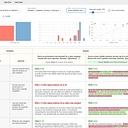
Data as of Sep 26, 2026 · Based on 54 AI responses from ChatGPT Search and Google AI Mode · See how Parse measures this
Sources AI cites for this prompt
Source
Citation share
WhatLLM.orghttps://whatllm.org/
2%
Key features to compare AI coding assistants vs enterprise ...https://www.glean.com/perspectives/key-features-to-compare-ai-coding-assistants-vs-enterprise-context-platforms
2%
Comparison of AI Models across Intelligence, Performance ...https://artificialanalysis.ai/models
1%
LLM Leaderboard & AI Model Benchmarks — September 2026https://benchlm.ai/
1%
Top 10 Low‑Code AI Workflow Automation Tools (2026)https://www.vellum.ai/blog/top-low-code-ai-workflow-automation-tools
1%
LLM Evaluation Tools: The Complete Comparison Guide (2026) | Inference.nethttps://inference.net/content/llm-evaluation-tools-comparison/
1%
LiveBench.aihttps://livebench.ai/
1%
5 best AI evaluation tools for AI systems in production (2026) - Articles - Braintrusthttps://www.braintrust.dev/articles/best-ai-evaluation-tools-2026
Evaluating model providers across coding, research, planning, and enterprise automation requires looking at two distinct categories of tools: Public/Independent Benchmark Dashboards (to see how models stack up generally on capability and performance) and Production Evaluation Frameworks (to test models against your specific enterprise workloads, prompts, and agentic pipelines).
Part 1: Public Comparison & Benchmarking Platforms
Use these to filter and compare raw model capabilities, speed, and cost before bringing them into your environment.
The gold-standard open-source CLI framework for running reproducible academic benchmarks.
Running standardized capability evaluations locally or in a private cloud.
Part 2: Enterprise Evaluation & Testing Frameworks
To test how a model handles your proprietary codebases, research corpus, or multi-step automation workflows, use these developer platforms:
Braintrust — An enterprise-grade evaluation and observability platform that unifies production tracing, regression testing, and CI/CD quality gates. Ideal if you need a collaborative dashboard for cross-functional teams.
Promptfoo — A developer-first, CLI-based tool great for running local prompt regression, security testing, and automated red-teaming directly in your terminal or CI pipeline.
DeepEval — A popular open-source testing framework tailored for Python development shops , designed to integrate seamlessly into unit-testing workflows like pytest.
LangSmith — Comprehensive evaluation and tracing platform optimized heavily for complex agentic loops, planning chains, and multi-step enterprise automation.
Implementation Checklist for Model Selection
Define Your Evaluation Dataset: Extract 50–100 actual prompts, messy codebase snippets, or multi-step agent scenarios from your internal logs (do not rely purely on public benchmarks like HumanEval or MMLU).
Establish Scoring Criteria: Combine deterministic assertions (e.g., does the code output compile/pass unit tests? ) with LLM-as-a-judge metrics for nuances like logic soundness and planning accuracy.
Run a Comparative Harness: Use a tool like Promptfoo or Braintrust to run your custom dataset simultaneously across candidate providers (e.g., OpenAI, Anthropic, DeepSeek , or local open-weight models).
Factor in Infrastructure Realities: Cross-reference intelligence results with Artificial Analysis to verify if the winning model meets your latency and per-token budget thresholds.
If you'd like to narrow this down, tell me:
Are you planning to evaluate proprietary APIs (OpenAI, Anthropic), open-weights models (Llama, Qwen) , or both?
Do you already have a preferred CI/CD or Python stack for internal tooling?
I can recommend a specific evaluation architecture tailored to your team.
Yes. For your use case, I’d separate public model-comparison/benchmarking tools from your-own-workload evaluation platforms. The latter is usually more important for enterprise procurement.
1. Public model-comparison tools
Tool
What it measures
Particularly useful for
Artificial Analysis
Capability benchmarks plus latency, throughput, pricing, context, etc.
Broad model/provider screening and cost-performance analysis
LMArena / Chatbot Arena
Human preference comparisons
General conversational quality and qualitative preference
SWE-bench
Real software-engineering tasks against repositories
Coding and agentic coding capability
LiveBench
Fresh benchmark tasks designed to reduce contamination
General capability comparisons
Stanford HELM
Broad, transparent multi-dimensional evaluation
Research, safety, robustness, and academic comparison
EleutherAI lm-evaluation-harness
Large collection of standardized benchmarks
Reproducible research/model benchmarking
OpenAI Evals
Framework for running standardized and custom evaluations
Building your own repeatable model tests
Different leaderboards answer different questions: for example, SWE-bench is specifically about software engineering, while human-preference leaderboards measure something quite different.
2. Tools for testing your workloads
For an enterprise buying decision, these are often more valuable than leaderboard rankings.
Promptfoo — open-source, configuration-driven model/prompt testing; particularly useful for running the same test suite against multiple providers and putting evaluations into CI/CD.
DeepEval — pytest-style evaluation framework, useful for automated regression tests and custom metrics.
Ragas — particularly useful for evaluating RAG/research systems: retrieval quality, faithfulness, relevance, etc.
Braintrust — experiment/evaluation platform for comparing models, prompts and application versions, with datasets, scoring and regression tracking.
LangSmith — particularly useful for agentic systems and /LangGraph applications; supports offline/online evals, human review, pairwise comparisons and CI/CD evaluation.
Recent comparisons generally put these into roughly three categories: code-first evaluation frameworks, open-source observability/eval platforms, and commercial evaluation platforms.
3. For your four workloads
I'd construct the evaluation around four separate test suites, rather than looking for one leaderboard:
Coding
Use SWE-bench + your own repository tasks.
Measure:
task completion
tests passed
correctness
number of iterations
ability to navigate an unfamiliar codebase
tool-call errors
latency
cost per completed task
SWE-bench gives you a useful external reference point, but your own codebase is the procurement-relevant test.
Research
Build a set of representative research questions with known-good source sets.
Measure:
factual accuracy
citation correctness
source quality
completeness
ability to distinguish evidence from inference
research depth
time/cost per answer
For this, HELM/OpenAI Evals/Promptfoo + your own golden dataset is a useful combination.
Planning
Give every model the same realistic multi-step tasks.
Measure:
plan completeness
constraint adherence
tool selection
ability to recover from errors
execution success
unnecessary steps
consistency across repeated runs
This is where agent/trajectory evaluation becomes important. Modern eval platforms can evaluate the entire agent trajectory rather than just its final answer.
Enterprise automation
Test actual workflows rather than asking models generic questions.
For example:
email → classify → retrieve information → make decision → call API → update system → produce audit record
Measure:
successful completion rate
unauthorized actions
policy violations
structured-output validity
tool/API accuracy
escalation behavior
reliability
latency
cost
auditability
This category should also include security and failure-mode testing, not merely model intelligence.
4. A practical evaluation stack
For a serious provider-selection exercise, I'd consider something like:
Public benchmarks
→ Artificial Analysis + SWE-bench + HELM/LiveBench
Custom model testing
→ Promptfoo or OpenAI Evals
Production/agent evaluation
→ Braintrust, LangSmith, Langfuse, Arize Phoenix, etc.
Your golden dataset
→ 100–500 representative coding, research, planning and automation tasks
The important point is that you don't need to pick a single "best model." You can create a provider-neutral harness that sends identical workloads to OpenAI, Anthropic, Google, open-weight models through an inference provider, etc., and records quality, latency, reliability and cost.
There are also newer comparison platforms specifically oriented around this problem; recent evaluations describe Braintrust, LangSmith, Arize/Phoenix, W&B Weave, Langfuse and Comet Opik as major options for agent evaluation, tracing and CI/CD.
If you're doing an actual enterprise procurement, I can also lay out a concrete model-provider evaluation matrix with ~30 criteria across coding, research, planning, automation, security, data residency, SLA, pricing and vendor risk, plus a suggested test protocol.
Yes. For an enterprise comparison of model providers across coding, research, planning, and automation, I’d separate the landscape into public benchmarks, model-comparison platforms, and your own evaluation harness.
1. Public model-comparison tools
Artificial Analysis — useful for comparing frontier models on intelligence, price, latency, throughput, context, and other standardized dimensions. Good for building an initial provider shortlist.
LMSYS Chatbot Arena / LMArena — useful for broad human-preference comparisons and side-by-side model performance.
HELM (Stanford) — useful when you want more research-oriented, standardized evaluations rather than relying on a single benchmark.
SWE-bench — particularly relevant for coding and software-engineering agents.
GPQA / MMLU-style benchmarks — useful for research/knowledge capabilities, although they should not be treated as proxies for enterprise task performance.
The important limitation is that public benchmarks measure capabilities under their particular test setup. They don't tell you which model will perform best on your workflows.
2. Evaluation platforms
These are more useful if you're actually making a procurement decision.
Tool
Particularly useful for
Enterprise relevance
Promptfoo
Model/prompt A/B tests, CI, red-teaming
Strong for engineering-owned regression suites
Braintrust
Experiments, datasets, model comparisons, production evals
Strong for systematic provider comparisons
Current 2026 comparisons broadly distinguish these tools by whether they're primarily eval runners, experiment platforms, observability systems, or research/capability frameworks.
3. For your four workloads, I'd build a matrix like this
Workload
What to actually measure
Coding
Test pass rate, SWE task completion, bug-fix success, code review quality, repo navigation, tool-call correctness, cost/task
Research
Factual accuracy, citation correctness, source quality, completeness, ability to distinguish uncertainty, research time/cost
Planning
Goal completion, constraint satisfaction, plan quality, recovery from changed conditions, number of unnecessary steps
For agents, don't just score the final answer. Evaluate the whole trajectory: tools selected, arguments passed, intermediate decisions, retries/recovery, and whether the requested task actually completed. That distinction is increasingly important in current evaluation tooling.
4. The most defensible enterprise approach
I'd use a two-layer evaluation:
Layer 1 — external benchmarks
Use Artificial Analysis, LMArena, HELM, SWE-bench, GPQA, etc. to establish the capabilities and economics of candidate providers.
Layer 2 — your private benchmark
Create perhaps 100–500 representative tasks drawn from your actual workflows. Run every candidate model through exactly the same agent harness, tools, permissions, prompts, and success criteria.
Then measure something like:
quality × task completion × reliability ÷ cost
without collapsing everything into a single opaque "model score." Keep the underlying measurements visible so engineering, research, security, and procurement can apply their own priorities.
Tools such as Braintrust, Promptfoo, LangSmith, Phoenix, Langfuse, and Inspect can provide much of the infrastructure for this second layer.
One particularly useful resource is Braintrust's public eval library, which now publishes reproducible model/agent comparisons and datasets rather than only generic benchmark numbers.
If you're evaluating OpenAI vs Anthropic vs Google vs xAI vs open-weight providers, I can also lay out a concrete enterprise evaluation scorecard and 50–100-task benchmark suite for these four workloads, including suggested metrics, test design, and cost/latency measurements.
Evaluating model providers across multi-faceted needs like coding, research, planning, and enterprise automation requires looking at a mix of crowdsourced preference arenas, performance/speed metrics trackers , and specialized engineering benchmarks.
The primary comparison tools and platforms available to benchmark and evaluate model providers include the following:
1. Human-Preference & Blind Test Platforms
LMSYS Chatbot Arena (LMArena): The gold standard for real-world human preference. It uses blind A/B testing where users prompt two anonymous models and vote on the better response, calculating Elo ratings. Crucially, it features category-specific leaderboards (such as Coding, Hard Prompts, and Multi-turn) so you can isolate how providers stack up specifically for programming or complex reasoning rather than general conversation.
2. Performance, Speed, and Cost Dashboards
Artificial Analysis: An independent platform that goes beyond raw intelligence to benchmark practical deployment metrics. It provides interactive tools comparing model providers on intelligence indices, output generation speed (tokens/second), time-to-first-token latency, pricing per million tokens , and context window capacities . It is ideal for evaluating the trade-offs between high-end reasoning and enterprise cost-efficiency.
3. Coding-Specific & Agentic Benchmarks
SWE-bench: A rigorous evaluation framework that assesses how well language models can resolve real-world GitHub issues in large codebases. Rather than just writing snippet functions, it tests end-to-end software engineering capabilities—making it essential for your coding and automation evaluation.
LiveCodeBench / HumanEval Leaderboards: Continuously updated tracking boards that evaluate models on freshly released coding problems to prevent data contamination and memorization.
4. Enterprise & Planning Benchmarks
GAIA (General AI Assistants) Benchmark: Focuses on complex, multi-modal tasks that require reasoning, tool-use, multi-step planning, and web-browsing—closely mirroring real enterprise automation and assistant workflows.
AutomationBench (via Artificial Analysis / industry evals): Specifically targets agentic and workflow automation capabilities to see how reliably a model can execute tool chains and business logic without failing mid-plan.
If you want to narrow this down, let me know:
Are you leaning toward API/closed-source providers (OpenAI, Anthropic, Google) or open-weight models you'll host yourself?
Do you need help setting up a custom internal evaluation pipeline (like Promptfoo or Langfuse) for your specific enterprise data?
Yes. For your use case, I’d avoid relying on a single “best LLM” leaderboard. There are several useful comparison tools, but they answer different questions.
Best comparison tools
Tool
Best for
What it gives you
Artificial Analysis
Overall provider/model selection
Intelligence, coding, agentic performance, price, latency, throughput, context, etc.
LMArena / Chatbot Arena
Human-perceived quality
Blind head-to-head comparisons and preference rankings.
Whether agents can actually resolve real software issues. SWE-bench Pro is particularly useful for serious engineering evaluation.
Terminal-Bench
Coding agents / automation
Performance on command-line, multi-step agent tasks.
GPQA Diamond
Research / difficult reasoning
Expert-level scientific and knowledge reasoning.
MMLU-Pro
General professional knowledge
Broad reasoning/knowledge across professional domains.
BrowseComp / GAIA
Research agents
Web research and multi-step information gathering.
Phaseo
Quick benchmark aggregation
Hundreds of benchmark/model comparisons in one interface, including coding, agents, GPQA, LiveBench, SWE-bench and cost.
LLM•DIR
Procurement-style shortlisting
Comparisons organized around jobs such as coding, reasoning, RAG, context length, cost and deployment.
TokenCost
Cost/performance analysis
Plots benchmark quality against actual model cost, useful for finding the value frontier.
There are also comprehensive directories of evaluation frameworks if you want to build an internal evaluation system; one current catalog tracks 300+ open-source and commercial evaluation tools.
How I'd evaluate your four workloads
I'd create a scorecard rather than asking “Which model is best?”
1. Coding
Weight:
SWE-bench Pro
SWE-bench Verified
Terminal-Bench
LiveCodeBench
Your own repository tasks
Cost per successfully completed task
Tool-call reliability
Ability to recover from failed tests
SWE-bench and Terminal-Bench are particularly relevant because they move beyond code-generation trivia toward actual agentic software work.
2. Research
Weight:
GPQA Diamond
BrowseComp
GAIA
Humanity's Last Exam
Citation accuracy
Retrieval/search quality
Ability to distinguish conflicting sources
Research completeness
For enterprise research, I'd give your own research tasks much more weight than a generic knowledge benchmark.
3. Planning
This is where public leaderboards become considerably less useful.
Test models on scenarios such as:
“Take this ambiguous business objective, identify constraints, create a 30-step plan, identify dependencies and risks, and revise the plan after three constraints change.”
Measure:
Goal understanding
Decomposition
Constraint handling
Dependency correctness
Long-horizon consistency
Recovery after changes
Whether the model knows when it needs more information
This should largely be an internal eval, rather than a benchmark-shopping exercise.
4. Enterprise automation
I'd evaluate:
Tool selection accuracy
Correct argument generation
Multi-step execution
Failure recovery
Permission/security awareness
Structured output reliability
Long-context performance
Latency
Cost per successful workflow
Human escalation rate
For this category, agentic benchmarks + your actual workflows are much more informative than MMLU-style scores.
The important distinction: model vs. provider
For enterprise procurement, don't compare only:
Claude vs GPT vs Gemini
Compare the provider + model + API configuration.
For example:
Model quality
Input/output pricing
Cached-input pricing
Latency
Rate limits
Context window
Availability/SLA
Data-retention policy
Training/data-use policy
Enterprise controls
Regional availability
Tool/function calling
Structured outputs
Batch APIs
Fine-tuning
Observability
Security/compliance
Artificial Analysis is particularly useful here because it combines capability with operational metrics such as price and latency.
My recommended evaluation stack
If I were setting this up for an enterprise buying decision, I'd use:
Artificial Analysis → initial shortlist
↓
LMArena → human-quality sanity check
↓
SWE-bench / Terminal-Bench → coding & agents
GPQA / BrowseComp / GAIA → research
↓
Your proprietary eval suite → planning & automation
↓
Cost × latency × success-rate analysis → final provider decision
The last step is crucial. A model that scores 5% higher but costs 3× as much and takes twice as long may be substantially worse for an enterprise workflow.
Also, benchmark numbers should be treated cautiously: methodology, scaffolding, and contamination can materially change results, and different leaderboards frequently disagree.
Evaluating model providers across coding, research, planning, and enterprise automation requires looking at two different things: public leaderboards (to see how models stack up generally in these domains) and developer evaluation platforms (to test models on your organization's specific data and workflows).
Phase 1: Public Leaderboards & Benchmarks (For Initial Filtering)
To filter which model providers (Anthropic, OpenAI, Google, DeepSeek, open-weight communities) are worth testing for specific capabilities:
Coding : Check specialized developer benchmarks like SWE-bench (for end-to-end software engineering fixes in real repos) and LiveCodeBench. Platforms like BenchLM aggregate these scores alongside pricing and context window metrics.
Research & Complex Reasoning : Look at graduate-level expert reasoning benchmarks like GPQA (Graduate-Level Google-Proof Q&A) and MMLU-Pro, which stress-test models beyond standard multiple-choice trivia into multi-step deduction.
Planning & Enterprise Automation : Look at agentic benchmarks and crowdsourced blind tests like the LMSYS Chatbot Arena, which helps gauge conversational instruction-following, multi-turn logic, and tool-use capabilities in real-world prompts.
Public leaderboards only tell half the story. To evaluate providers against your company's proprietary codebases, automation scripts, and internal knowledge bases, you need an evaluation framework or workspace:
Braintrust : Best when a dedicated, collaborative eval workspace is the main point. It is structured around the experimentation loop, offering a hosted playground for prompt iteration, human-in-the-loop review, and side-by-side model comparison.
Confident AI (DeepEval) : Best for open-source, evaluation-first workflows. It is an Apache 2.0 framework shipping with over 50 ready-to-use LLM-graded metrics (using G-Eval and QAG techniques) well-suited for setting up CI/CD regression testing gates.
LangSmith : Best if your enterprise infrastructure or internal automation agents are already built on LangChain or LangGraph. It provides native tracing, dataset management, and regression testing without extra instrumentation.
To help narrow down the right tools and providers for your team, let me know:
Are you leaning toward hosted SaaS platforms or self-hosted/open-source tools due to data privacy?
Do you already have an agent framework (like LangGraph, CrewAI, or custom Python code) in place?
Yes. For a serious provider evaluation, I’d use several complementary comparison tools rather than one leaderboard. The useful split is between public benchmarks, agent-specific evaluations, and your own enterprise task suite.
Build test suites, score outputs with multiple metrics, compare prompts/models/workflows and detect regressions.
LMArena / WebDev Arena
Human preference + coding
Useful as a complementary signal for interactive quality, particularly coding/web-development tasks.
SWE-bench / Terminal-Bench / GAIA / GDPval
Specific capabilities
Good benchmark components for software engineering, terminal agents, research/knowledge work and business tasks respectively.
How I'd map them to your four requirements
1. Coding
Don't rely on generic "coding benchmark" scores. Look at agent + harness + model combinations.
Artificial Analysis is particularly useful here because it explicitly separates the underlying model from the coding-agent harness and reports cost and execution time.
Your own GitHub issues/PRs — probably the most important signal
2. Research
Look for:
Long-horizon research
Web search/tool use
Citation correctness
Information synthesis
Resistance to hallucination
Ability to produce a useful deliverable rather than merely answer questions
Artificial Analysis now has an AA-Briefcase evaluation specifically aimed at agentic knowledge work involving deliverables such as spreadsheets, presentations and memos.
3. Planning
This is where conventional model leaderboards are weakest.
I'd create a private suite of realistic planning tasks—for example:
"Plan migration of 40 services to AWS"
"Create a six-month product launch plan"
"Investigate this incident and produce an action plan"
"Turn these 200 requirements into an implementation roadmap"
Score constraint satisfaction, completeness, sequencing, assumptions, risk identification and adaptability, rather than relying on a single public benchmark.
4. Enterprise automation
This should be evaluated as an agent/workflow, not just a model.
Measure:
Task completion rate
Correct tool selection
Error recovery
Human intervention rate
Security/policy compliance
Latency
Cost per successfully completed task
Reliability across repeated runs
Auditability
Vellum is useful here because its evaluation tooling lets you compare entire prompts/workflows against a baseline with custom metrics and aggregate statistics.
The important caveat
I would not select a provider from a leaderboard alone. Recent comparisons demonstrate why: different agents can excel on different task types, and the agent/harness can materially affect results. One 2026 empirical study of 7,156 PRs found that no single coding agent dominated every task category.
For an enterprise procurement exercise, I'd therefore build a model-provider scorecard with roughly:
30% your proprietary tasks + 25% coding/agent benchmarks + 20% research/planning + 15% economics/performance + 10% enterprise/security
Then run the same tasks through OpenAI, Anthropic, Google, and whichever other providers you're considering, with identical tools/context wherever possible.
If you tell me which providers you're considering (e.g. OpenAI vs Anthropic vs Google vs xAI vs AWS/Bedrock models), I can build a concrete evaluation matrix with benchmarks, test cases, scoring criteria, and recommended tools for all four workloads.
Evaluating model providers across coding, research, planning, and enterprise automation requires looking at two different angles: public intelligence & performance leaderboards (to see how models stack up generally) and code-first/enterprise evaluation frameworks (to test them on your company's proprietary data and workflows).
Phase 1: Public Leaderboards & Performance Dashboards
Use these to get baseline comparisons on reasoning capability, speed, cost, and throughput across different cloud providers.
LMSYS Chatbot Arena : The gold standard for crowdsourced human preference. It uses blind A/B testing and Elo ratings to rank how models perform in real-world, open-ended conversational, coding, and planning prompts.
Artificial Analysis : Essential for infrastructure metrics. It breaks down model providers by intelligence benchmarks alongside critical operational metrics like output speed (tokens per second), latency , and price per million tokens.
BenchLM : Aggregates current open-weight and proprietary model leaderboards, giving a quick, evidence-qualified view of top performers in specific capability tiers.
Public benchmarks only tell half the story. For enterprise automation, coding agents, and complex planning, you should run your own evaluation suite against candidate APIs.
DeepEval : An open-source, Pytest-style evaluation framework that works exceptionally well for CI/CD pipelines. It supports multi-turn agent testing, RAG pipelines, and local harness evaluation for coding workflows.
Pydantic Logfire : A code-first evaluation approach where datasets and grading rubrics live right in your repository. It integrates experiments directly into OpenTelemetry traces, making it easy to monitor both local test runs and live production traffic.
Promptfoo / Arize Phoenix: Other heavy-hitting open-source frameworks used heavily by enterprise engineering teams to continuously test prompts, security guardrails, and model regressions across multiple providers (like OpenAI, Anthropic, and local endpoints) simultaneously.
To help narrow this down, what is your primary deployment constraint?
Are you looking for hosted API providers (like AWS Bedrock, Azure, or direct APIs) or open-weight models to self-host?
Do you already have a CI/CD or logging infrastructure (like Datadog, OpenTelemetry, or Python/TS stacks) you want the eval tools to plug into?
Yes. There are several useful model/provider comparison tools, but they serve different purposes. For your four areas—coding, research, planning, and enterprise automation—I’d use a small stack rather than trust a single leaderboard.
Important coding signal, but compare methodology carefully
How I'd map them to your use cases
1. Coding → Artificial Analysis + SWE-bench
Don't just compare base models. Compare agent + model + harness, because the coding environment can materially change results. Artificial Analysis explicitly measures coding agents on performance, cost, execution time and token usage, using multiple software-engineering benchmarks.
For example, their comparison tool lets you directly compare combinations such as Claude Code, Codex, Cursor CLI and Gemini CLI.
2. Research → Artificial Analysis + HELM
For research/knowledge work, look beyond generic "IQ" scores. Artificial Analysis now includes AA-Briefcase, an agentic knowledge-work benchmark involving deliverables such as spreadsheets, presentations and memos, alongside reasoning and knowledge evaluations.
HELM is useful as the more academic/reproducible counterweight: it evaluates models across standardized scenarios and multiple metrics rather than reducing everything to one score.
One caveat: Stanford says HELM entered maintenance mode June 1, 2026, so I'd treat it as a rigorous reference rather than the freshest source for frontier-model rankings.
3. Planning → agentic/long-horizon benchmarks
This is where conventional benchmarks become particularly misleading. I'd prioritize evaluations involving tool use, multi-step execution, long-context reasoning and task completion, rather than MMLU-style knowledge tests.
Artificial Analysis's current evaluation set includes agentic tool use, agentic coding, knowledge work and real-world work tasks, making it a convenient starting point.
4. Enterprise automation → benchmark + your own workload
For enterprise automation, I wouldn't select a provider based on a public leaderboard alone. Stanford's enterprise benchmark work explicitly points out that performance can differ substantially on domain-specific datasets—for example finance or legal—compared with generic language benchmarks.
I'd therefore evaluate:
task success rate
human-review rate
hallucination/error rate
tool-call reliability
latency
cost per completed workflow
security/privacy controls
data retention
deployment options
observability/evaluation APIs
failure recovery
A practical evaluation stack
If you're building an enterprise provider scorecard, I'd start with:
Artificial Analysis → shortlist models/providers
↓ Coding-agent benchmarks → evaluate engineering
↓ HELM/domain benchmarks → sanity-check general and enterprise capability
↓ Your own 50–200 representative workflows → make the purchasing decision
The last step matters most. A model that wins a public reasoning benchmark can still lose badly on your workflow because of tool reliability, formatting requirements, context, latency, or cost.
If you want, I can also build you a 2026 comparison matrix of OpenAI vs Anthropic vs Google vs xAI vs Meta/Mistral/etc. across coding, research, planning, enterprise automation, price, latency, context, API/deployment, security, and benchmark performance, with a recommended shortlist for each workload.
To evaluate AI model providers across specialized disciplines like coding, research, planning, and enterprise automation, you should utilize a combination of independent intelligence indexes, crowd-sourced playgrounds, contamination-free benchmarks, and internal observability suites . Relying on a single leaderboard is rarely enough for enterprise-grade deployments.
Independent Analytical Indexes (Best for Speed, Cost, & Base Quality)
These tools provide highly analytical, side-by-side matrices comparing raw token costs, throughput speed (tokens/sec), latency, and normalized intelligence metrics.
Artificial Analysis : The industry gold standard for tracking commercial models. It provides precise data on Time-to-First-Token (TTFT) , cost per million tokens, and maps capabilities systematically.
LLM Stats : Aggregates global scores into a single independent performance metric across hundreds of models.
Vellum AI Leaderboard : Specifically targets business-ready frontier and open-weight models , filtering out saturated benchmarks to focus purely on enterprise-grade workloads.
Contamination-Free & Behavioral Benchmarks (Best for Coding & Planning)
Standard benchmarks (like MMLU) suffer from data contamination. Modern evaluation tools test real-world execution.
LiveBench : Refreshes its reasoning, math, and data tasks every six months to completely avoid training data contamination.
Specific Benchmark Datasets to track inside these tools:
Coding : Track SWE-bench Verified or Terminal-Bench (evaluates autonomous code changes, terminal execution, and repository-wide refactoring).
Planning & Automation : Look for the Berkeley Function Calling Leaderboard (BFCL) , which evaluates how accurately an LLM coordinates API and tool calls—crucial for enterprise automation.
Human Preference Arenas (Best for Research & Nuance)
Automated benchmarks can miss qualitative differences in how an AI presents structured research or synthesizes information.
LMSYS Chatbot Arena : A crowd-sourced, blind, A/B testing platform. Models are ranked purely by human preference Elo ratings. You can filter their leaderboards specifically for "Coding" or "Longer Context" to find the top researchers.
Enterprise Observability & In-House Evals (Best for Automation)
Enterprise automation workflows cannot rely entirely on external benchmarks. To safely run multi-step agent simulations or custom regression tests on your own data, you must utilize continuous internal evaluation platforms.
Confident AI (DeepEval) : Highly rated for enterprise regression testing and CI/CD quality gates , protecting automation chains against hallucinations.
Braintrust : Best for offline pipeline testing, prompt versioning, and managing customized evaluation datasets.
: Offers outstanding OpenTelemetry tracing to visually evaluate multi-step agent orchestration and trace complex tool execution failure points.
Framework: What to look for by Use Case
When navigating these tools, filter by the specific benchmarks that align with your pillars:
Use Case Pillar
Key Target Metrics & Benchmarks to Filter By
Top Provider Tiers to Compare
Coding
SWE-bench Pro / Verified, Terminal-Bench
OpenAI GPT-5/Codex, Anthropic Claude Opus/Sonnet, Qwen Coder
Research
GPQA Diamond (PhD-level logic), Long Context Windows
Google Gemini (for context length), Anthropic Claude
Planning
AIME (Advanced Math Olympiad), LiveBench Reasoning
Frontier reasoning models (OpenAI 'o' series / Anthropic Thinking models)
If you would like, I can help you draft a custom evaluation framework scorecard tailored to your specific infrastructure. Let me know:
Will you be using hosted APIs or deploying self-hosted open-weight models?
What legacy tools or software stacks do your enterprise automation systems need to plug into?
Langfuse — open-source/self-hostable tracing and evaluation infrastructure.
Arize Phoenix — open-source observability/evaluation, with OpenTelemetry support.
W&B Weave — evaluation and tracing integrated with the Weights & Biases ecosystem.
Patronus AI / Galileo / Confident AI — more specialized enterprise evaluation, safety, agent and quality-testing capabilities.
LangSmith
Agent traces, evaluation, production monitoring
Especially useful for agentic workflows
Arize Phoenix
Tracing, observability, evals, RAG
Good if you want open-source/self-hosted infrastructure
Langfuse
Open-source tracing + evaluation
Attractive for self-hosting/data-control requirements
Inspect AI
Capability and safety research
Particularly useful for rigorous research/agent evaluations
DeepEval
Python/pytest-style evaluation
Good for engineering-centric test suites
Ragas
RAG/retrieval evaluation
Useful as a specialized component rather than a complete provider benchmark
Arize Phoenix / Arize AI : Excellent for local-first or agent-focused evaluations. Phoenix allows you to run evaluations locally or via containerized deployments, while their broader platform excels at session evaluations, agent tracing, and multi-step workflow visualization.
Langfuse : Best if your enterprise has strict data residency or self-hosting requirements, featuring an MIT-licensed core available for open-source deployment.

















 Artificial Analysis