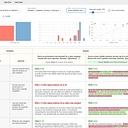
Data as of Sep 18, 2026 · Based on 347 AI responses from ChatGPT Search and Google AI Mode · See how Parse measures this
For detecting model over-memorization, MemHunter is the most widely recommended research tool for dataset-level auditing of fine-tuned models. For engineering teams requiring production-ready solutions, 
Brands AI recommends here
Named in 37% of answers
Named in 17% of answers
Named in 13% of answers
Best for enterprise teams needing automated, production-grade privacy testing. It is supported for integration into CI/CD development pipelines to evaluate privacy risks and identify data extraction vulnerabilities.
Named in 10% of answers
Source | Citation share |
|---|---|
 MemHunter: Automated and Verifiable Memorization Detection at Dataset-scale in LLMshttps://arxiv.org/abs/2412.07261 | 2.9% |
 Benchmarking Privacy Vulnerabilities in LLM Adaptation ...https://proceedings.neurips.cc/paper_files/paper/2024/file/12b18a15dcd73e1991e9959a94375fab-Paper-Datasets_and_Benchmarks_Track.pdf | 2.8% |
Integrate Explainable LLM Data Leakage Testing into your CI/CD Pipeline with DynamoEval | Dynamo AI Bloghttps://www.dynamo.ai/blog/integrate-explainable-llm-data-leakage-testing-into-your-ci-cd-pipeline-with-dynamoeval | 2.0% |
 Code Membership Inference for Detecting Unauthorized Data Use in ...https://aclanthology.org/2024.findings-emnlp.621.pdf | 1.8% |
 Why Your AI Model Might Be Leaking Sensitive Data | NeuralTrusthttps://neuraltrust.ai/blog/ai-model-data-leakage-prevention | 1.6% |
Automated and Verifiable Memorization Detection at Dataset ...https://arxiv.org/html/2412.07261v1 | 1.6% |
 Early Detection and Reduction of Memorization for Domain ...https://direct.mit.edu/tacl/article/doi/10.1162/TACL.a.49/133796/Early-Detection-and-Reduction-of-Memorization-for | 1.6% |
Early Detection and Reduction of Memorization for Domain ...https://direct.mit.edu/tacl/article/doi/10.1162/TACL.a.49/133796/Early-Detection-and-Reduction-of-Memorization-for | 1.5% |
 What is Data Leakage in Machine Learning? | IBMhttps://www.ibm.com/think/topics/data-leakage-machine-learning | 1.5% |
 Training Data Leakage: When Models Remember Too Much – AiSecurityDIRhttps://aisecuritydir.com/training-data-leakage-when-models-remember-too-much/ | 1.4% |
**For a fine-tuned LLM, I’d use a combination of membership inference + canary/regurgitation testing rather than a single tool.** A promising current option is **EZ MIA**, specifically designed to detect memorization in fine-tuned LLMs and reported to outperform LOSS, Min-K++, and SPV-MIA in experiments. [The…
For a fine-tuned LLM, I’d use a combination of membership inference + canary/regurgitation testing rather than a single tool. A promising current option is EZ MIA, specifically designed to detect memorization in fine-tuned LLMs and reported to outperform LOSS, Min-K++, and SPV-MIA in experiments.
If you tell me your stack (e.g. Hugging Face/TRL + LoRA, OpenAI fine-tuning, Llama, etc.), I can point you to the most practical implementation.
Checking whether a fine-tuned model has over-memorized its training data (rather than learning generalizable patterns) usually involves two complementary strategies: **Membership Inference Attacks (MIAs)** to see if the model treats training points differently than unseen data, and **Vulnerability/Data-Leakage…
Checking whether a fine-tuned model has over-memorized its training data (rather than learning generalizable patterns) usually involves two complementary strategies: Membership Inference Attacks (MIAs) to see if the model treats training points differently than unseen data, and Vulnerability/Data-Leakage Scanners designed for LLMs.
The industry standard tools and frameworks used for this purpose include:
If you want to narrow down the best approach, tell me:
I can help you outline a quick script or configure the right tool for your setup.
Detecting over-memorization and training data leakage in a fine-tuned Large Language Model (LLM) usually relies on **Membership Inference Attacks (MIAs)**, **exact-match/substring tracing** , or **behavioral evaluation frameworks** . Because pre-trained and fine-tuned models have complex internal states, there isn't…
Detecting over-memorization and training data leakage in a fine-tuned Large Language Model (LLM) usually relies on Membership Inference Attacks (MIAs), exact-match/substring tracing , or behavioral evaluation frameworks . Because pre-trained and fine-tuned models have complex internal states, there isn't one single "magic button," but several prominent open-source tools and methodologies approach the problem:
To help narrow down the best approach, tell me:
For a fine-tuned model, the best way to detect **over-memorization / training data leakage** is usually not a single tool but a combination of: 1. **Membership inference testing** — “Was this example in the training set?” 2. **Extraction/regurgitation testing** — “Can the model reproduce training examples verbatim?”
For a fine-tuned model, the best way to detect over-memorization / training data leakage is usually not a single tool but a combination of:
The best choice depends on whether you still have access to the training data and whether you need a research-grade audit or a practical engineering check.
Recommended: build a canary audit into your pipeline.
You add unique synthetic sequences to your fine-tuning data, such as:
USER_92817_SECRET_TOKEN_XQ91: The internal project code is "violet-cactus-741".
After training, test whether the model can reproduce them with prompting or likelihood scoring.
Pros:
A recent privacy auditing approach found that carefully designed canaries can significantly improve detection of memorization leakage compared with simpler methods.
If you want to answer:
“Can an attacker tell whether a specific document was in my fine-tuning set?” use membership inference.
Useful implementations/research tools:
Typical workflow:
A model with strong separation between members and non-members is showing memorization risk.
Useful when your concern is:
“Will users be able to make the model spit out private training text?” Methods:
This catches the most obvious leaks but can miss memorization that only appears through likelihood differences. Membership inference and extraction measure different failure modes.
For most fine-tuned LLM projects, I would run:
| Goal | Test |
|---|---|
| “Did the model memorize my dataset?” | Membership inference |
| “Can it reveal secrets verbatim?” | Extraction/regurgitation probes |
| “Can I prove privacy before deployment?” | Canary audit |
| “I have no training data access” | Black-box membership inference |
A reasonable open-source audit stack:
If you tell me:
I can suggest a more specific toolchain.
**The best approach for detecting training data over-memorization (data leakage or membership vulnerability) in fine-tuned models is using Membership Inference Attack (MIA) frameworks and Perplexity/Loss-based auditing tools** **.** Rather than a single universal GUI, the industry relies on specialized programmatic…
The best approach for detecting training data over-memorization (data leakage or membership vulnerability) in fine-tuned models is using Membership Inference Attack (MIA) frameworks and Perplexity/Loss-based auditing tools . Rather than a single universal GUI, the industry relies on specialized programmatic toolkits that test whether a model responds with abnormally low loss or verbatim regurgitation to specific training rows.
| Tool / Framework | Primary Purpose | Key Metric Used |
|---|---|---|
| PyTorch / Hugging Face Loss Evaluators | Direct training vs. validation loss tracking | Perplexity / Cross-Entropy Loss |
| TAPAS / User-built MIA Scripts | Membership Inference Attacks | Likelihood ratio & shadow model confidence |
| Inspect / EleutherAI LM-Evaluation-Harness | Benchmark contamination & data leakage | N-gram overlap & exact-match scores |
If you can share what type of data (e.g., medical records, source code, general text) and which fine-tuning method (Full fine-tuning vs. LoRA) you are using, I can recommend a more specific script or mitigation technique like DP-SGD.
If your specific question is **“Did my fine-tuning cause the model to memorize training examples?”**, I’d use **membership-inference testing**, rather than a generic LLM red-team scanner. ### My top pick: EZ-MIA **EZ-MIA** is currently one of the strongest practical approaches I’d recommend for this exact problem. It…
If your specific question is “Did my fine-tuning cause the model to memorize training examples?”, I’d use membership-inference testing, rather than a generic LLM red-team scanner.
EZ-MIA is currently one of the strongest practical approaches I’d recommend for this exact problem. It was specifically designed to detect membership leakage in fine-tuned autoregressive LMs. It compares token-level probabilities from your fine-tuned model against a pretrained/reference model and produces a membership score. It requires only two forward passes per sequence and doesn't require training shadow models.
The 2026 evaluation reports substantially better detection than several common baselines, particularly at very low false-positive rates—important when you're trying to establish that a particular training example was actually memorized.
For a broader “can an attacker actually extract training data?” assessment, I'd pair that with microsoft.github.io.
PyRIT is a general AI red-teaming framework and now has a Leakage scenario specifically intended to test whether models leak things such as training data.
So I'd think of the tools this way:
| Goal | Best approach |
|---|---|
| Measure whether specific training examples were memorized | EZ-MIA |
| Try to extract training data through prompts | PyRIT Leakage |
| Look for verbatim reproduction | Canary/extraction tests + exact/near-duplicate matching |
| Quantify privacy risk rigorously | Membership-inference evaluation with held-out nonmembers |
Create three groups:
Then test the fine-tuned model against all three. In particular, compare member vs. nonmember membership-inference scores and measure TPR at a very low FPR (e.g. 0.1% or 1%), rather than just reporting average loss. That's much more informative for leakage.
If you tell me what model stack you're using (e.g. Llama + Hugging Face/PEFT, OpenAI fine-tuning, Mistral, etc.), I can recommend the easiest concrete implementation and give you a test script.
For a broader “can an attacker actually extract training data?” assessment, I'd pair that with microsoft.github.io.
PyRIT is a general AI red-teaming framework and now has a Leakage scenario specifically intended to test whether models leak things such as training data.
So I'd think of the tools this way:
**The best approach to detect over-memorization and data leakage in fine-tuned models is to implement Membership Inference Attacks (MIAs) using evaluation frameworks like privacy-meter or specialized scripts from [llm-jp-membership-inference](https://github.com/llm-jp/llm-jp-membership-inference)** **.** Because…
The best approach to detect over-memorization and data leakage in fine-tuned models is to implement Membership Inference Attacks (MIAs) using evaluation frameworks like privacy-meter or specialized scripts from llm-jp-membership-inference . Because commercial turnkey GUI tools for LLM memorization are rare, data scientists rely on loss-based and perplexity-based MIAs to mathematically score whether specific training records were over-fitted into the model weights.
Core Methods for Detecting Memorization
Recommended Tooling Frameworks
| Tool / Framework | Primary Use Case | How It Detects Leakage |
|---|---|---|
| privacy-meter | Auditing machine learning privacy | Evaluates the gap in vulnerability and confidence scores between training and test sets. |
| llm-jp-membership-inference | Large language model audit | Runs targeted membership inference workflows to test if text prompts expose training sequences. |
| Custom Perplexity Scripts (PyTorch/Hugging Face) | Lightweight pipeline checks | Computes token-by-token cross-entropy loss distributions across datasets to flag outlier low-loss sequences. |
Would you like a Python code snippet using Hugging Face Transformers to calculate and compare the perplexity of your training versus validation sets to spot over-memorization?
If your concern is specifically **“Did my fine-tuned model memorize examples from the training set?”**, I’d use **membership-inference testing (MIA)** rather than a generic LLM eval. ### My top pick: EZ-MIA **EZ-MIA** is currently one of the strongest practical choices for fine-tuned autoregressive LLMs. It was…
If your concern is specifically “Did my fine-tuned model memorize examples from the training set?”, I’d use membership-inference testing (MIA) rather than a generic LLM eval.
EZ-MIA is currently one of the strongest practical choices for fine-tuned autoregressive LLMs. It was specifically designed to detect membership leakage in fine-tuned models and works by looking at how the model's probabilities change at positions where it makes prediction errors. The 2026 ACL paper reports substantially better detection than earlier MIA methods at very low false-positive rates.
I'd choose it if you have white-box access to the model/log probabilities, which is typical for your own fine-tune.
There are really two different questions:
A particularly useful approach is to insert unique canary strings into your training set, keep held-out canaries as controls, fine-tune, and then test whether the model preferentially memorizes or reproduces them. A recent open-source auditor combines canary MIA with regurgitation testing specifically for Trainer/TRL/PEFT fine-tunes.
For a serious leakage audit, I'd do:
Tools like Inspect are excellent for building a broader custom evaluation harness, but they're not my first choice for detecting training-data memorization specifically.
Bottom line: If you want one tool, start with EZ-MIA. If you're doing a privacy/security audit, pair it with canary + regurgitation testing because a model can show statistically detectable membership leakage without actually verbatim regurgitating the examples.
If you tell me whether you're using Hugging Face Trainer/TRL, LoRA, or another fine-tuning stack, I can give you a concrete audit setup and commands.
If your concern is specifically **“did my fine-tuning cause the model to memorize and reproduce training examples?”**, I’d use a **layered audit**, rather than relying on a single leakage detector. ### My top pick: Verified Extraction Audit For fine-tuned LLMs, **Verified Extraction Audit** is one of the most directly…
If your concern is specifically “did my fine-tuning cause the model to memorize and reproduce training examples?”, I’d use a layered audit, rather than relying on a single leakage detector.
For fine-tuned LLMs, Verified Extraction Audit is one of the most directly relevant tools I found. It was built specifically to measure whether a fine-tuned model leaks identifiers or other information from its fine-tuning data, including through extraction-style attacks.
It is particularly attractive if your training data contains PII, confidential records, customer data, medical data, or other sensitive strings.
I would combine it with:
There is also an open-source research implementation specifically studying memorization in fine-tuned LLMs using both membership inference and prompted-generation extraction.
For a serious privacy/leakage audit, I'd run:
1. Canary test → 2. Extraction test → 3. Membership inference → 4. Compare against a held-out control model
The key distinction is that “overfitting” and “data leakage” aren't identical. A model can have high training accuracy without exposing training examples verbatim, while a model can have relatively normal aggregate loss yet still memorize particular sensitive examples.
If you tell me what model you're fine-tuning (e.g. Llama, Qwen, GPT, etc.), what framework you're using (Hugging Face/PEFT, OpenAI, Axolotl, Unsloth, etc.), and whether the training data contains PII, I can recommend the most appropriate tool and give you a concrete leakage-testing setup.
Detecting whether a fine-tuned Large Language Model (LLM) is over-memorizing training data—often framed as **training data leakage** or **membership inference** —is handled via statistical behavioral analysis, perplexity tracking, and specialized auditing methodologies.[](https://dl.acm.org/doi/10.1145/3779430)…
Detecting whether a fine-tuned Large Language Model (LLM) is over-memorizing training data—often framed as training data leakage or membership inference —is handled via statistical behavioral analysis, perplexity tracking, and specialized auditing methodologies.
Because proprietary or out-of-the-box SaaS tools for this are rare, developers typically rely on open-source libraries, custom metric scripts, or data-centric evaluation frameworks.
Before picking a tool or writing a script, you need to understand how over-memorization is mathematically detected:
To help narrow down the best approach, tell me: